


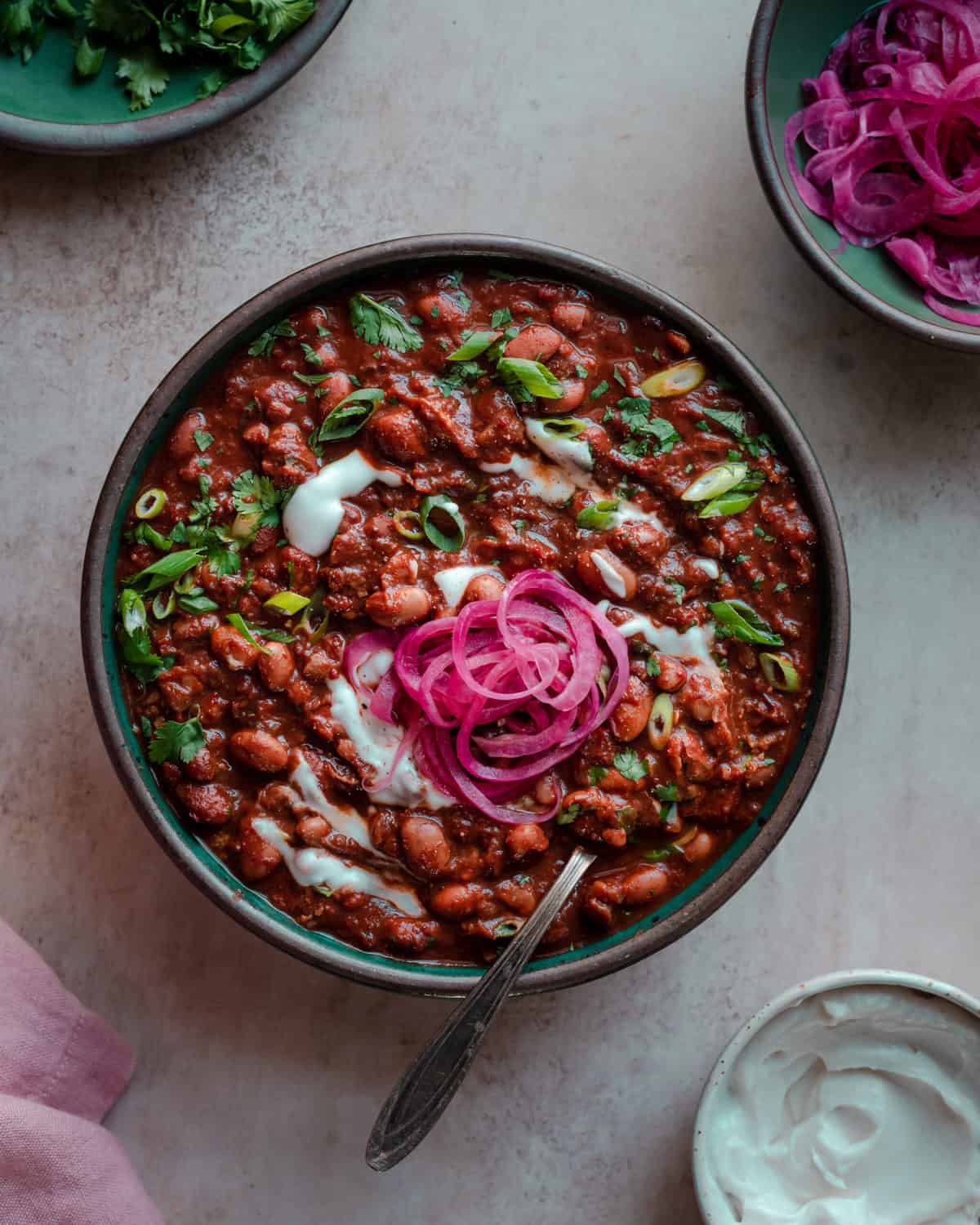
No exaggeration, this is the best vegan or vegetarian chili you will ever try. Thanks to a few key techniques, this baby has layers of complex flavors and an incredible velvety texture.
Most vegan chili recipes have you take so many shortcuts that you end up with a bowl of bean soup dressed up with some chili powder. But if you’re willing to follow the steps in this recipe, you’ll be rewarded with an authentic bean chili unlike any other.
In this post:
🎥 Watch me make life-changing chili

With over 950K views and 25K likes, my YouTube video on how to make chili was a huge hit with my community. I hope you love it just as much!
5 Secrets to Incredible Vegan Chili
1. Start with real chile peppers.
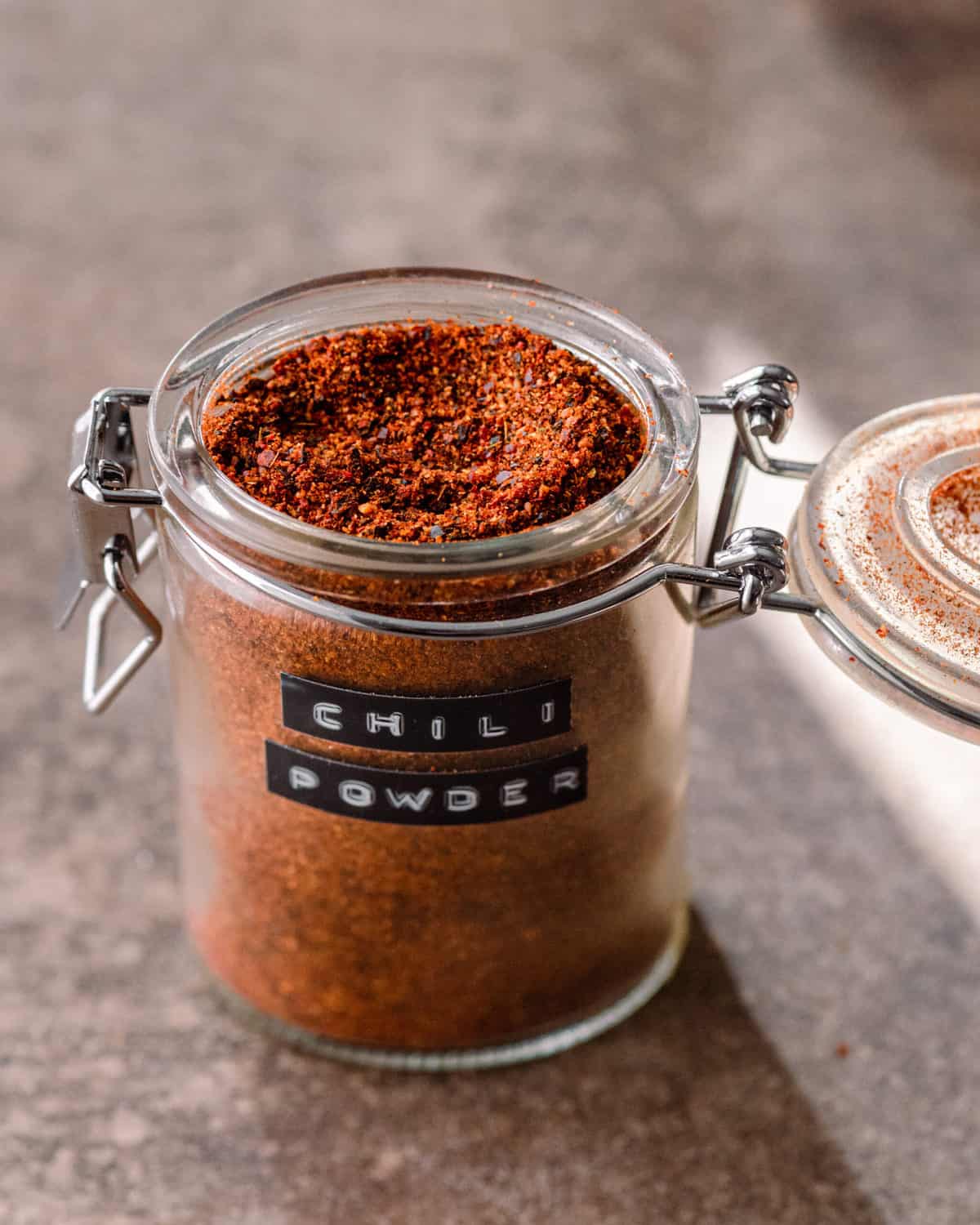
If you want the best chili with a serious depth of flavor, it’s time to make your own chili powder from whole dried chile peppers. Store-bought chili powders are a nice convenience, but they simply cannot hold a candle to the flavor complexity of the stuff made from scratch.
Many dried chile peppers carry notes of fruit, berries, chocolate, coffee, and/or raisins, adding layers of rich flavors. And when you combine homemade chili powder with fresh jalapeños and canned chipotle peppers, you get layer upon layer of complementary warming flavors: smoky, fruity, grassy, all in one bowl of chili.
Need more convincing? Check out what these professional chefs have to say:
“A bowl of chili starts with chiles.” – Texas-born chef Ben Berryhill for Fine Cooking
“The best thing you can do to up your chili game is to leave those jars of pre-ground chili powder on the shelf.” – J. Kenji López-Alt for Serious Eats
“[Using dried chile peppers] is a much better way to make this dish than with chili powder.” – Rick Martinez for Bon Appetit
It only takes 10-15 minutes to make chili powder, and it stays fresh for 6 months (meaning you can make a killer chili whenever the mood strikes). You can find my homemade chili powder in the second recipe card at the bottom of this post.
Substitute: While I think it’s worth making your own chili powder, I have tested this particular recipe with store-bought chili powder and it’s still great (because this recipe uses many other “secrets”/techniques to amp up the flavors).
If using pre-made chili powder, I recommend ancho chili powder (made from just ground ancho chile peppers). It’s more flavorful than the standard chili powder, which is a blend of seasonings.
2. Toast the spices
There are two reasons you should always toast your spices rather than just plopping them into liquid:
- Many spices are bitter when uncooked (taste a pinch of ground cumin or oregano and you’ll see what I mean). As a result, your final dish ends up with bitter notes.
- When you toast spices first (in some oil, usually after or along with the aromatics), you draw out their essential oils. This heightens the spice’s true flavor, so that you actually taste a hint of cumin or oregano in your final dish.
Takeaway: Always toast your ground spices (e.g., chili powder, cumin, oregano) before adding the liquid (e.g., vegetable broth) to draw out their flavor. The toasting will happen quickly, in about 30 seconds.
3. Boost the umami
Traditional chili has a ton of natural rich savory flavor from meat. To add savory notes to vegan chili, it’s necessary to add in a little extra umami. In this chili recipe, you’ll do that in three ways:
- Cook the tomato paste for a few minutes. This caramelizes it and unleashes the natural umami found in tomatoes.
- Use whole peeled canned tomatoes and crush them by hand (they have more pure tomato flavor and no additives, compared to pre-diced or pre-crushed tomatoes).
- Add soy sauce. Sounds unusual in chili, but it lends a potent form of plant-based umami and saltiness that salt alone can’t bring. Note: If you have vegan Worcestershire sauce on hand, it’s a great sub for the soy sauce.
4. Add some richness and body
Classic chili recipes are very rich, but many of the vegetarian chili recipes I tried online were more loose, like soup.
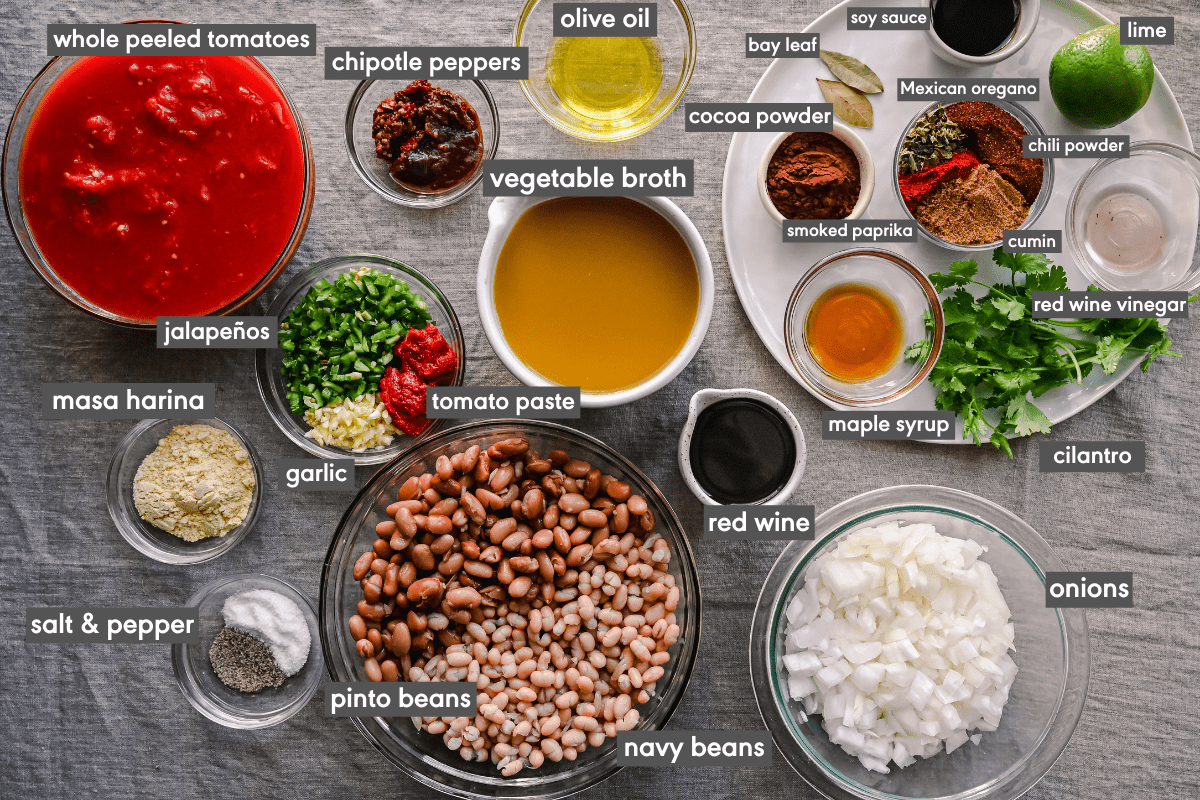
To ensure my chili is very rich, I rely on a few all-star ingredients:
- Red wine: This intensifies all the aromatics, spices, and chili peppers in a way that vegetable broth alone cannot. It also adds to the rich body of the chili (you’ll notice as the wine deglazes, the mixture becomes SO jammy). While beer is more traditional in chili, every time I’ve made chili with beer, it ends up too bitter for my taste.
- Cocoa powder: It may sound strange, but lots of chili recipes actually add a small amount of dark chocolate or cocoa powder. Cocoa not only adds depth of flavor but also accentuates the fruity notes of the dried chili peppers.
- An additional bean: Instead of using only pinto beans, I add in one can of navy beans. Since they’re so small, they partially disintegrate during simmering, which naturally thickens the chili.
- Masa harina, AKA Mexican corn flour: When stirred in at the end, it thickens the chili even more, gives it a velvety texture, and a nice subtle corn flavor. This chili recipe is already quite thick, so you can skip this ingredient if you don’t have it.
Takeaway: Chili should be rich both in taste and texture. Red wine, cocoa powder, and masa harina all contribute to that.
5. Slow simmering is key for texture and flavor
Many chili recipes tell you to simmer for just 30 minutes. You can get a decent chili this way (if the other tips are followed), but chili is designed to be a slow-simmered dish.
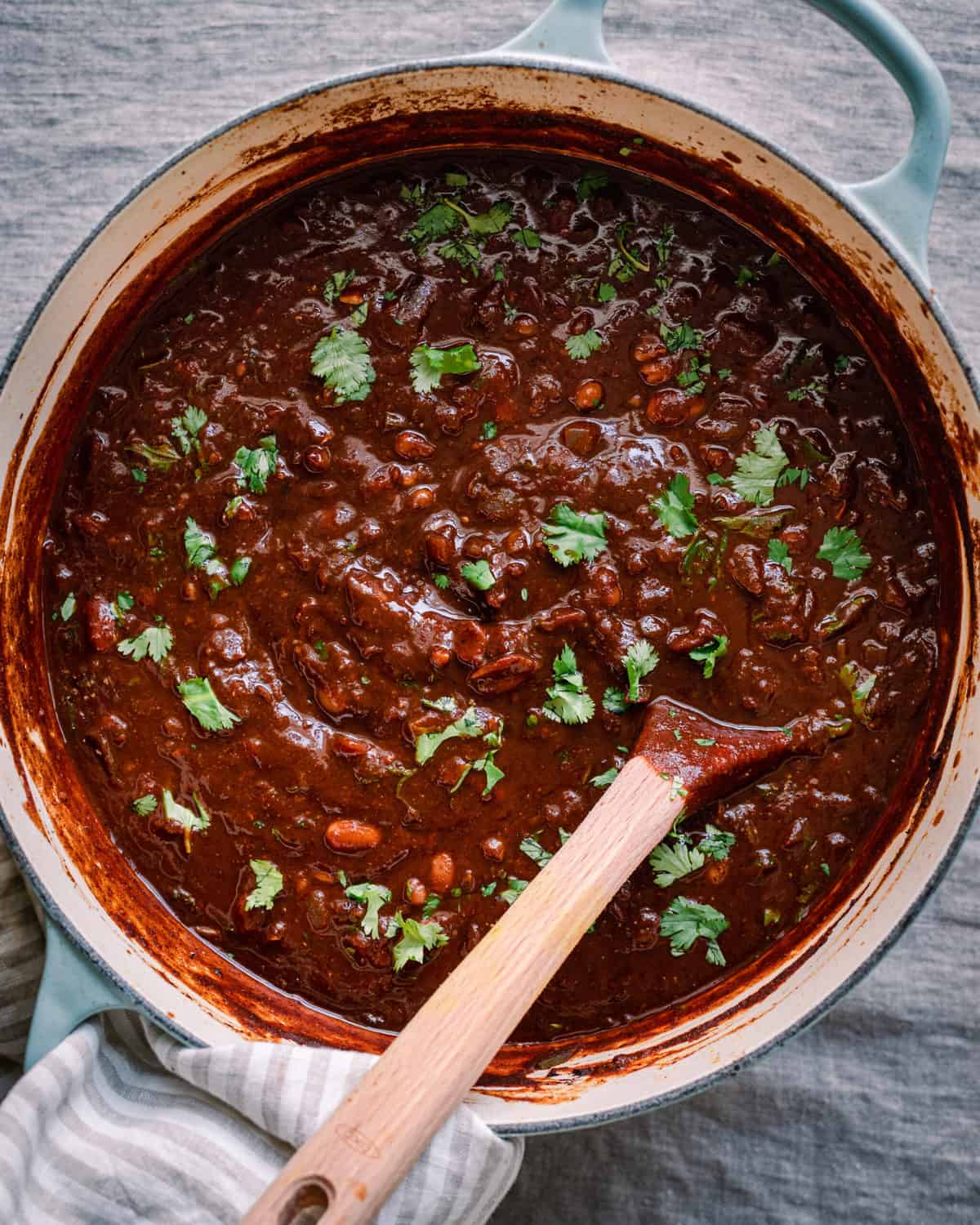
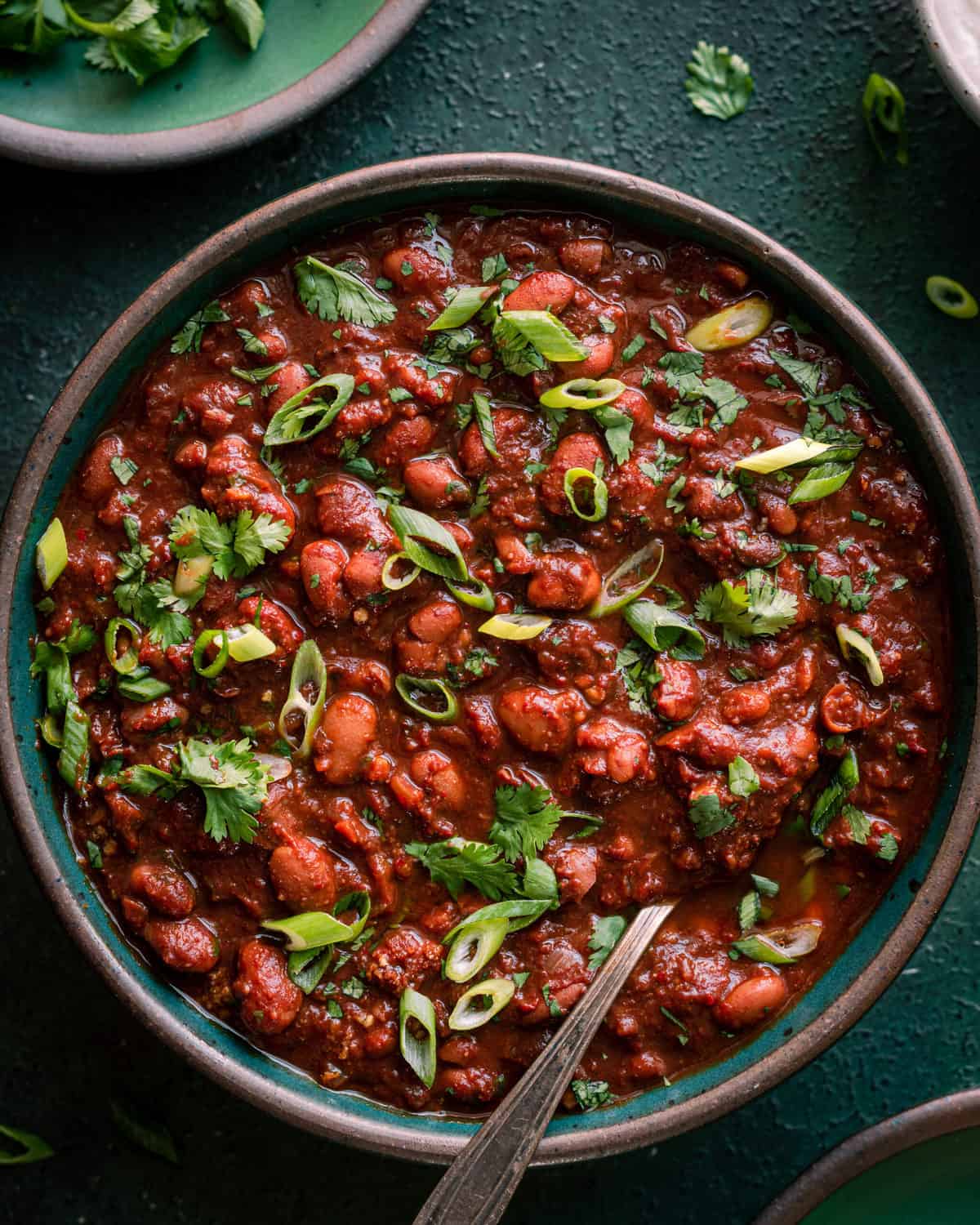
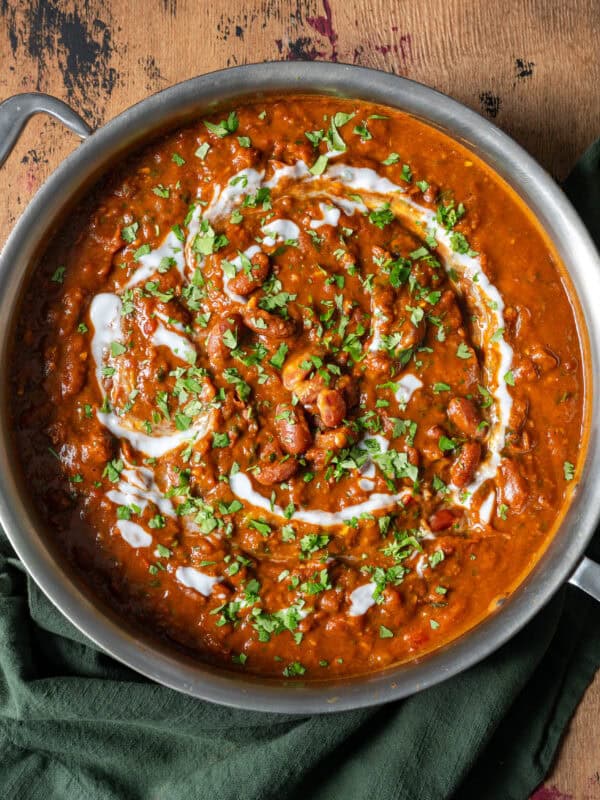
This is because the flavors of chili always improve with a long, slow simmer. Slow simmering also contributes to a thicker, more unctuous consistency, so that every bite has the same flavor and texture (check out that velvety texture in the photo below!).
Takeaway: Gently simmer this chili for 1 1/2 hours (or up to 2 hours) for maximal flavor and the most luxurious texture.
Step-by-step instructions
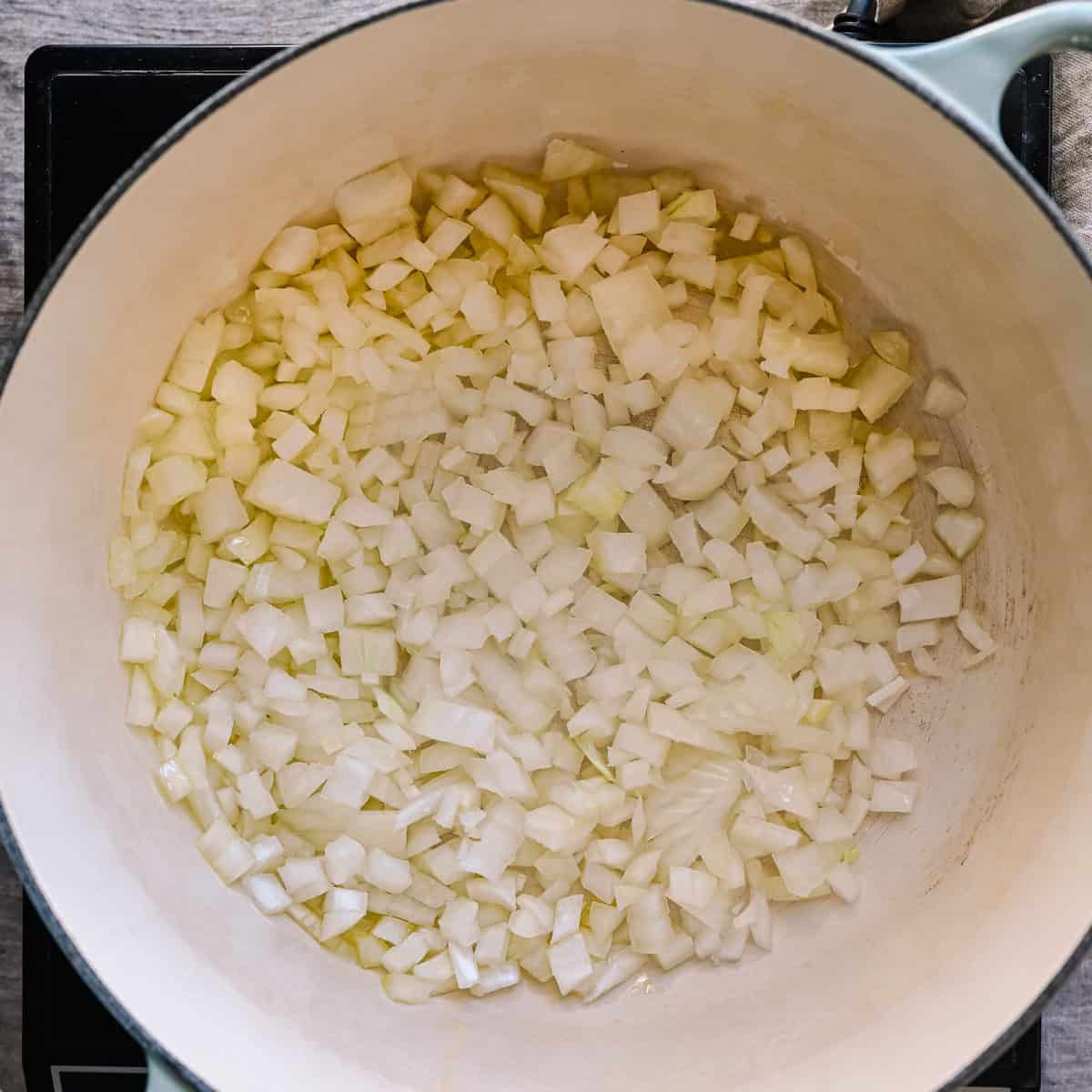
- Heat the olive oil in a Dutch oven or large soup pot over medium-high heat. Add the onions with a pinch of salt.
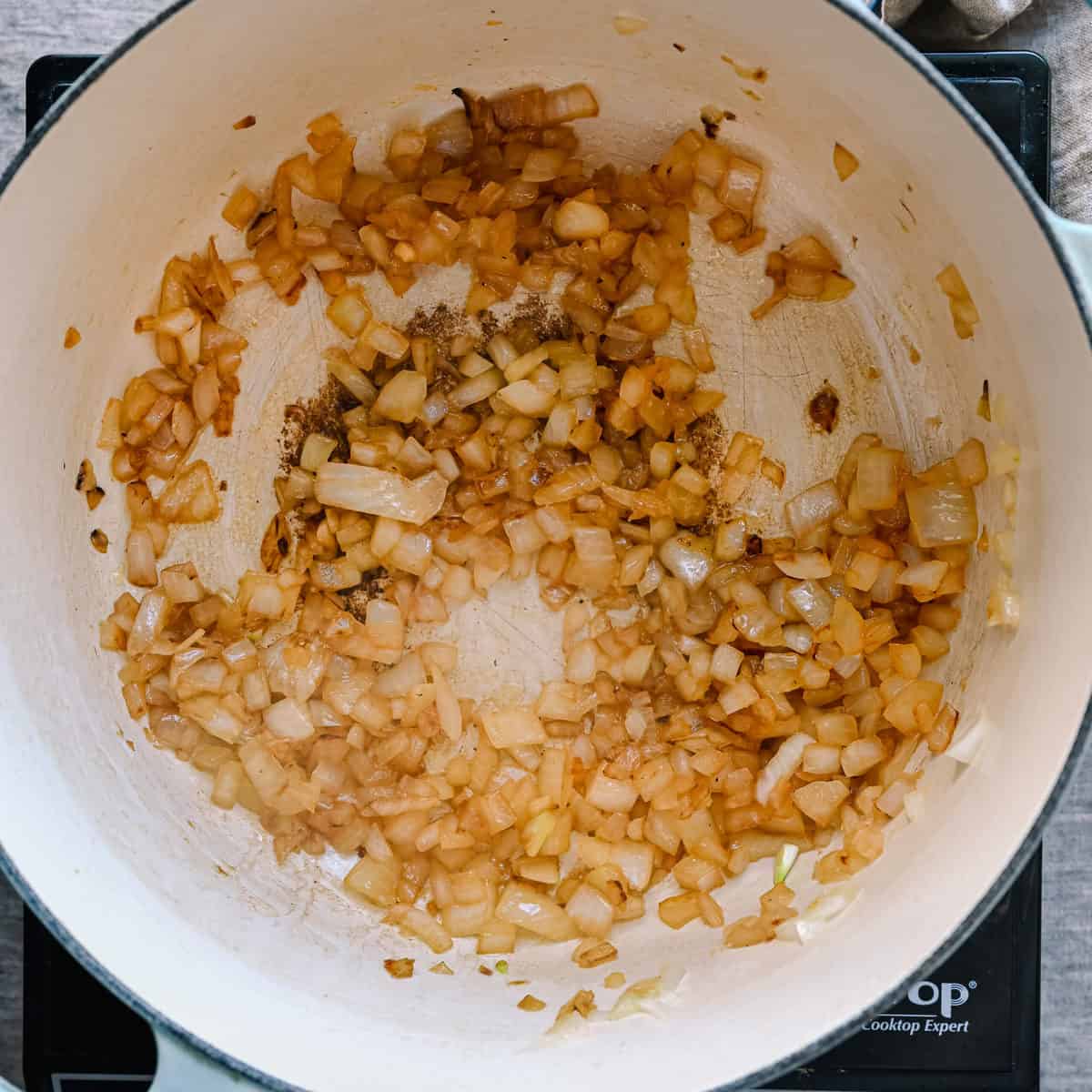
- Cook until nicely golden brown, about 10 minutes.
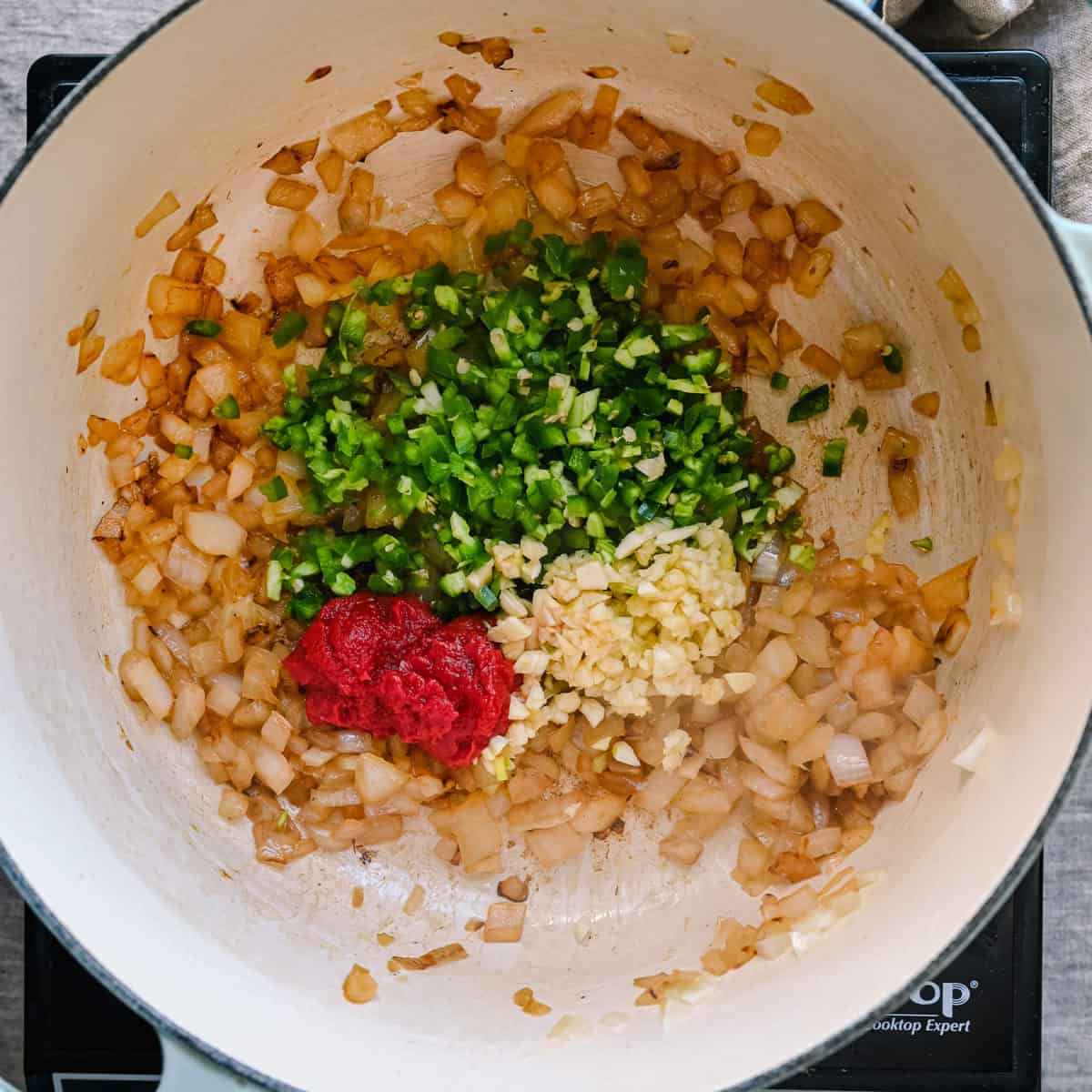
- Add the garlic, jalapeños, and tomato paste.
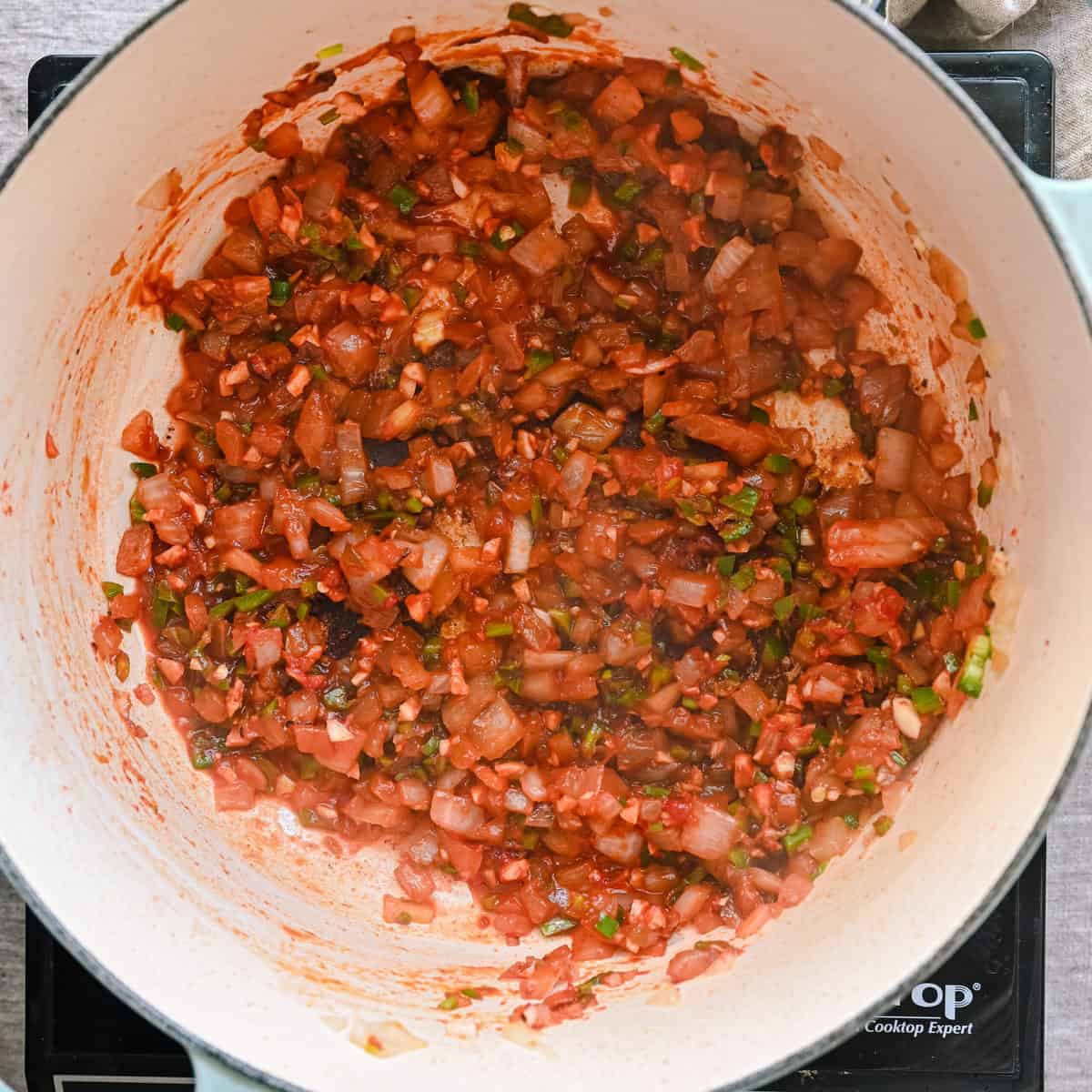
- Cook for 2-3 minutes, or until the tomato paste darkens.
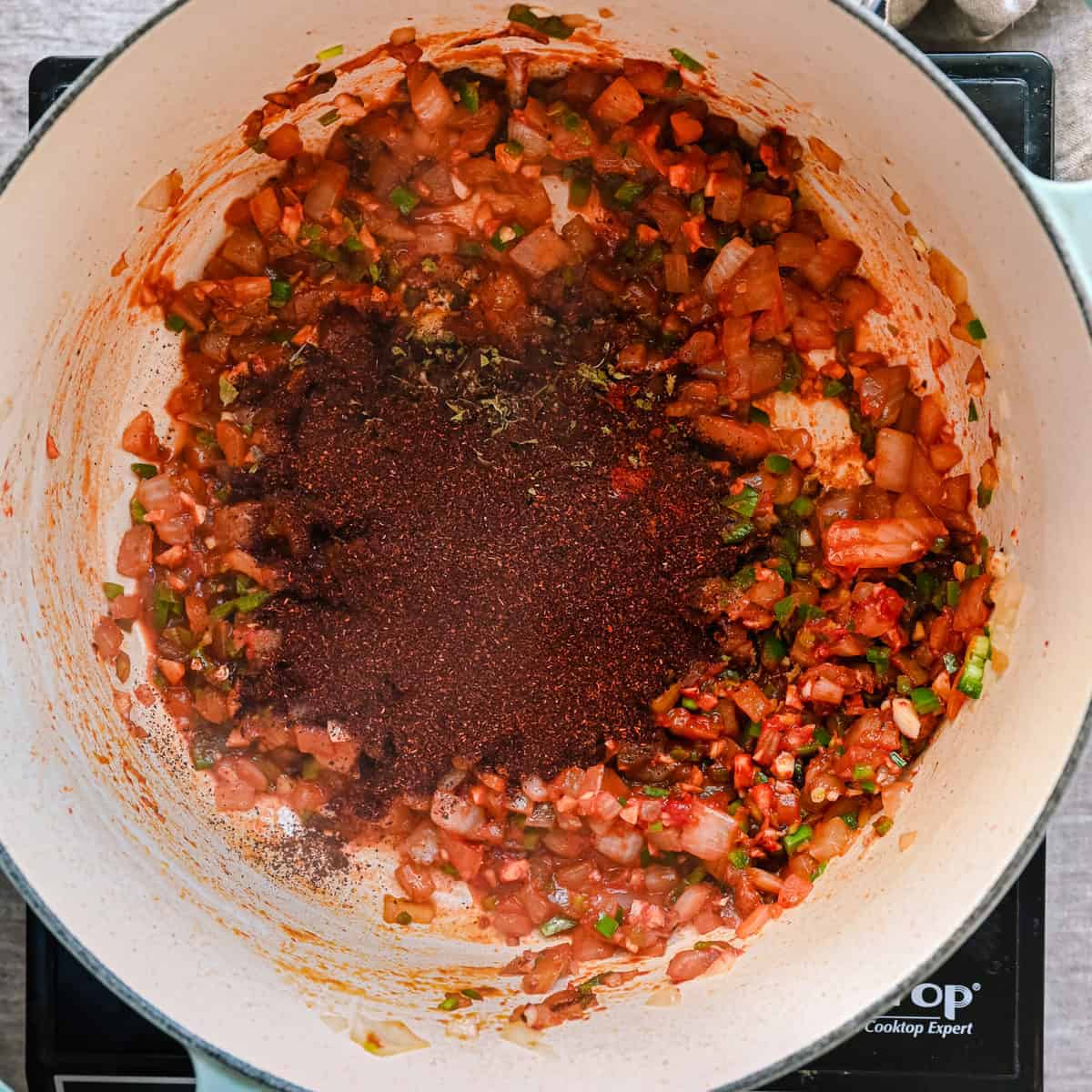
- Add the chili powder, cumin, smoked paprika, and Mexican oregano and stir vigorously for 30 seconds (for homemade chili powder, see the next section).
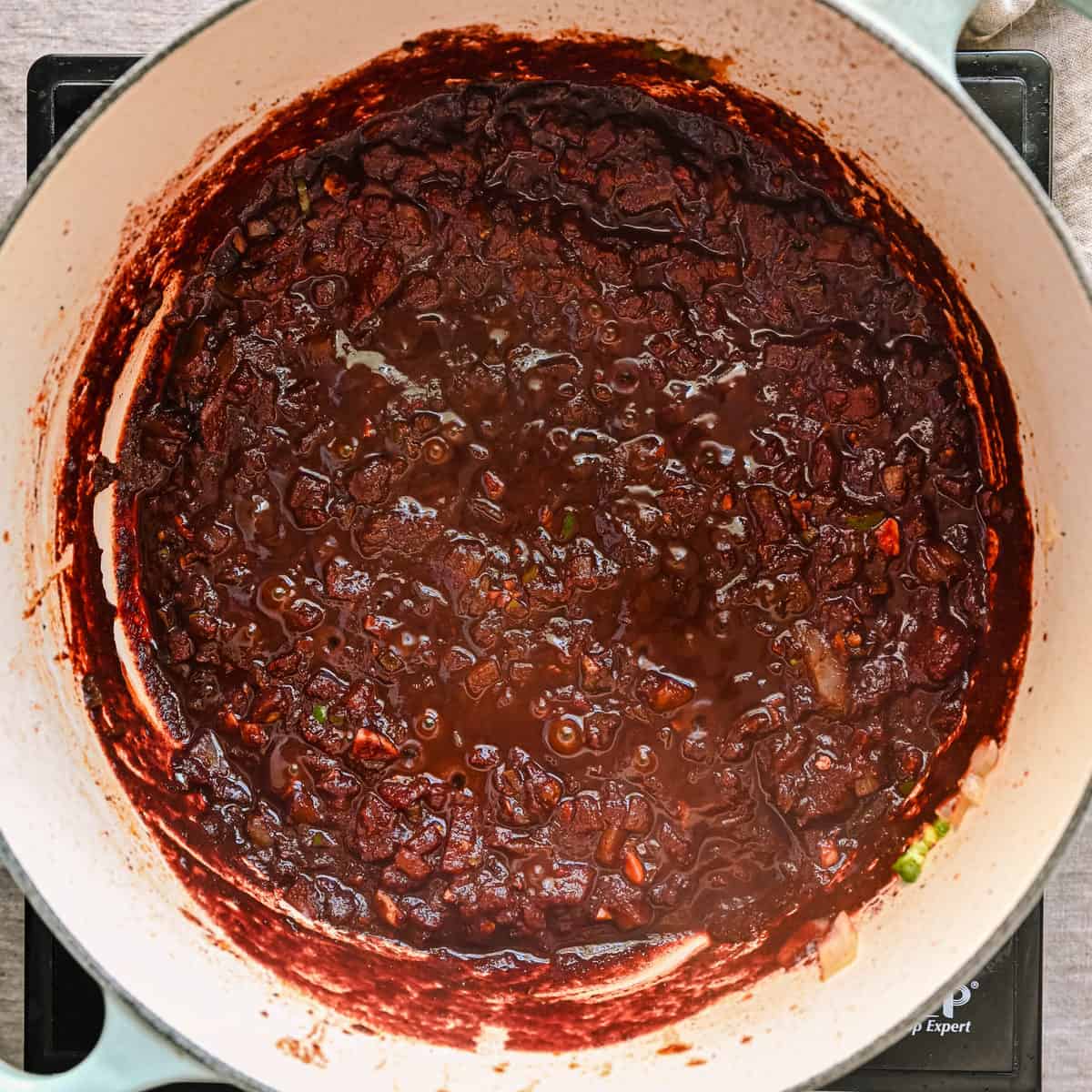
- Deglaze the pot with the red wine, scraping up the browned bits.
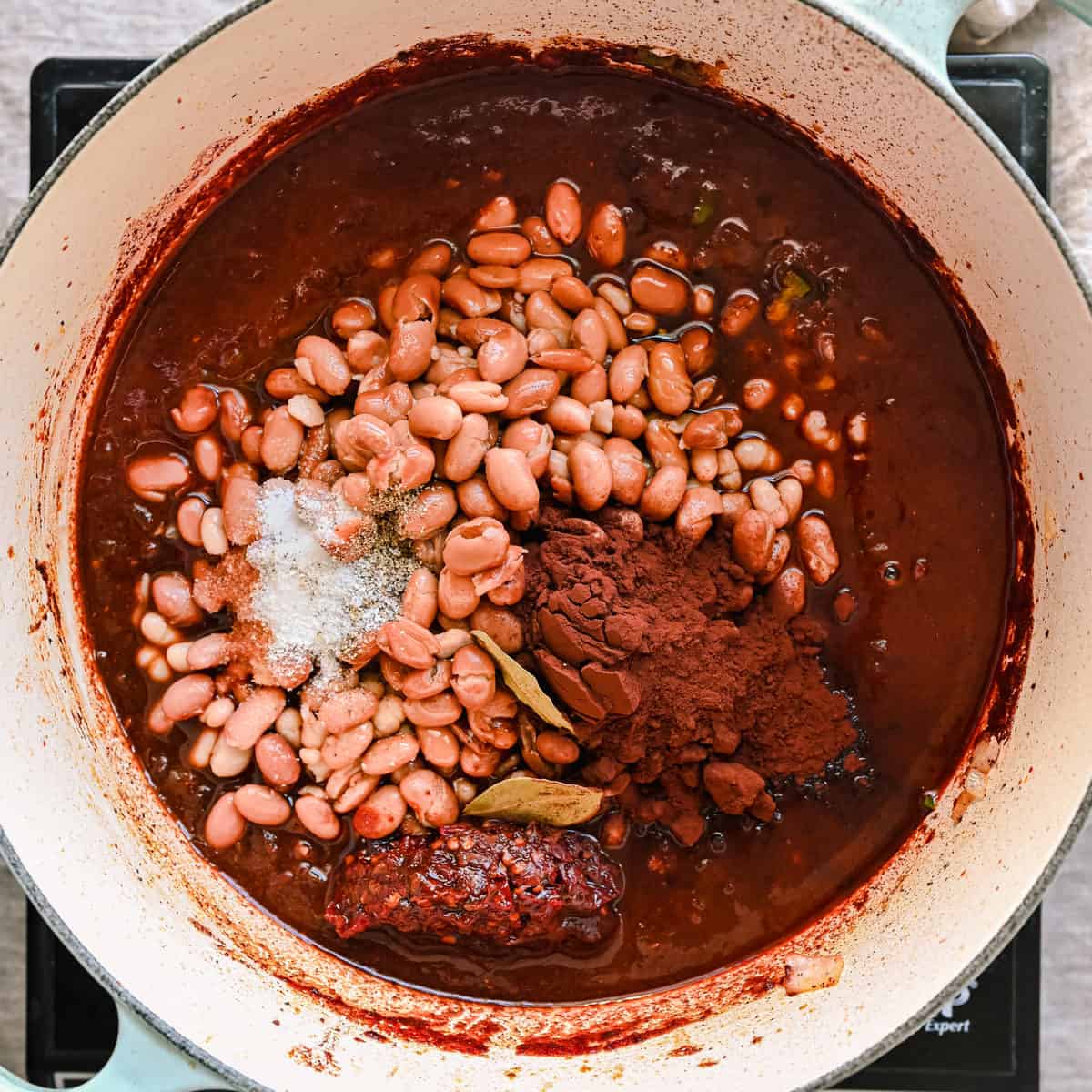
- Add the broth, and scrape up any browned bits. Add the pinto beans, navy beans, chipotle peppers, bay leaves, salt & pepper, cocoa powder, maple syrup, and soy sauce.
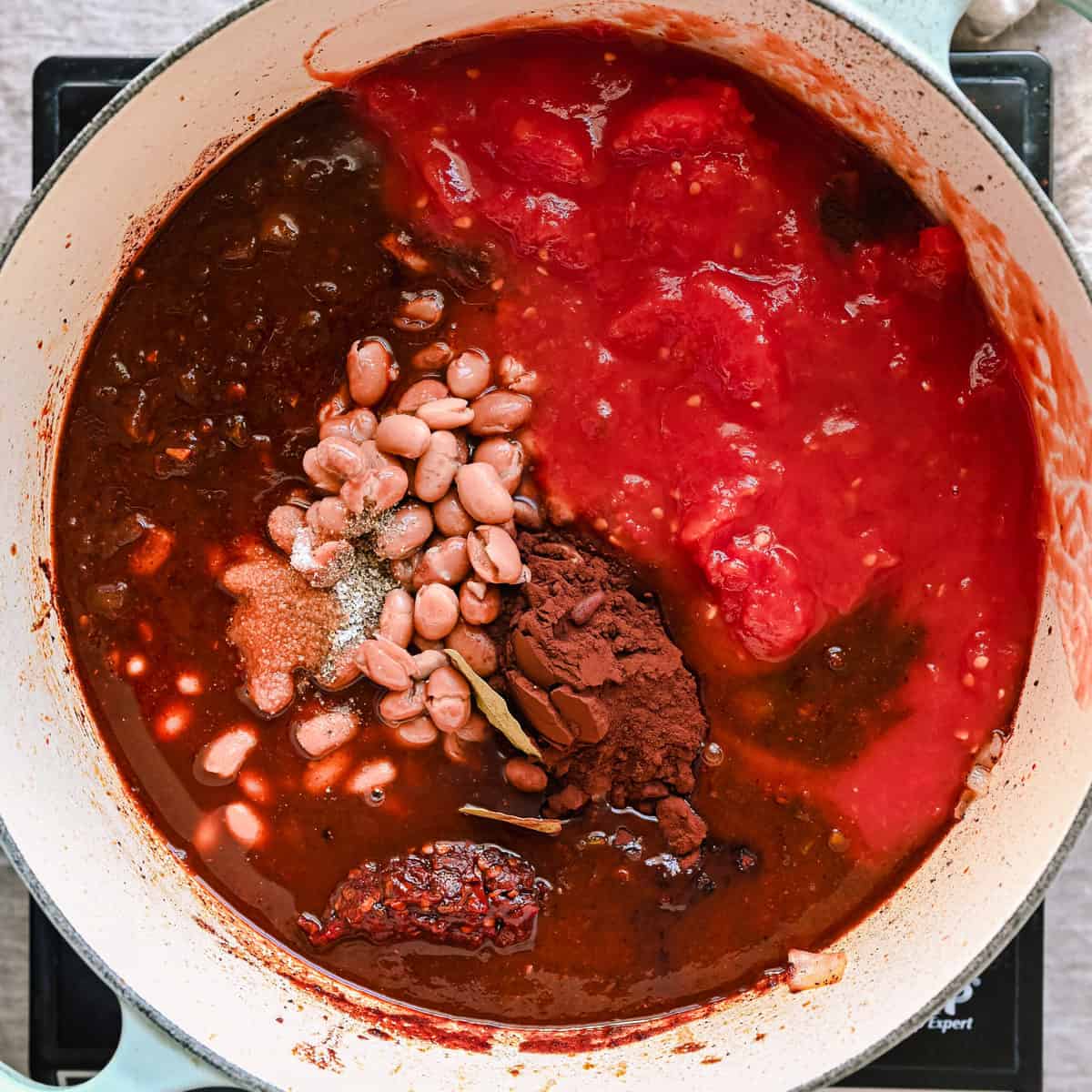
- Crush the tomatoes and add in.
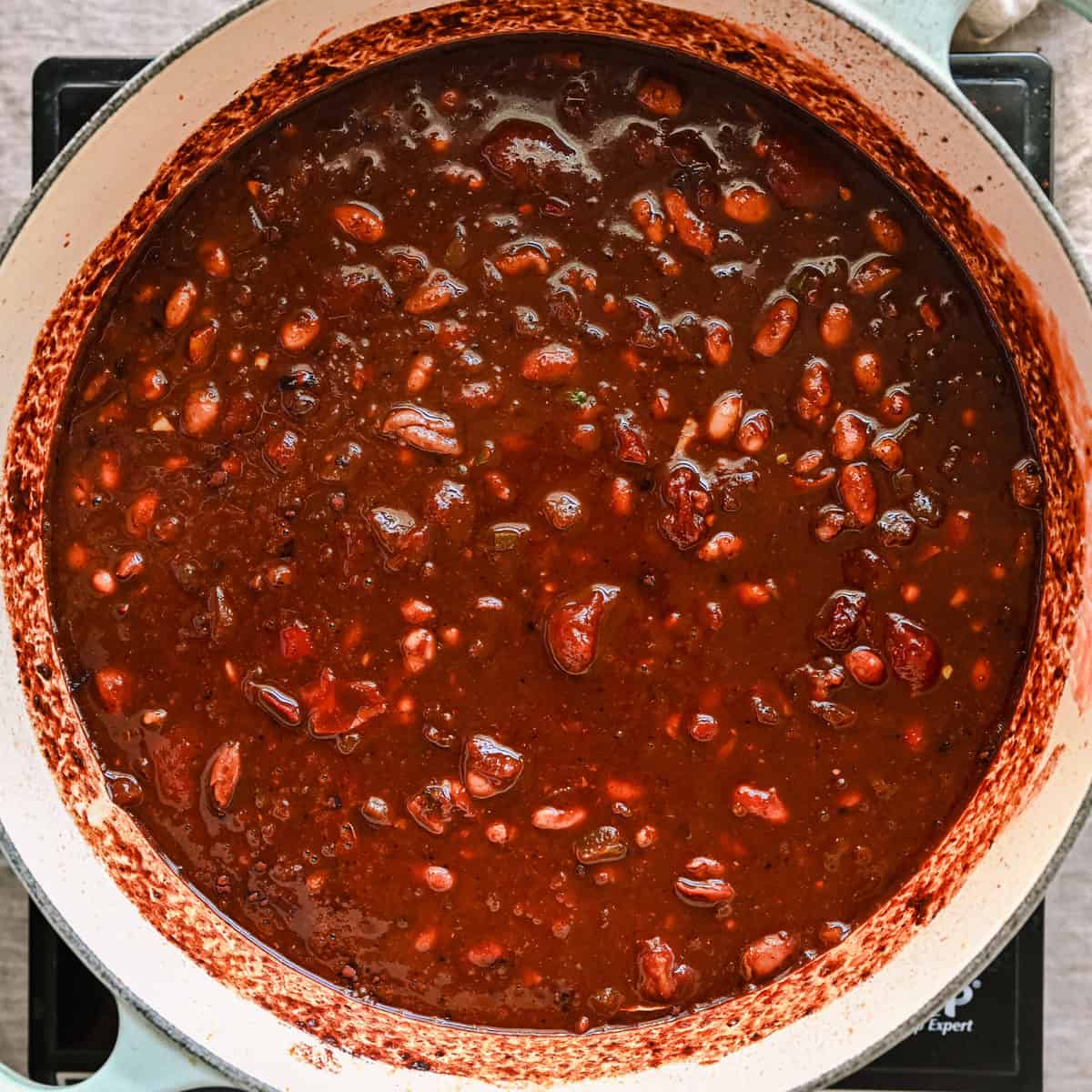
- Bring the chili to a boil, then reduce to a gentle simmer.
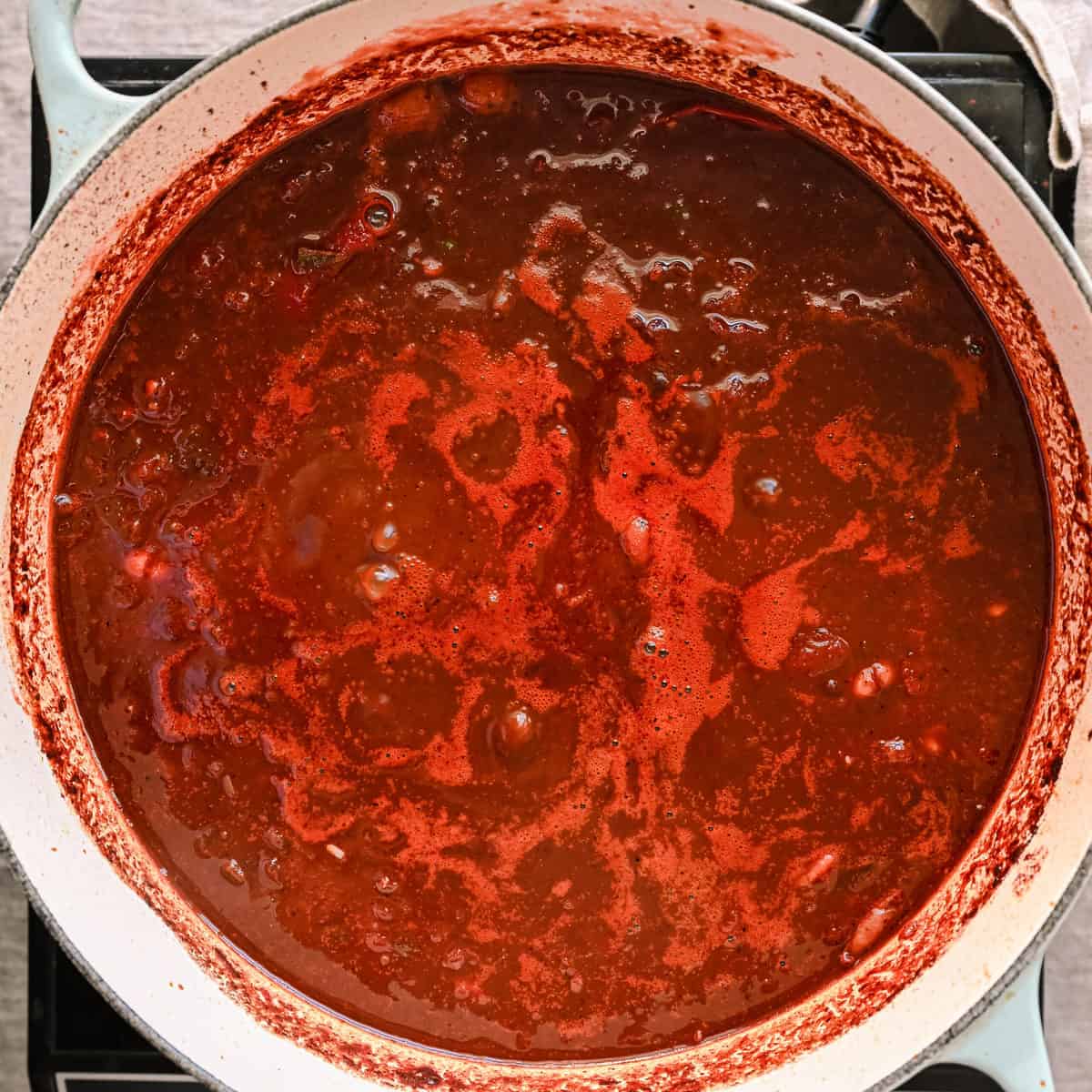
- Simmer for 1 1/2 hours, stirring every 10 minutes, until thick and velvety.
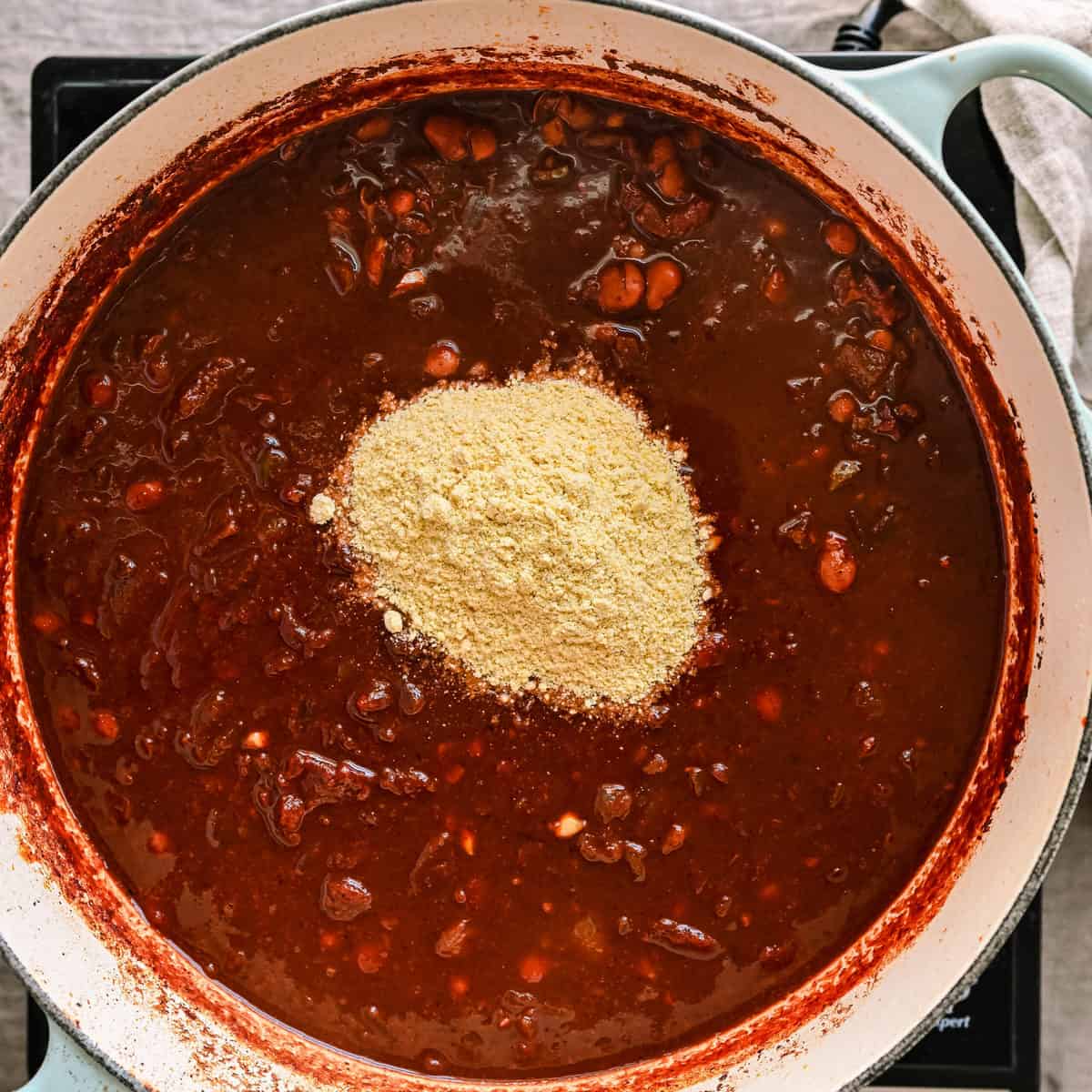
- Stir in the masa harina, if using, and simmer for 3 minutes, until further thickened.
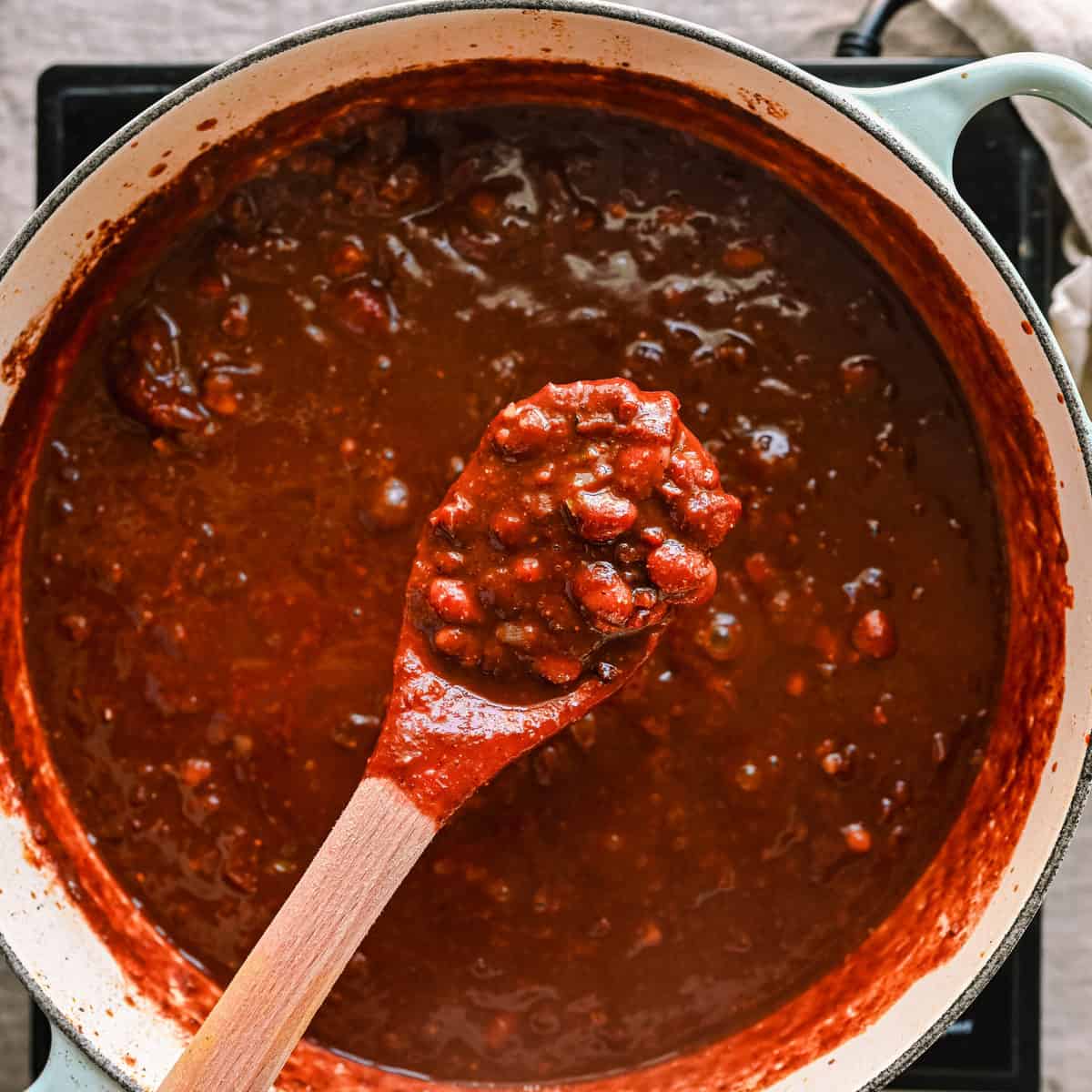
- Add the cilantro, lime juice, and vinegar. Taste, adding more maple syrup or lime juice as needed. Season with salt and pepper.
How to make homemade chili powder
I promise that making your own chili powder is 1) actually quite simple, and 2) will dramatically upgrade your chili.
If you’re unable to make homemade chili powder, though, substitute with store-bought ancho powder and check out Note 1 in the recipe card.
Where can I buy dried chili peppers?
You can find a variety of dried chile peppers at Mexican grocery stores, some standard grocery stores, as well as online.
If buying online, I really love the dried chiles from Rico Rico or Amazing Chiles & Spices. Both sell super fresh chiles that have a much softer texture (an indicator of freshness) than other dried peppers I’ve tried.
Shopping tip: This three-pack is the exact variety of chili peppers I use in my chili powder.
How to select dried chile peppers for chili powder
For complex yet balanced flavors, I use three different chile peppers: ancho, arbol, and guajillo. Check out the graphic below for the flavor profile, heat level, and substitutes for each chile pepper.
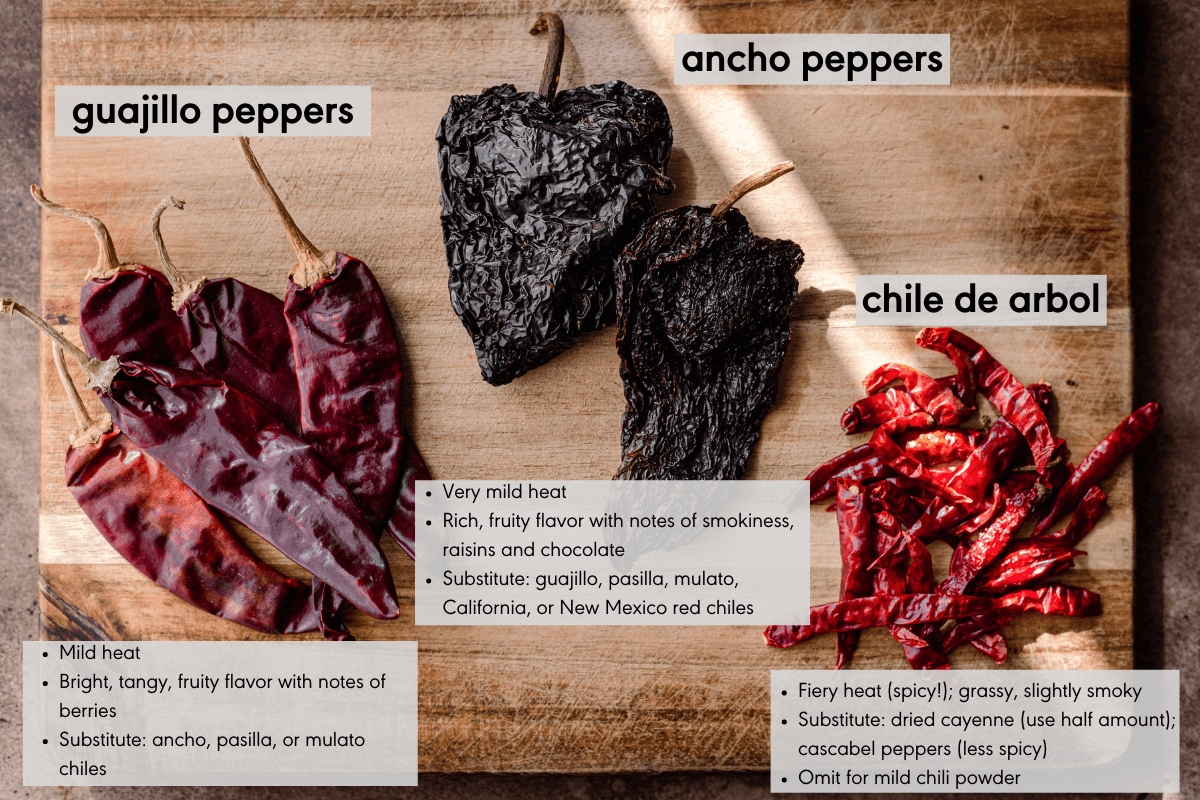
Tip: Check out the Choosing your chili’s heat level section below for suggestions on picking the right number of chiles de arbol to suit your heat tolerance!
Tips for working with dried chile peppers
First, open up the peppers to remove the seeds and membranes, which are often bitter. I find it’s easiest to gently tear open the peppers with my hands, but some people use kitchen shears. Be sure to wash your hands afterwards (or wear food-safe gloves if you have sensitive skin).
Second, toast the peppers. It releases their natural oils and reinvigorates them, giving the chili powder (and final chili) more complex flavors. We tested this recipe with untoasted chile peppers and it was good, but lacked some of the warm depth of flavor and tasted overall lighter and less complex.
When toasting the peppers, watch them closely and toast very briefly, maybe 1 minute per side. If they blacken or scorch, they get bitter. Small peppers, like chiles de arbol, don’t need much time—maybe 20-30 seconds per side.
Allow the chiles to cool before grinding them. You’ll need a spice grinder, a high-powered blender like a Vitamix, or a food processor. Grind the peppers with the toasted whole spices until pulverized. Add in your pre-ground spices, blend again, and that’s it!
Choosing your chili’s heat level
🔥🔥🔥 For spice fiends (like me)
As y’all probably know, I like my food quite spicy. Here’s what I add to my chili:
- In the homemade chili powder: I add ~ 3 chiles de arbol (extreme heat-seekers can add up to 5, but do so at your own risk)
- 2 jalapeños (with membranes/seeds intact)
- 2 chipotle peppers in adobo + 1 tablespoon adobo sauce
This will likely be too spicy for most folks, so check out some of the below options for scaling back on the heat and creating your perfect spice level.
🔥 For a little heat (not too much)
Play with the number of chiles de arbol in the homemade chili powder:
- Use 1 to 2 chiles de arbol for moderate heat
- OR, omit the chiles de arbol entirely for a mild chili powder (this will have roughly the same amount of heat as a store-bought chili powder)
Adjust the number of jalapeños:
- Use 1 jalapeño and remove the membranes (I wouldn’t omit the jalapeños entirely, as they do add flavor)
Cut back on the chipotle peppers in adobo:
- Use just 1 chipotle pepper and 1 teaspoon adobo sauce (or omit the adobo sauce)

Tips for making this chili
Balance the flavors
A great chili should have “a rich, complex chile flavor that combines sweet, bitter, hot, fresh, and fruity elements in balance.”
J. Kenji López-Alt, Serious Eats
The reason I add maple syrup to my chili is that its sweetness balances both the spiciness and bitterness inherent in chile peppers. I finish the chili with lime juice and vinegar because sour flavors also mellow bitter tastes (and enhance the umami found in soy sauce and tomatoes).
It’s critical to taste the chili after it has simmered to see what flavors it needs more or less of. If you use a store-bought ancho chili powder, for instance, your chili might be slightly less bitter, so you won’t need as much less lime juice or maple syrup.
Chili always tastes better the next day
When chili rests overnight, the chili powder and spices have a chance to meld with the other flavors so you end up with a full-bodied chili with harmonious flavors.
Frequently Asked Questions
We have lots of details in the section on “Choosing your chili’s heat level” so be sure to check that out.
Sure! I prefer a bean-based chili without any faux meat, but adding vegan ground meat is a great option if you want to add a more traditional meaty texture or taste. We tested this recipe with Impossible Meat’s plant-based ground burger.
Option 1: Cook the onions until lightly browned, about 6 minutes. Add in your vegan ground meat and break it up with a wooden spoon. Cook until it’s starting to brown, 8 to 10 minutes, adding a splash of water as needed to deglaze. Proceed with the rest of the recipe.
Option 2: Brown the vegan ground meat in a separate pan, then add it to the chili when you add the beans.
If you can’t have any alcohol, just deglaze with more vegetable broth and add ~ 1 tablespoon red wine vinegar, cooking for 2 minutes.
I’d suggest the best vegetable broth you can find. Imagine Organic is my favorite for store-bought veggie broth (rich and flavorful). For more deeply savory notes, you can try these “vegan chicken” or “vegan beef” broth bases (they are quite salty, so use less than the jar calls for).
Your chili will have less complexity and body without the red wine, but it will still be good if you omit it!
With your favorite toppings, obviously! The toppings you choose help bring more balance to the final dish. For instance, vegan sour cream (I like Kite Hill or Tofutti brands) and avocado are great for cooling down the heat. Extra lime wedges and pickled onions bring a nice tanginess (find my recipe in the recipe card below). Cilantro and scallions offer a fresh contrast. Tortilla chips, obviously, add a nice crunch!
If you like adding a vegan cheese to your chili but don’t love store-bought shredded vegan cheese, a spoon of this Vegan Queso stirred in would be really good!
To stretch this chili further, serve it alongside warm corn tortillas (char the tortillas by placing them directly over a gas burner for ~20 seconds per side). Or, scoop over a bed of rice.
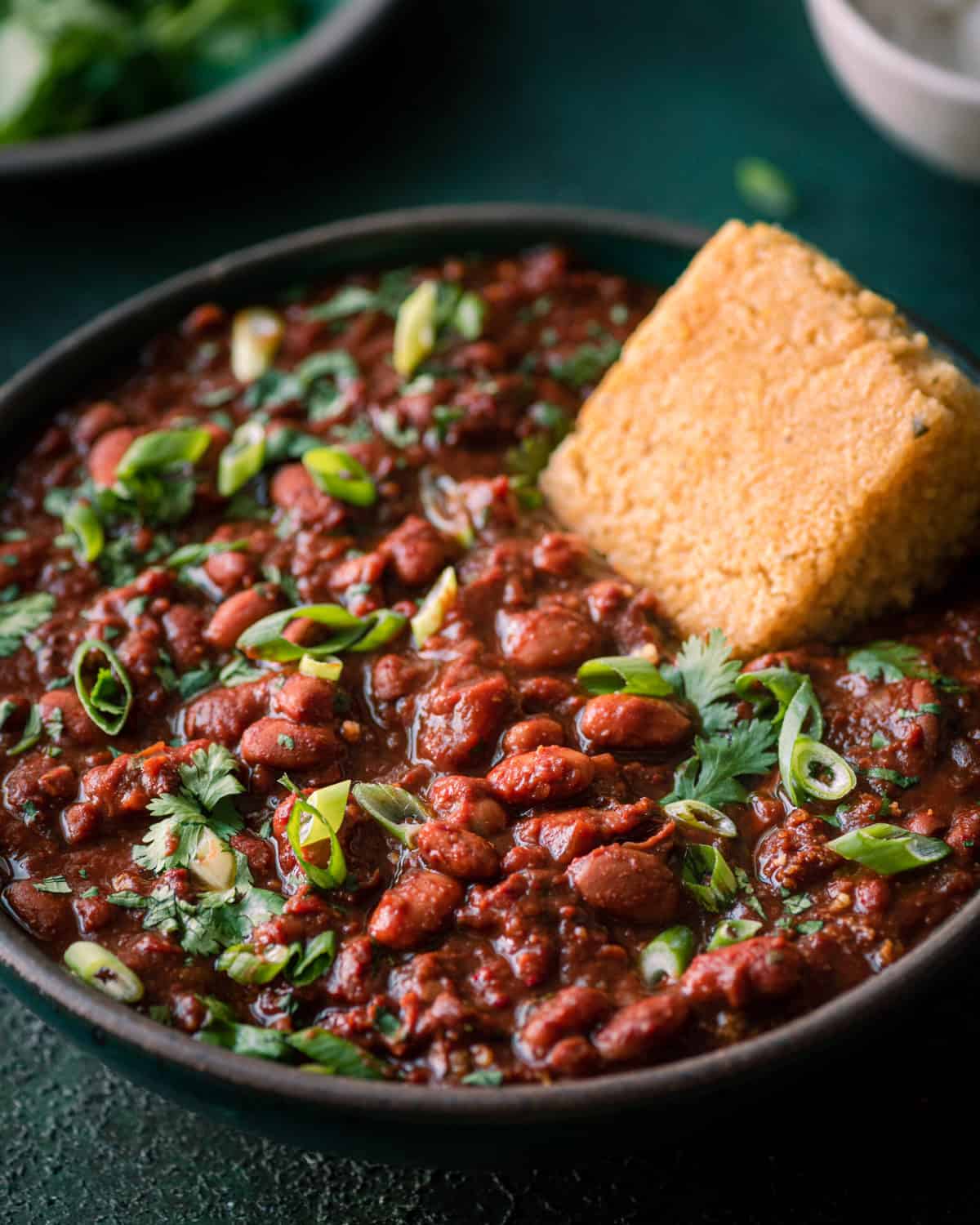
It’s also INCREDIBLE with my homemade cornbread, which adds the perfect slight sweetness to this chili.
In a glass jar in a dark place, like your pantry. When stored this way, it’ll stay good for 6 months!
Simply store in an airtight container in the fridge for 5 to 6 days. You can reheat on the stove (my preference) or microwave.
And yes, chili freezes great for 3-4 months. I prefer to freeze it individual-sized portions (it defrosts much more quickly). These Souper Cubes in 1-cup or 2-cup portions are great for that!
There is really very little to no fat in this recipe besides the oil. I actually tried this recipe with half the amount of oil and it was less rich and harmonious in flavors. That’s because fat is an excellent carrier of flavor! The oil also enables the onions to get nicely golden brown and allows the full depth of flavor to be released from the spices.
I understand that some of my readers are oil-free, so if you must skip it, please stir some vegan sour cream or cashew cream in before serving!

Introducing
Big Vegan Flavor
Techniques and 150 recipes to master vegan cooking.
The Best Vegan Chili

Ingredients
- 3 tablespoons olive oil
- 1 large yellow onion, diced
- 6 cloves garlic, chopped finely
- 2 jalapeños, diced (remove membranes for less heat)
- 2 tablespoons tomato paste
- 4 tablespoons homemade chili powder, or store-bought ancho chili powder (see Note 1)
- 1 tablespoon ground cumin
- 1 ½ teaspoons smoked paprika
- 1 tablespoon Mexican oregano (or 2 teaspoons regular oregano or marjoram) (See Note 2)
- 3/4 cup(180 mL) dry red wine (such as Malbec, Syrah or Pinot Noir)
- 2 cups (480 mL) vegetable broth
- 2 (15-ounce/425g) cans pinto beans, drained and rinsed
- 1 (15-ounce/425g) can navy beans (or other small white beans), drained and rinsed
- 2 tablespoons cocoa powder (I prefer Dutch process cocoa powder)
- 2 bay leaves
- 1 ½ tablespoons tamari or soy sauce if you have vegan Worcestershire sauce, you can use that
- 2 chipotle peppers in adobo, chop the peppers + measure out 1 tablespoon adobo sauce (See Note 3)
- 1 (28-ounce/800g) can whole peeled tomatoes, crushed by hand (include juices)
- 1 ½ teaspoons kosher salt plus more as needed
- Freshly cracked black pepper to taste
- 1 tablespoon pure maple syrup, plus more to finish as needed (See Note 4)
- 1 to 1 1/2 tablespoons freshly squeezed lime juice
- 1 teaspoon red wine vinegar (or apple cider vinegar)
- 3 tablespoons masa harina (Mexican corn flour) (optional)
- 1 cup (12g) cilantro leaves and tender stems, chopped
Toppings of choice
- Vegan sour cream or diced avocado
- Sliced scallions or chopped cilantro
- Shredded vegan cheese or Vegan Queso
- Quick Pickled Red Onions (See Note 5)
Instructions
- Read all the instructions and notes before getting started, especially about moderating the spiciness level.
- Heat a Dutch oven or heavy-bottomed saucepan over medium-high heat. Add the olive oil, and once it’s shimmering, add the onions and season with a few pinches of salt. Stir frequently and cook the onions until nicely golden brown, stirring occasionally, about 10 minutes. If they start to burn around the edges, stir more frequently and/or add a splash of water.
- Add the garlic, jalapeños, and tomato paste, and cook for 2-3 minutes, stirring very frequently, until tomato paste is darker in color. If it starts to dry out, add a splash of water and scrape up any browned bits.
- Stir in the chili powder, cumin, paprika, and oregano and stir vigorously for 30 seconds.
- Pour in the red wine to deglaze the pot, scraping up any browned bits. Simmer rapidly for 3 to 4 minutes, or until the smell of alcohol has cooked off and it's jammy.
- Pour in the vegetable broth, pinto beans, navy beans, cocoa powder, bay leaves, soy sauce, chopped chipotle peppers + adobo sauce, hand-crushed tomatoes + their juices, salt, black pepper to taste, and 1 tablespoon maple syrup. Stir well.
- Bring the chili to a boil over high heat, then reduce to a gentle simmer (this is lowest heat on my small burner). Take care to not boil or too rapidly simmer the chili, as it will break down the beans too much. Cook, stirring every 10 minutes, until thick and velvety and the flavors have melded together, about 1 1/2 hours (or up to 2 hours). Discard the bay leaf.
- Stir in the masa harina, if using. Simmer for 3 minutes, until the texture has further thickened.
- Stir in 1 tablespoon lime juice, the vinegar, and cilantro. Taste and add more lime juice as needed for tanginess and add up to 1 more tablespoon maple syrup for sweetness to balance any bitterness. Season with salt and pepper, as needed.
- Serve with toppings of choice, such as pickled onions, chopped cilantro, sliced scallions, vegan sour cream, avocado, tortilla chips, etc.
Video
Notes
- My homemade chili powder recipe is below. If using store-bought, I recommend an ancho chili powder (simply ground ancho peppers) instead of standard chili powder, which has other seasonings and is usually less flavorful. If using store-bought chili powder, which is not spicy, you may want to make a few tweaks: (1) you may not need as much maple syrup or lime juice to balance the flavors in step 9. (2) if you like your chili spicy, consider adding 3 jalapeño peppers.
- Mexican oregano (citrus, bright, floral) is most traditionally used in chili and better suited to Mexican dishes than standard/Mediterranean oregano (bitter, mint, peppery). If you don’t have Mexican oregano, sub with 2 teaspoons marjoram or standard oregano.
- This is just 2 peppers from a can of chipotle peppers in adobo sauce, not 2 whole cans. If you’re looking for milder heat, use 1 pepper only and 1 teaspoon of adobo sauce.
- You can use agave nectar or brown sugar if desired. If using a store-bought chili powder, you may not need as much sweetener to balance.
- For quick pickled onions:
- Very thinly slice 1 medium red onion. Add to a large mason jar.
- Mix together freshly boiled water (3/4 cup or 180 mL) with 1/2 cup (120 mL) apple cider vinegar or distilled white vinegar. Add in 1 tablespoon organic cane sugar or maple syrup, stir until dissolved.
- Pour the hot liquid over the onions. Cool to room temperature, at least 30 minutes.
- You can serve now, but I prefer to refrigerate them for a more developed flavor
Nutrition
Nutrition information is automatically calculated, so should only be used as an approximation.
 Love this? Leave a rating below!
Homemade Chili Powder
Equipment
- Spice grinder, high-powered blender, or food processor
Ingredients
- 4 ancho peppers (See Note 1)
- 4 guajillo peppers (See Note 1)
- 2 to 5 chiles de arbol (See Note 2)
- 2 tablespoons cumin seeds
- 1/2 tablespoon coriander seeds (optional)
- 1 tablespoon Mexican oregano (or 2 teaspoons regular oregano or marjoram)
- 2 teaspoons garlic powder or granulated garlic
- 2 teaspoons onion powder or granulated onion
- 1 teaspoon smoked paprika
- 1/4 teaspoon ground cinnamon
Instructions
- Using your fingers, remove the stem from each chili pepper and gently tear the peppers apart. You can use kitchen shears, but using your hands is easier. Be sure to wash your hands after handling the peppers, or wear food safe gloves if your skin is sensitive.
- Once the peppers are open, loosen all of the seeds and any membranes, or scrape them out. This is necessary to minimize bitterness.
- Heat a cast iron skillet or other heavy, dark pan over medium heat, but don't heat for too long. Add the larger chilies (anchos and guajillos) in a single layer without overlap. Toast just until fragrant, about 1 minute, maybe 1 1/2 minutes, then flip and toast for 30-60 seconds. Smaller peppers like chile de arbol need 30 to 45 seconds, so I toast those separately. (See Note 3)Take care not to scorch them or they will taste bitter. Remove and allow to cool completely. Take off the heat and allow to cool.
- Add the cumin and coriander seeds to the hot pan. Toast until very fragrant, about 45 to 60 seconds, shaking the pan or stirring frequently to prevent burning, until toasty and aromatic. Remove and allow to cool.
- Once cool, add the chile peppers and toasted whole spices to a spice grinder or high powered blender. If using a small spice grinder, tear up the chilies with your hands into smaller pieces and do this in two batches. Blend until the peppers and spices are pulverized.
- Add the ground spices (oregano, garlic powder, onion powder, paprika, and cinnamon). Blend until a fine powder has formed. Allow the powder to settle before removing the lid.
- Store in an airtight container in a cool, dry place for up to 6 months. Makes 12 tablespoons, enough for 3 batches of this chili recipe.
Notes
- You can sub ancho peppers with guajillo, pasilla, mulato, or New Mexico red chile peppers. You can sub guajillos with ancho, pasilla, or mulato peppers. The flavors across these peppers aren’t all the same but will still yield a good chili powder.
- Omit chiles de arbol entirely for a mild chili powder. Use 2 chiles de arbol for moderate heat. I typically use 4 or 5.
- If toasting peppers in two batches, lower the heat a bit after the first round because the pan will already be hot.
Nutrition
Nutrition information is automatically calculated, so should only be used as an approximation.
Love this? Leave a rating below!








can I buy a jar of this chili powder from you?
Hi Karl, we don’t have any physical food products available currently, but I will absolutely relay your request to my team! We hope you enjoy the chili 🙂
This recipe is amazing! It’s my go to chilli recipe. I’ve also tried it with a combination of habanero, ancho and chipotle. And with all different kind of beans. It’s great every single time! It never disappoints!
We appreciate your feedback and support, Tatiana. Thank you for leaving a review!
This is SO GOOD!
I loved the depth.
I like coriander so I used a little more and reduced the cumin a tiny bit.
I made it medium-spicy and it was just fantastic.
One thing: The alcohol does not all cook off (in really any recipe–this has been demonstrated scientifically many times, but the fallacy that cooking a dish removes the alcohol persists).
If you are serving this to someone who does not drink alcohol (e.g. in recovery, observant Muslim or LDS, etc.), you HAVE TO omit the wine.
It’s kind of a big deal.
Hey there! So happy that you loved the chili so much! Thanks for pointing that out. In the instructions, when we say “until the alcohol cooks off,” we’re referring to the smell of alcohol because you will taste the alcohol if you don’t wait for the smell to cook off, but we understand that the alcohol is still present. We’ll try to be more mindful when writing these instructions.
I was referring not to the recipe instructions but to the answer about what to use if you don’t use red wine. It said that the alcohol cooks off. It seems to have been edited now which is really great! I appreciate you. Love Rainbow Plant Life.
The flavor reminds more of a Mole rather than a typical Tex Mex chili. It’s delicious. Next time I make it, I may blitz some carrots and add it into the pot for extra vegetables.
I also want to try adding some nuts to give it that mole taste.
We’re happy you enjoyed the chili, Steph! Thanks for the review!
This is so so so so good! Make it you will not be disappointed. I have never had a good chili as a lifelong vegetarian but always thought meat chilis looked/smelled incredible and always kept trying new recipes. Finally, I have found the chili of my dreams! I recommend making it with the full suggested spice level – it is incredible as written. Will try in the future with different bean combos!
Your review made our day, Priscilla! Thank you for taking the time to share your thoughts and for trying out the recipe.
rainbow plant lifes video have truly been so incredibly helpful. more often than not regardless of if im making a curry or a sauce or a chili, as in this instance, regardless of what extra additions i am feeling in that moment, rainbow plant has this incredible ability to create an archetypal recipe that can understood by both slightly amateur cooks (like myself) and people who have greater experience in the craft. beyond taste these recipes have a level of finesse that makes their skills widely transferrable whereas sometimes other recipe treat dishes as individual things and not an overlap of techniques and flavors. highly recommend these recipes to any aspiring cook.
Thank you for your thoughtful review, Sarah! I totally agree. 🙂
I just made this chili last night. We LOVED it!! I’m a big wimp for spice, so adjusted the chili powder and I added some veg to it, and it was DELICIOUS!! It was still mildly spicy, with a beautiful rich, thick sauce and incredible flavour. A tiny bit fussier than my usual chili, but was so worth it!! And next time will be easier having made it once. Thank you for the amazing chili recipe! It’s going into our “faves” list!
Wow wow wow!!! This is not only a damn good vegetarian chili, it’s just a good chili! Honestly, maybe one of the best chilies I’ve had in years. I actually made it twice. The first time I used the coriander seed and only used the homemade chili powder. To be honest, it was a little too fruity for me. So I made it again tonight, and I left out the coriander seed, used 2Tbs. Homemade chili powder, and 2 Tbs. McCormick’s dark chili powder. I used one and a half chipotles in adobo. It is incredibly complex, well balanced, and outright delicious! Just enough heat and spices without being overpowering. This will be my new standard, thank you so much!
We appreciate your feedback and support, Andrea. Thank you for leaving this amazing review, it means the world!
Ok, This is the best dang chili I’ve had in a very long time. The flavor is magnificent. Thank you. I doubled the recipe too!
We’re over the moon to hear you enjoyed the chili, Eileen. Thanks for your kind words!
What can I substitute for wine and broth?
Hi Ks, we don’t recommend removing the broth here, as it adds more flavor to the finished dish than simply water. If you don’t keep cartons of vegetable broth on hand at all times, we recommend using bouillon from a jar like this mixed with hot water according to the package instructions anytime a recipe calls for broth!
As for a red wine substitute, you can find our answer in the FAQ section, but I will paste it for you below!:
“The alcohol does cook off, but if you don’t drink any alcohol, you can try replacing the red wine with 1/2 cup (120 mL) of red grape juice (no added sugar variety).
Or just deglaze with more vegetable broth. I’d suggest the best vegetable broth you can find. Imagine Organic is my favorite for store-bought veggie broth (rich and flavorful). For more deeply savory notes, you can try these “vegan chicken” or “vegan beef” broth bases (they are quite salty, so use less than the jar calls for).
Your chili will have less complexity and body without the red wine, but it will still be good if you omit it!”
Enjoy the chili!
The alcohol DOES NOT all cook off. Really. Truly. That is a false belief about cooking dishes with alcoholic ingredients.
How flexible can you be on bean varieties? Small red beans/chili beans, black beans etc.
Hi there, the two cans of pinto beans are the body of the chili. We like their soft, creamy texture. If you wanted to replace them, a white bean like cannellini or great northern (or kidney beans) would be the closest thing. Black beans and red beans hold their shape more than pintos do, so you’ll get a slightly firmer bite, but nothing that’ll throw the dish off too much
The one can of navy beans is doing something a bit different. They’re small and soft enough that they partially break down over the long simmer, which is part of what gives the chili that thick, velvety texture. If you swap those for something bigger, you may end up with a looser chili.
If you don’t have navy beans, another small white bean is the closest match.
And if it does come out thinner than you’d like, the masa harina at the end will help pull it back together. Enjoy!
Cooked this last night for the family plus two very physically active middle aged people, one of whom is vegan. It was perfect! Although I did add more lime juice, just because we like it like that!
Hi there, we’re thrilled to hear everyone enjoyed this recipe! Next time, would you mind leaving a rating alongside your review? Star ratings are big help to readers who are thinking of making the recipe. Thanks!
whoa!! this was amazing! I can’t have beans so I subbed it with equal amount in weight of green lentils and tvp and it turned out so thick and delicious! I didn’t realize I ran out of tomato paste so that isn’t even in it but wow this chili is out of this world !!
Thank you for your lovely comment, Carrie! It makes us happy to know that you enjoyed the chili.
WOW. I don’t even like chili that much. This was outstanding
We’re so happy you loved it, Kathy!
Like it (looking, not making it). BUT navy beans and maple syrup?
If I double this recipe, should I double everything including the red wine?
Hi Jesse, yes! Enjoy 🙂
Can this recipe be made in a slow cooker?
Hi Yumi, we never used a slow cooker ourselves, but it should work! I’d slow cook at high for 4 hours or at low for 6-7 hours, or until the chili is cooked through. If you have an extra 10ish minutes, I would recommend sautéing the onions on the stovetop, as directed in this recipe, and then add everything to your slow cooker. This will provide a deep, sweet-savory base for the chili and give it more complex flavors.
I wasn’t able to make my own chilli powder and couldn’t find the alternative and it still turned out to be the best chilli I’ve ever made. Looking forward to trying it with the correct ingredients.
Thanks for the lovely feedback, Nick! We can’t wait for you to try it with all of the correct ingredients either! 🙂
Absolutely delicious! So much more depth of flavour than most chili recipes out there. Now I’m a heat sook, so I left out the chiles de arbol, and unfortunately my guajillo peppers didn’t arrive until later in the day when it was too late, so I only used the ancho peppers in the chilli mix. Look forward to trying both next time. I also deseeded and removed the membranes of the jalapeños and it still was super spicy for me and half of my family, even with 3 big spoons of cashew cream added and served with extra cashew cream and avocado. Having said that, I loved the flavour, so I guess maybe I’ll just reduce to one jalapeno next time? I’d love to keep the dried milder (I understand) chilis in. Also I used kidney beans rather than white beans as I didn’t have any white left. Another great recipe Nisha, thank you.
We appreciate your feedback and support, Louisa. Thank you for leaving a review!
I have never followed a recipe to a T in my whole life and the level of over simplification I have adopted for this one is quite frankly embarrassing, from cutting down on ingredients to cooking time (def less than an hour). I did, however, went all in with the spices adding waaaay more than suggested amount.
It turned out outstanding, which clearly speaks volumes to the value of the original recipe. I have no doubts it truly is the best vegan chili out there
We’re so happy that the chili turned out well for you despite all the changes, Gaia! Thank you for taking the time to leave a comment and for trying out the recipe!