

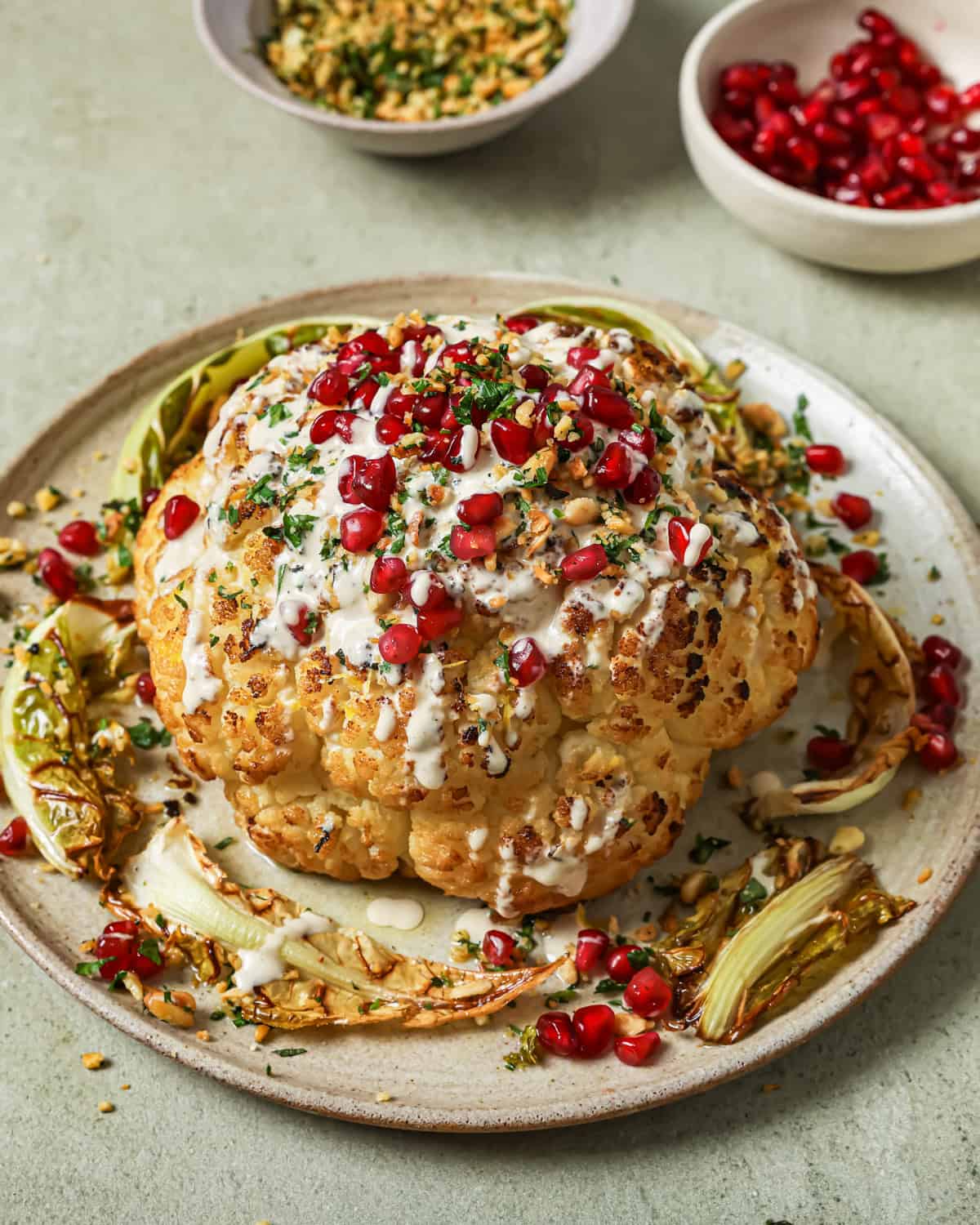
This centerpiece-worthy Whole Roasted Cauliflower proves that cauliflower can not only taste like the best dish on the table—it can look like it, too. 😍
My love for cauliflower is very well–documented, so it’s a big deal when I tell you that this is possibly my favorite way to cook the king of cruciferous veggies: par-boiled in salted water, bathed in lemon-infused olive oil, then roasted till a charred, crisp exterior surrounds its tender, almost creamy interior.
Drizzled in a zingy pomegranate-tahini sauce and dusted with an herb-nut topping, this is cauliflower at its most showstopping and dazzling, perfect as a side dish or starter for holiday meals, dinner parties, or date nights.
Ingredient notes & substitutes
The essentials
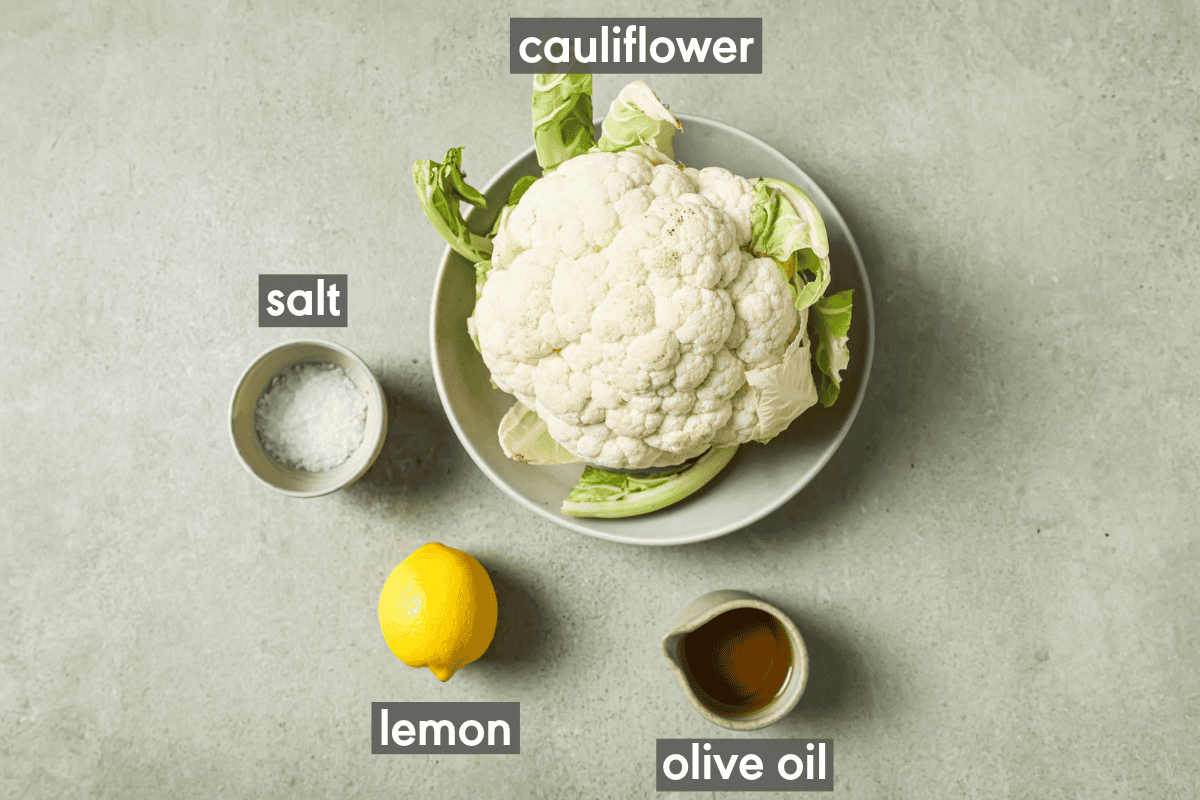
- Cauliflower: This unassuming, nutrient-dense veggie transforms into the jaw-dropping star of the show. You’ll use the whole cauliflower, including the leaves, which get added to the pan towards the end of the roast to get delectably crispy. See the Tips section for choosing the right size cauliflower for this recipe.
- Extra virgin olive oil + lemon zest + kosher salt: We’re keeping the seasoning on the cauliflower itself very simple for two reasons: (1) thanks to the way the cauliflower is cooked, you don’t need much to make it taste good; (2) the other elements of the dish bring major flavor.
The toppings
Once you have the basic whole roasted cauliflower, there are so many directions you can go in, but here are the ingredients I use for the sauce and topping.
- Pomegranate molasses: AKA one of my favorite ingredients of all time for its unique blend of sharp tang, sweetness, and a zing that wakes up your whole mouth. It makes this tahini sauce truly special.
- Tahini: This silky ingredient, made from ground sesame seeds, gives a lusciously smooth texture and rich nuttiness to the pomegranate tahini sauce, beautifully tempering the sharp vibrance of the pomegranate molasses.
- Pine nuts or pistachios: I love using pine nuts for their buttery richness or pistachios for their color, but almost any nut would work for this nutty herb topping. You’ll toast them in a dry pan until they’re fragrant, then roughly crush them using a mortar and pestle (or food processor).
- Fresh herbs: Use what you love—flat-leaf parsley, mint, cilantro, or a combination of these! You’ll muddle these with the toasted nuts to release their fragrant oils and create a fresh, herbaceous topping for the cauliflower.
- Pomegranate seeds: Not only do they add delightful bursts of sweetness and mirror the pomegranate molasses, but I love the way they stud the finished dish with festive color.
Substitutes and tips
- I recommend “all natural” pomegranate molasses where the sole ingredient is pomegranate juice. This is my go-to, but I also enjoy all of these brands. Find even more options at Middle Eastern markets!
- Don’t have access to pomegranate molasses? Omit it and add a touch of maple syrup to balance the flavors in the tahini sauce. OR, opt for a different flavor profile altogether! Jump to the Tips section for suggestions.
- In the herby nut topping: Not into pistachios or pine nuts? Sub with walnuts or almonds! Toast them as described in the recipe.
Step-by-step instructions
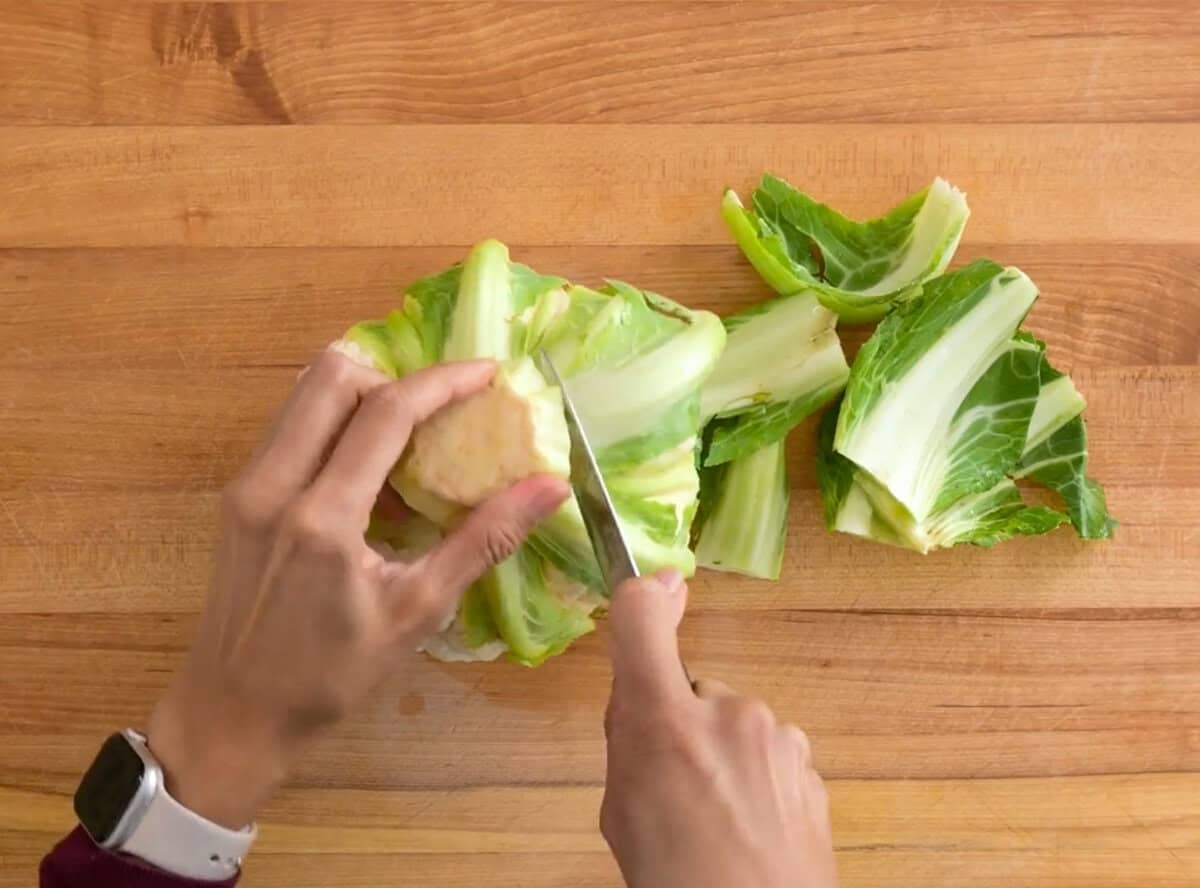
- Use a paring knife to remove the cauliflower leaves (set them aside). Trim the base so the head of cauliflower stands upright.
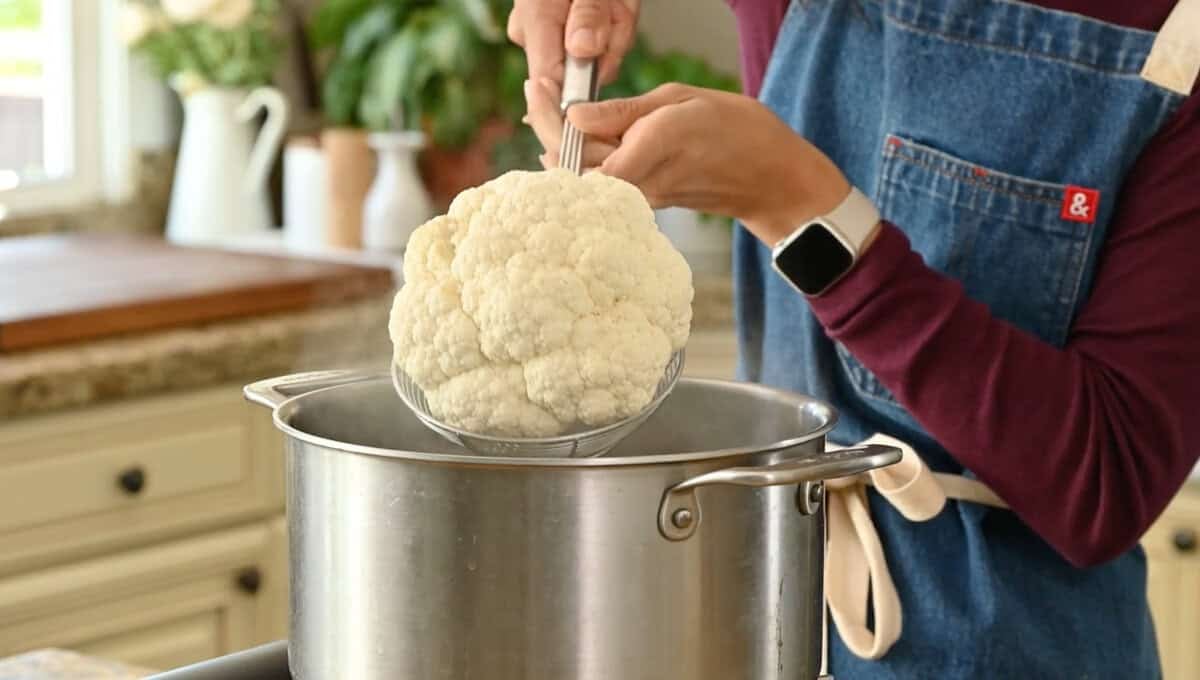
- Par-cook: Bring a large saucepan of 3 – 3.5 qts water to a boil. Add 3 TBSP kosher salt. Lower cauliflower (flower-side up) into the pot and cook, partially covered, for 5 minutes.
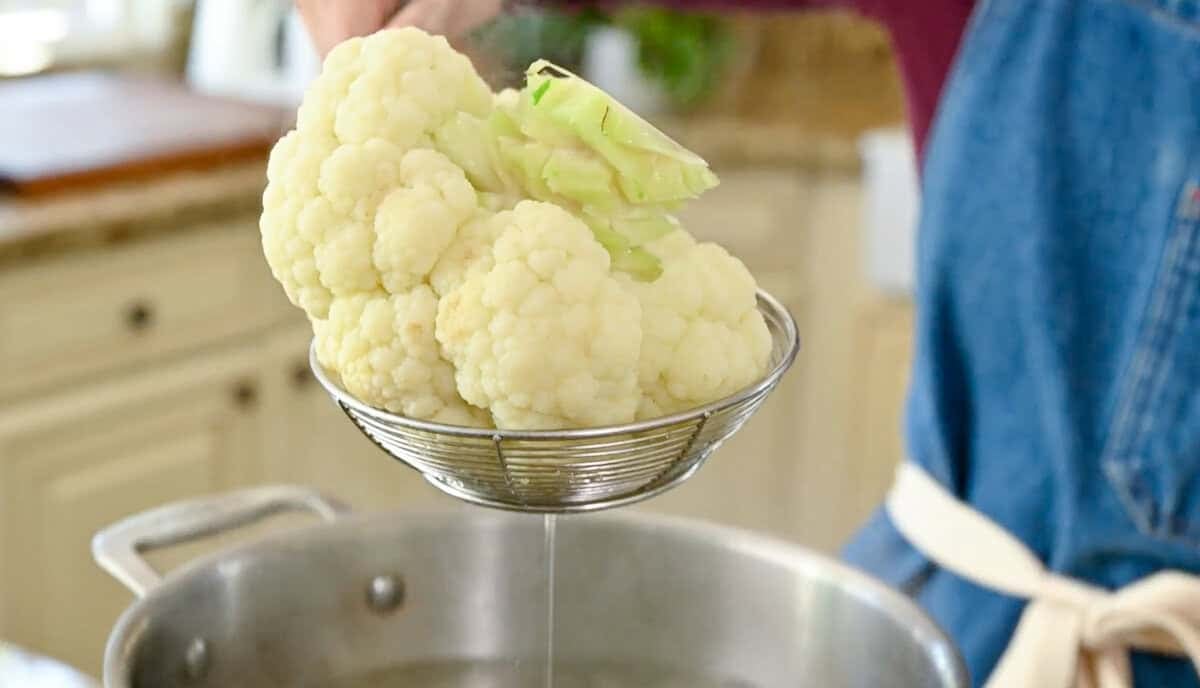
- Remove the cauliflower from the saucepan.
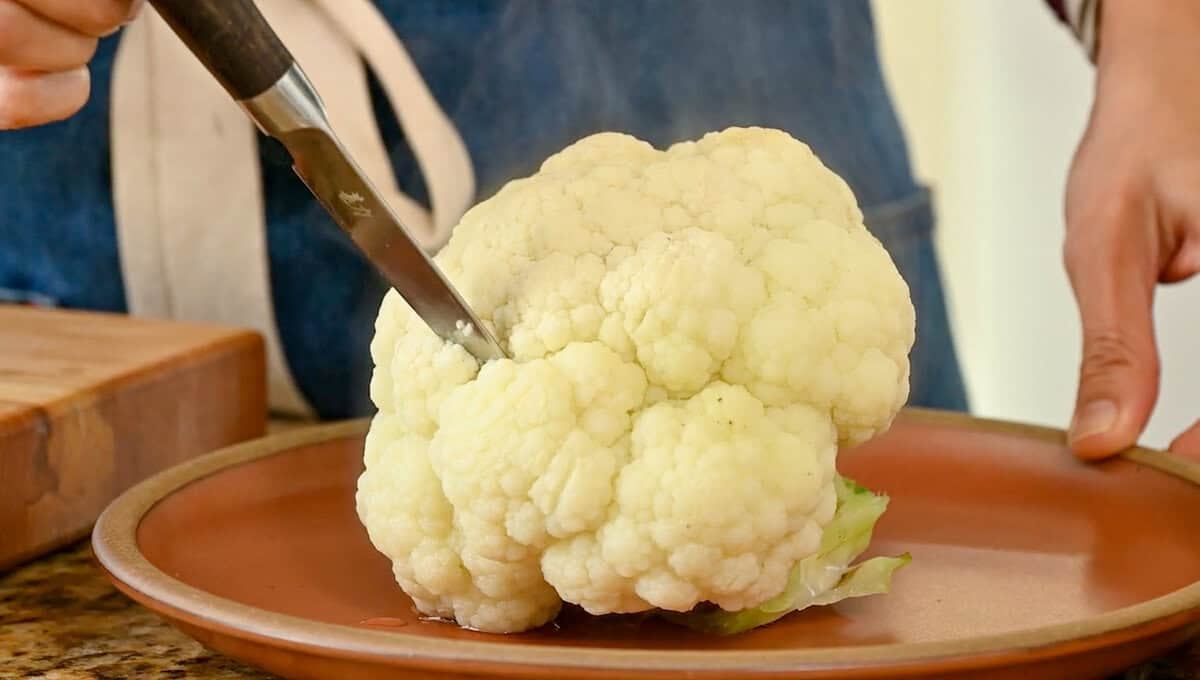
- Check for doneness (a knife should pierce it with little resistance).
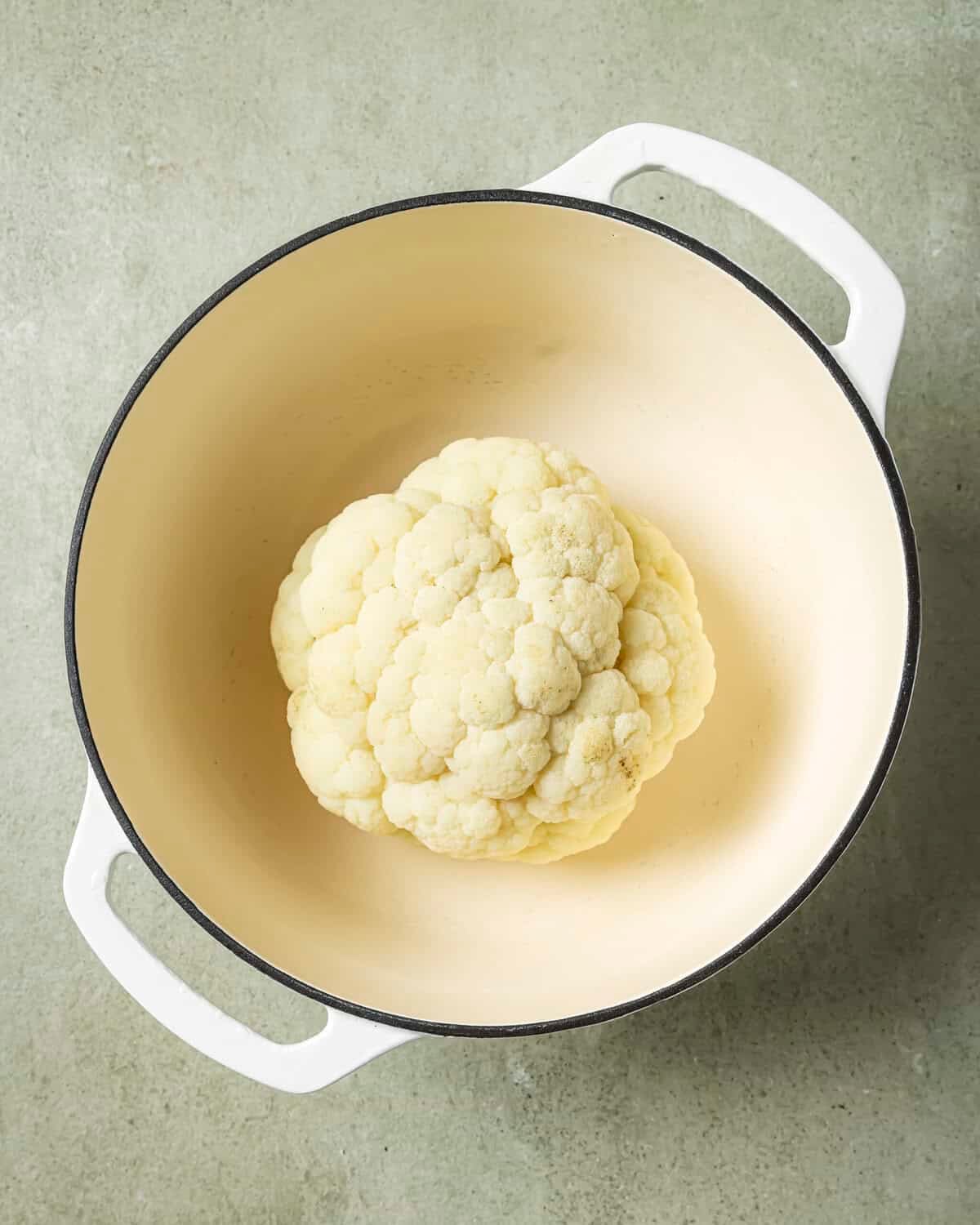
- Return to the hot pan to dry off for 10 minutes.
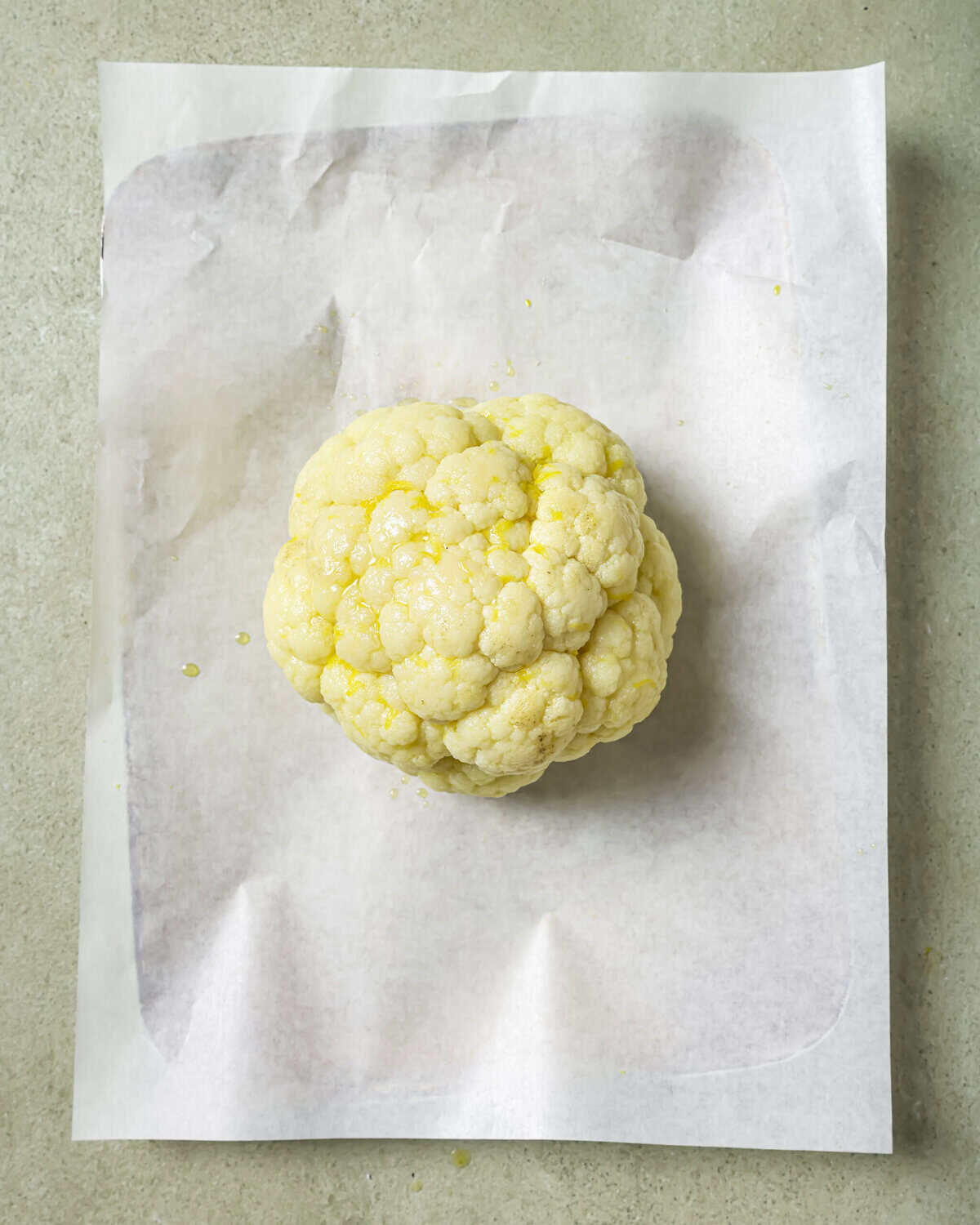
- Place the cauliflower on a rimmed sheet pan. Brush the lemon oil (minus the reserved 1 tablespoon) all over the cauliflower.
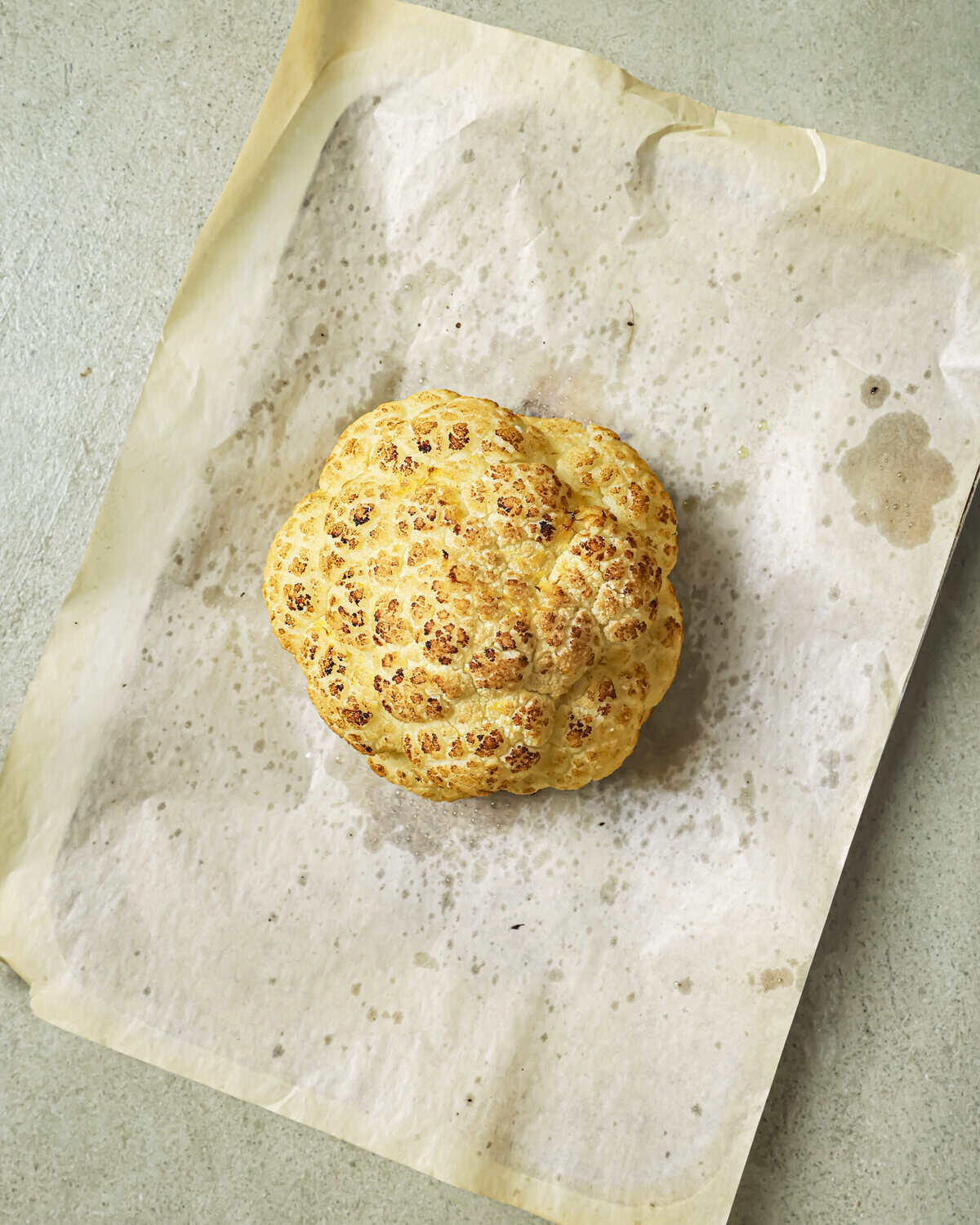
- Roast flower-side up on the center rack of a 400ºF oven for 20 minutes, then remove.
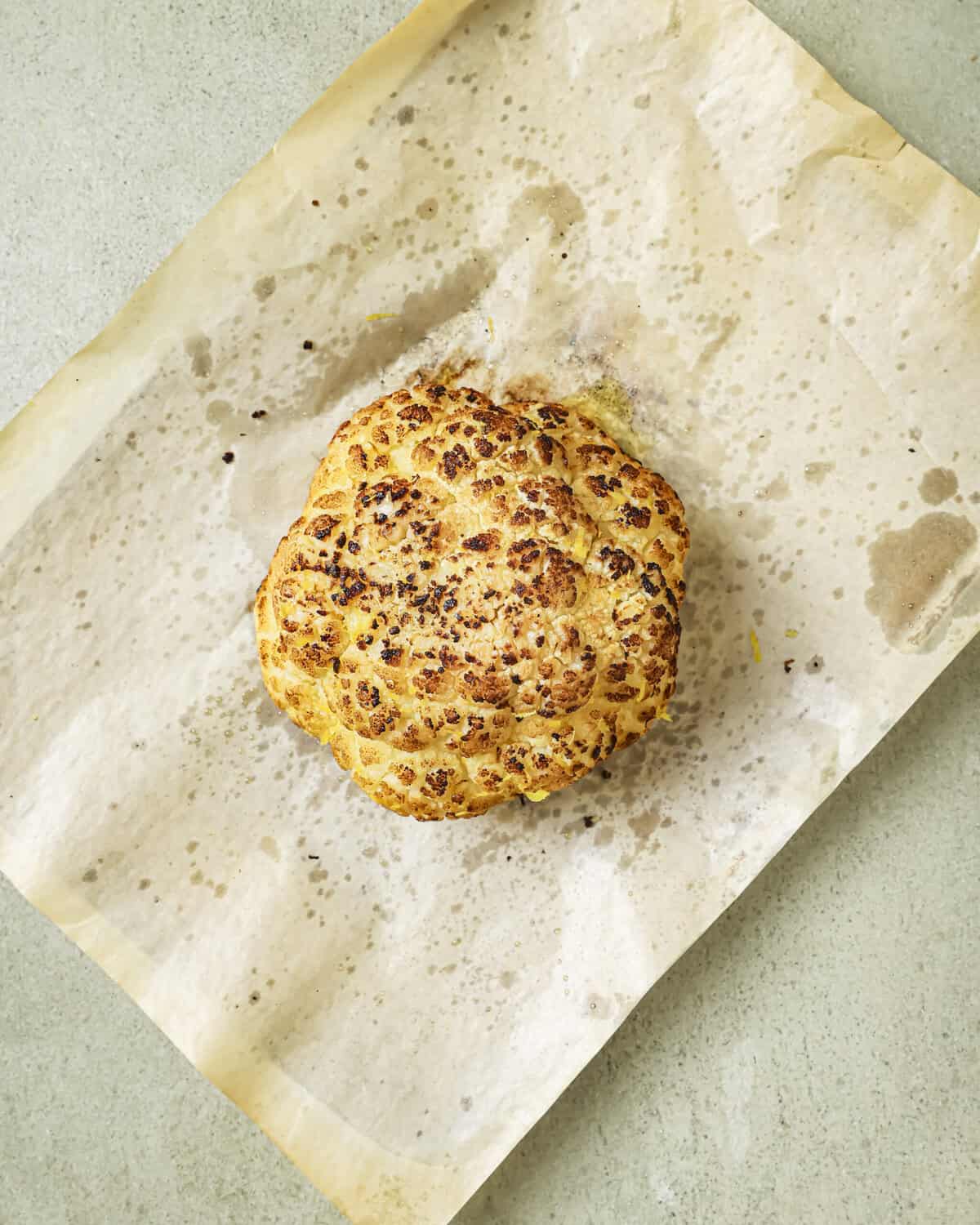
- Brush the cauliflower with the reserved lemon oil, then roast for another 20 minutes or until nicely browned all over.
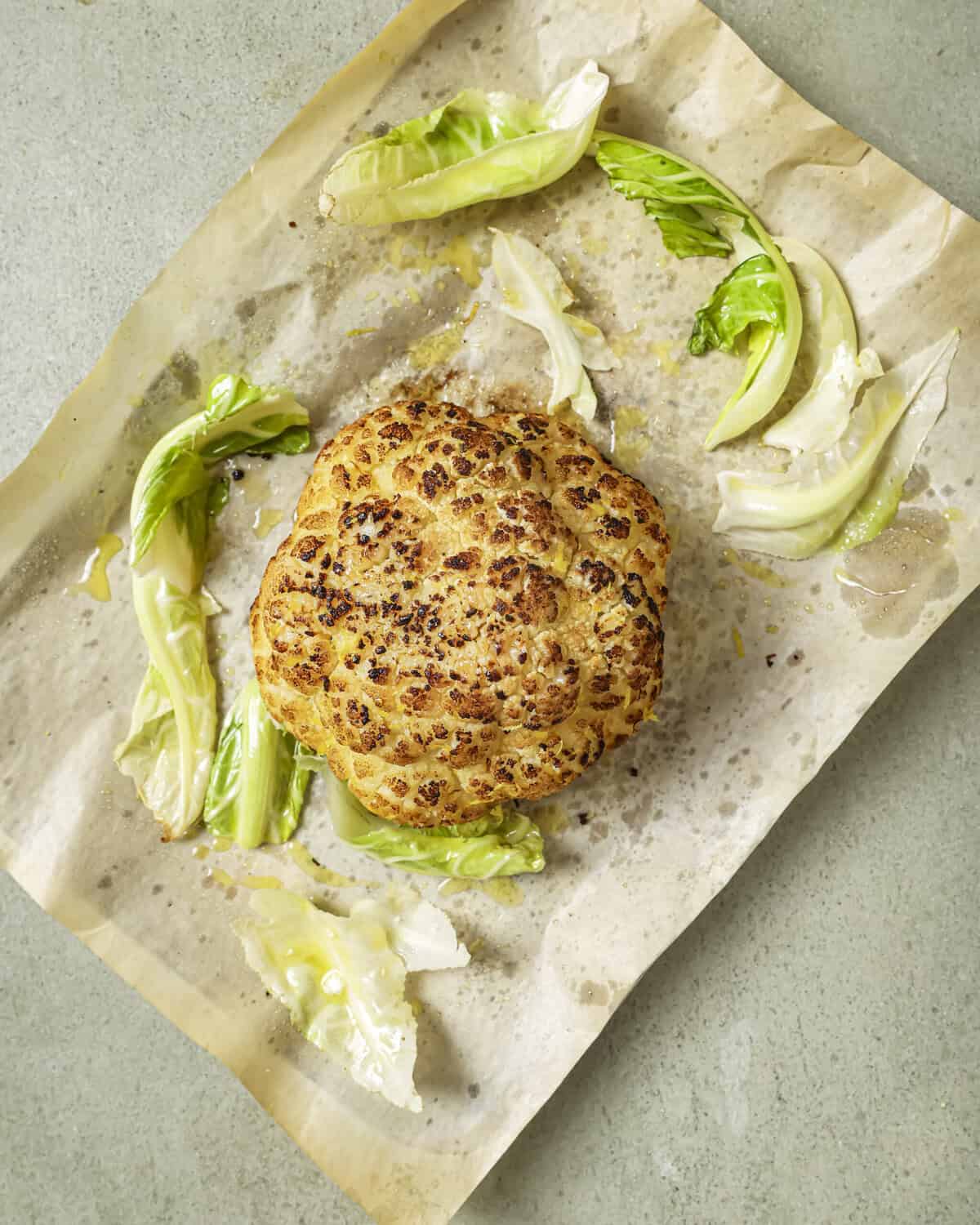
- Toss the cauliflower leaves with a bit of oil and salt. Add to the pan.
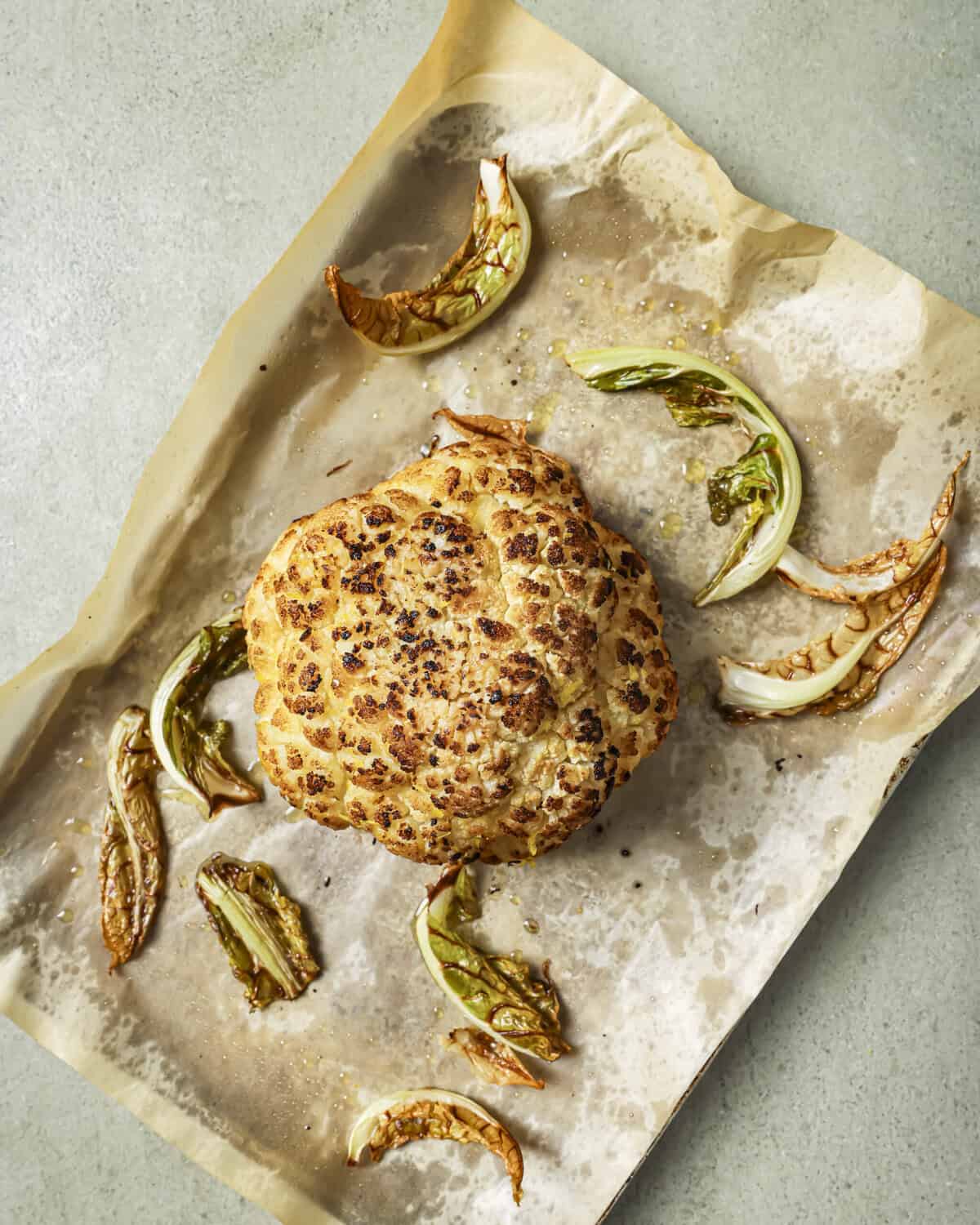
- Roast for another 10 to 15 minutes, until the cauliflower is deeply browned (some charring is good) and leaves are brown and crisp.
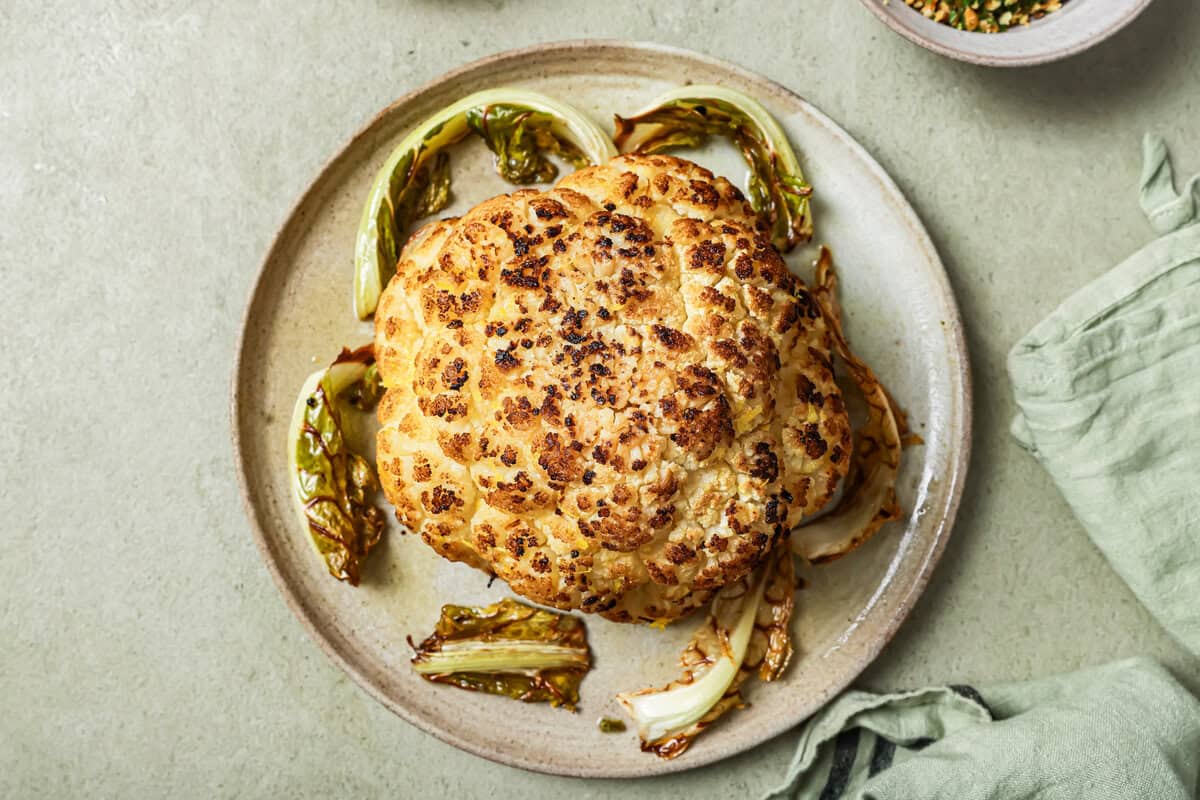
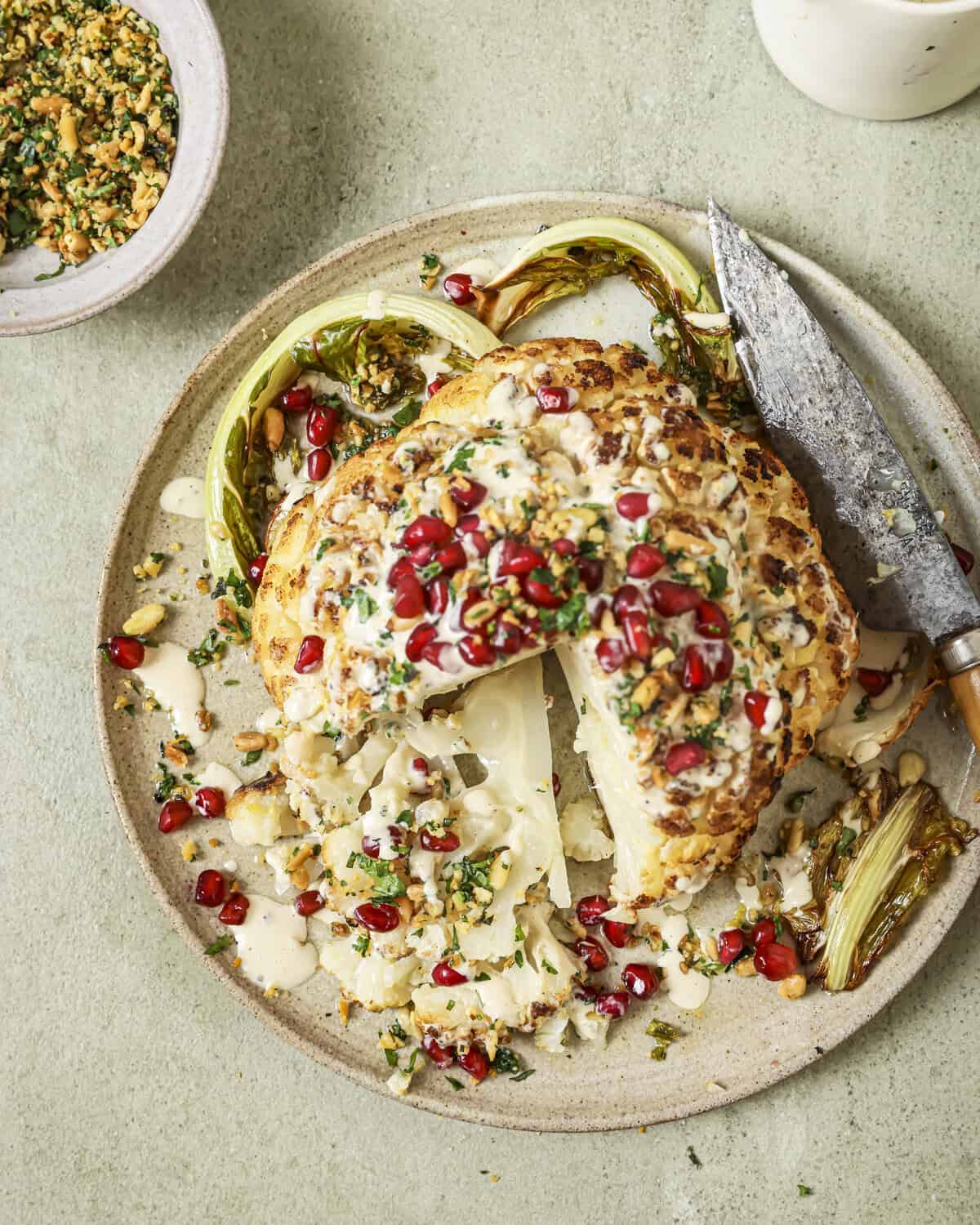
- Rest for 5 minutes, then transfer to a serving plate.
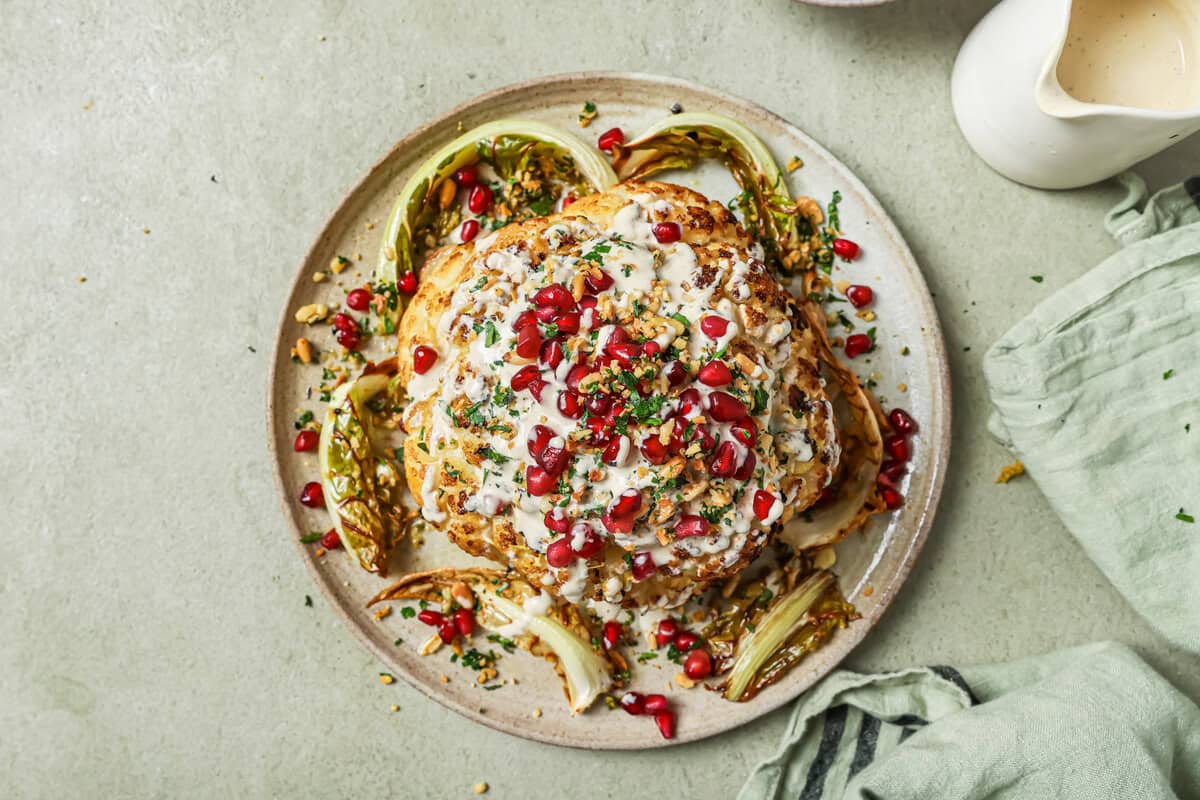
- Drizzle on the tahini sauce, then scatter with the nut-herb topping and pomegranate seeds.
Tips for making this recipe
Par-boiling the cauliflower is not optional
If you were to skip the initial boiling of the cauliflower and stick the whole head straight in the oven, the outsides would char before the inside had a chance to cook, leaving you with a burnt exterior and an undercooked interior.
Boiling the cauliflower first is critical for two reasons:
- It cooks the interior to a beautiful tenderness.
- The salt in the water permeates the cauliflower, seasoning it from within.
And remember! After draining the water, let the cauliflower sit in the hot pan for about 10 minutes so it can thoroughly dry. If you roast it while it’s still water-logged, you’ll end up with soggy cauliflower.
Modify based on your cauliflower size
This recipe is best with a medium cauliflower—one that’s about 2 pounds (900g), give or take.
If your cauliflower is a bit larger (closer to 2.5 lbs / 1.1 kg): slightly increase the amount of oil and salt for roasting—use an extra 2 to 3 teaspoons of olive oil and an additional pinch or two of salt.
If your cauliflower is a bit smaller than 2 pounds, use a bit less salt in the par-boiling stage (2 to 2.5 tablespoons kosher salt) and in the roasting stage (~½ heaping tsp kosher salt).
Don’t use a cauliflower much larger than 2.5 lbs (1.1 kg). In my tests, larger cauliflowers didn’t absorb as much flavor and they barely browned, so the end result felt more like steamed cauliflower.

Customize the flavor profile!
The roasted cauliflower is a canvas for whatever flavor experience you’d like to serve up!
- North African spin: Stir 2 to 3 teaspoons of ras el hanout into the olive oil/lemon zest mixture.
- Indian flair: Stir 1 tsp garam masala, 1 tsp ground cumin, and 1 tsp ground coriander, into the olive oil mixture and skip the lemon zest. Replace the pomegranate tahini sauce with raita. For the nutty topping, try cilantro or mint and cashews or peanuts.
- Italian twist: Swap out the pomegranate tahini sauce for dollops of basil pesto.
Frequently Asked Questions
1) I use Diamond Crystal kosher salt, which is about half as salty as sea salt and table salt so keep that in mind. If using table salt or sea salt, reduce the salt quantities by half.
2) A fair amount of salt is needed to penetrate the cauliflower as it cooks in water since it hasn’t been cut up. If you were cooking florets, you could definitely use less salt because it would more easily penetrate the nooks and crannies inside the florets.
3) As with cooking pasta, most of the salt will drain off when you drain the water, so you’re not going to be consuming anywhere near the amount of salt used.
The cauliflower is best when served immediately, but you can make the pomegranate tahini sauce up to 5 days in advance and store in the refrigerator.
Store cooked cauliflower in an airtight container in the fridge for 3 to 4 days. Unfortunately, this is not the kind of dish that will freeze well!
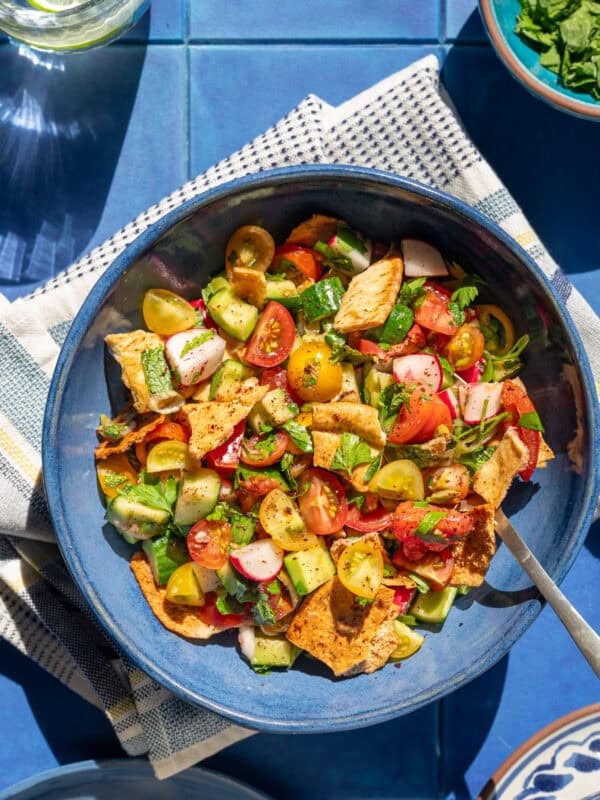
I’m so glad you asked! Whip up a batch of muhammara or roasted red pepper hummus, this unbeatable quinoa salad or this vibrant fattoush salad.
Drizzle it into other tahini sauces as well as yogurt sauces or use a touch of it in vinaigrettes.
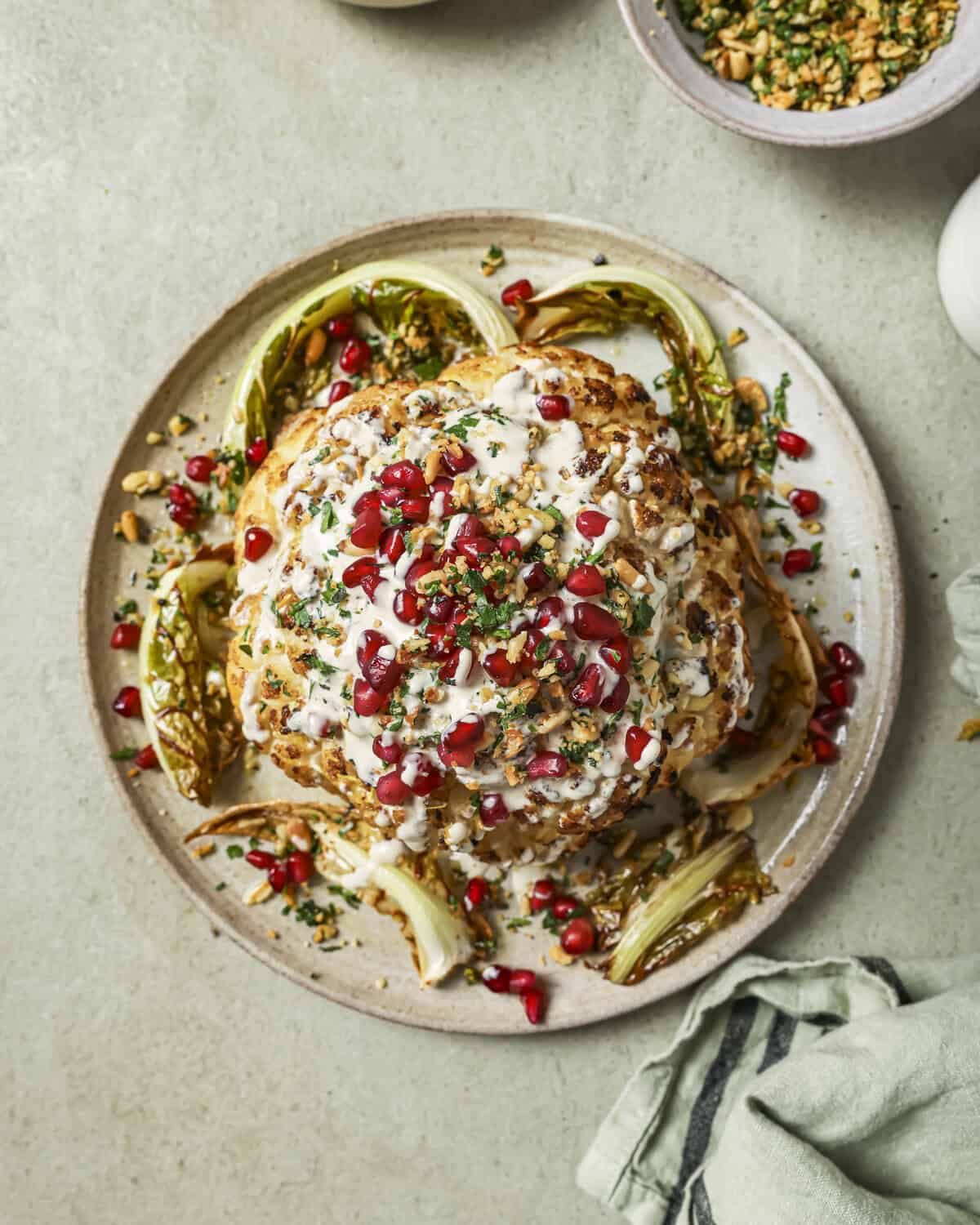
Was this stunning whole roasted cauliflower as big of a hit in your house as it was in mine?
I’d love to hear about it! Leave a rating and review below—and thanks, as always, for being part of the RPL community 🤗

Introducing
Big Vegan Flavor
Techniques and 150 recipes to master vegan cooking.
Whole Roasted Cauliflower

Ingredients
For the cauliflower
- 1 medium (~2 lbs / 900g) cauliflower (see Notes 1 and 2)
- 3 tablespoons (30g) Diamond Crystal kosher salt, plus more to season the cauliflower (see Note 3)
- 1 medium lemon
- 3 ½ tablespoons (49g) extra virgin olive oil, plus more for the cauliflower leaves
Toppings
- ¼ cup (56g) well-stirred tahini
- 2 tablespoons (30 mL) freshly squeezed lemon juice
- 2 teaspoons pure pomegranate molasses, plus more to taste
- 1 clove garlic, grated or crushed with a press
- ⅛ teaspoon ground coriander
- ⅛ teaspoon ground cardamom
- Kosher salt and freshly cracked black pepper
- 1 to 3 tablespoons ice water
- ¼ cup (35g) pine nuts or shelled pistachios (see Note 4)
- 1 small handful (5g) flat-leaf parsley, mint, or cilantro leaves, finely chopped
- ¼ to ⅓ cup (25 to 35g) pomegranate seeds
Instructions
- Fill a large saucepan with 3 to 3.5 quarts (~3 L) of water and bring to a boil.
- Preheat the oven to 400ºF/200ºC and arrange a rack in the center of the oven.
- Trim: Flip the cauliflower upside down and use a paring knife to remove the leaves; set aside for later. Trim the base so that the cauliflower can stand upright.
- Par-cook: Once the water is boiling, stir in 3 TBSP (30g) kosher salt (halve if using sea salt/table salt). Arrange cauliflower flower-side up on a slotted spoon or spider tool, then lower into the pot. Partially cover, leaving a crack at the edge to prevent boiling over. Set a 5-minute timer (don’t wait for it to return to a boil to start timing).Scoop cauliflower onto a plate—it's done if a paring knife pierces it without much resistance.
- Dry the cauliflower: Drain the hot water. Return the cauliflower to the hot pan, flower-side up, to dry for 10 minutes.
- Meanwhile, make the Lemon Oil: Zest the lemon into a small bowl. Add 3 1/2 TBSP (49g) olive oil and 1 heaping teaspoon kosher salt. Mix well. Scoop out ~ 1 TBSP for basting later.Meanwhile, prep the leaves: Wash and dry the cauliflower leaves. Tear any large ones, removing stringy bits. Toss with olive oil to lightly coat, then season with a pinch of salt. Set aside.
- First roast: Place cauliflower on a rimmed sheet pan. Use a pastry brush to brush the lemon oil all over the cauliflower (minus the reserved 1 TBSP), flipping it over and getting into the nooks and crannies. Roast flower-side up for 20 minutes, then remove from the oven. Use a pastry brush to baste the cauliflower with the reserved lemon oil. If the bottom is starting to char, carefully flip the cauliflower so the flower side faces down.
- Second roast: Return to the oven for 20 minutes, then remove. If it's not that browned yet, roast for another 10 minutes. If cauliflower is deeply brown and a bit charred on top/sides, add the dressed cauliflower leaves to open spaces on the pan.
- Final roast: Roast cauliflower plus leaves for 10 to 15 minutes, or until cauliflower is fully tender and deeply browned (some charring is good), and the leaves are deeply browned and crisp. Let rest for 5 minutes before assembling.
- While the cauliflower roasts, make the Tahini Sauce: In a medium bowl, whisk together: 1/4 cup (56g) tahini, 2 TBSP (30 mL) lemon juice, 2 tsp pomegranate molasses, 1 grated garlic clove, 1/8 tsp ground coriander, 1/8 tsp ground cardamom, and a few twists of black pepper. Now whisk in 1 tablespoon ice water at a time, adding more water until creamy yet pourable.Taste, adding more pomegranate molasses as desired. Season with a pinch of salt (but not more since the other components have salt).
- While the cauliflower roasts, make the Herb-Nut Topping: Heat a small frying pan over medium for a few minutes, then add the 1/4 cup (35g) pine nuts or pistachios. Stir occasionally until golden brown and/or toasty in aroma, 3 to 5 minutes.Finely chop 1 small handful of parsley/mint/cilantro. Combine herbs and nuts in a mortar and pestle. Roughly crush until the herbs cling to the nuts (see Note 4 if you don’t have a mortar and pestle or if using harder-textured nuts).
- Assemble: Serve cauliflower on a platter. Drizzle tahini sauce on top, leaving extra sauce for serving on the side. Scatter with the herb-nut topping and pomegranate seeds.
Video
Notes
- If your cauliflower is a bit larger (closer to 2.5 lbs / 1.1 kg): Slightly increase the amount of oil and salt for roasting—use an extra 2 to 3 teaspoons of olive oil and an additional pinch or two of salt. I don’t recommend using a cauliflower that’s much larger than 2.5 lbs (1.1 kg), as they don’t brown well or absorb much flavor.
- If your cauliflower is a bit smaller than 2 pounds, use a bit less salt in the par-cooking stage ( 2 to 2.5 tablespoons kosher salt) and in the roasting stage (~½ heaping tsp kosher salt).
- Diamond Crystal kosher salt is about half as salty as table salt and sea salt. If using table salt or sea salt, use half the amount of salt listed in the steps.
- You can sub pine nuts with pistachios, walnuts, or almonds. For harder nuts like almonds and pistachios or if you don’t have a mortar and pestle, add the herbs and nuts to a food processor and pulse repeatedly.
Nutrition
Nutrition information is automatically calculated, so should only be used as an approximation.
 Love this? Leave a rating below!