

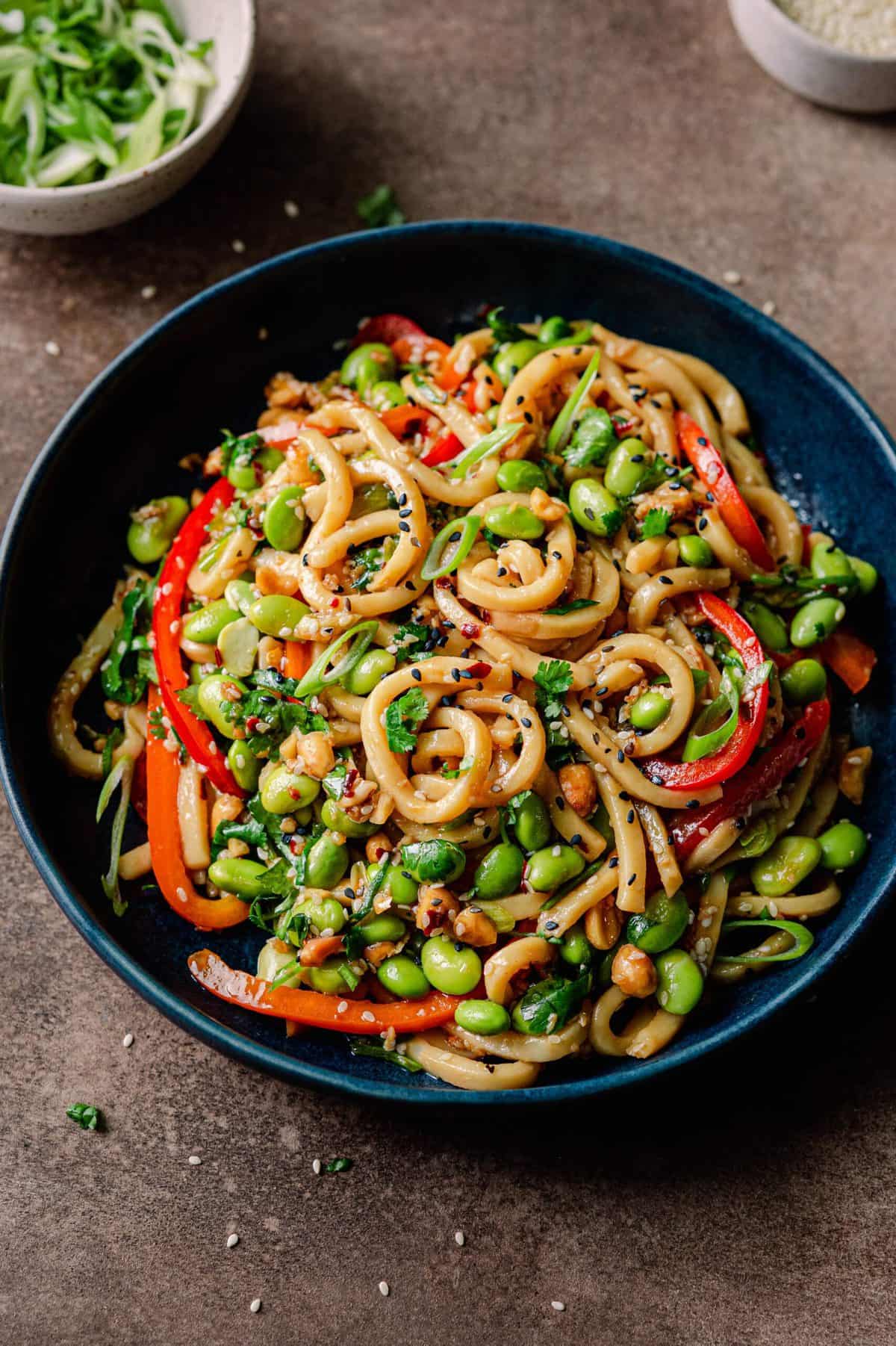
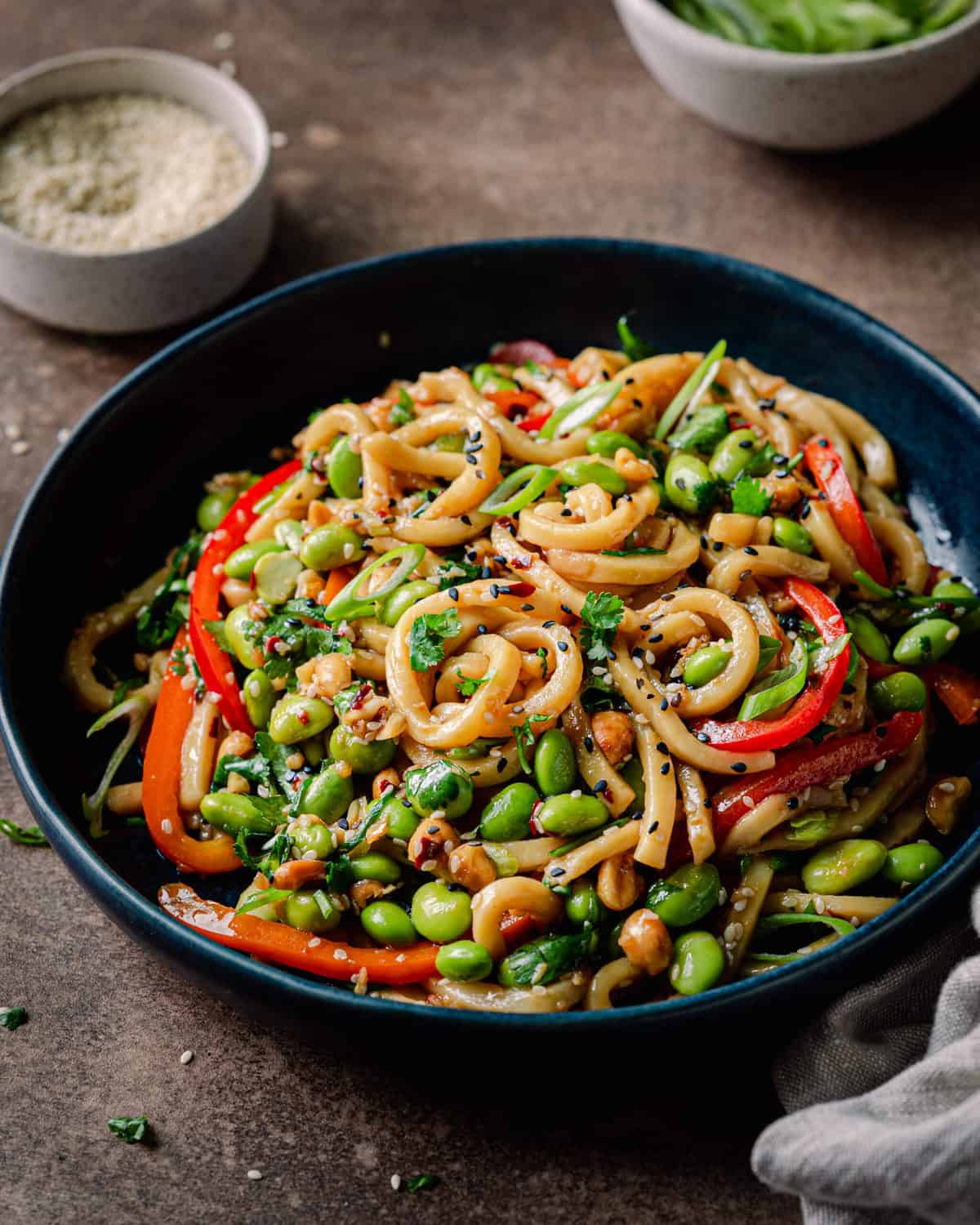
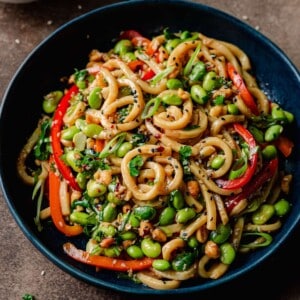
If you’ve ever struggled with getting food on the table on busy weeknights, these chili garlic noodles are guaranteed to become a staple in your household.
In this post, you’ll learn my formula for how to make Asian-inspired vegan noodles in less time than it takes to order takeout.
And these bad boys aren’t just fast; they’re flavorful, too. Spicy, garlicky, tangy and with a mix of chewy, saucy, and crunchy textures, be warned: this recipe is addictive.
The best part? The chili garlic oil/sauce makes a double batch, which means the next time make these noodles, it takes even less time and effort.
Table of Contents:
1. Ingredient Notes
2. Step by step instructions
3. Tips and Substitutes
4. Frequently asked questions
5. Video: How to make Chili Garlic Noodles
6. Full recipe
Ingredient notes
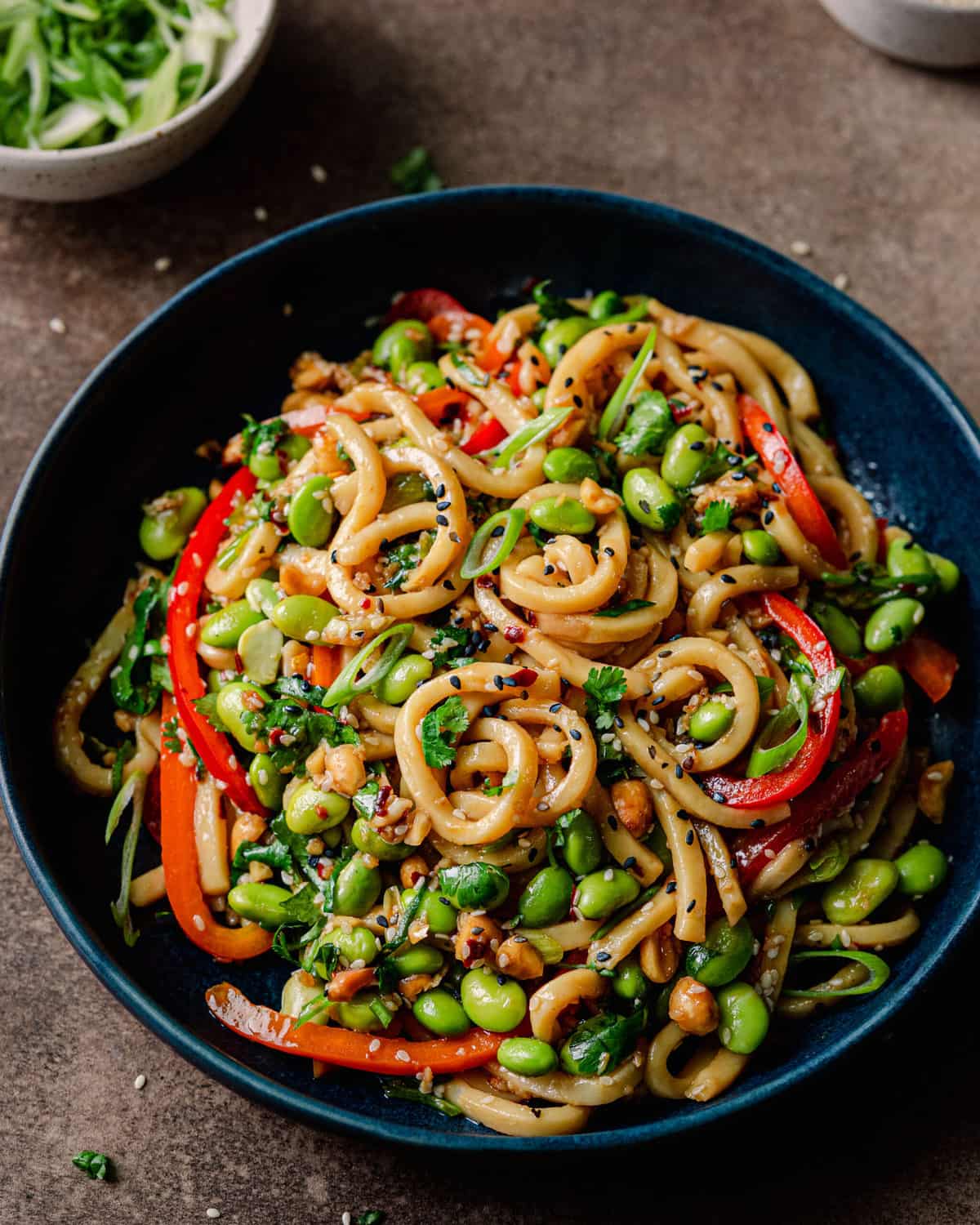
These vegan noodles fuse Chinese cooking techniques and ingredients with Japanese udon noodles in the most inauthentic-but-crazy-delicious way. Better yet, a medley of veggies, herbs, nuts and plant-based protein keeps everything pretty wholesome, too.
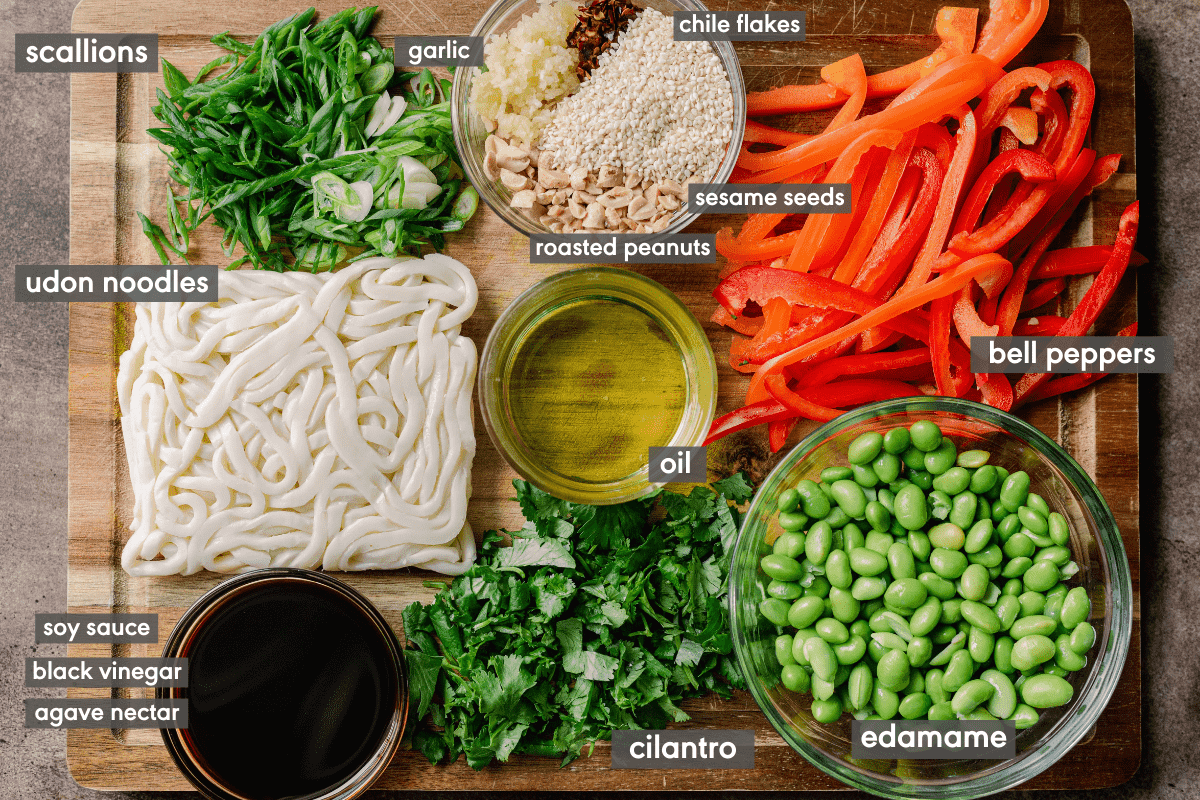
Here’s what you’ll need to make this recipe:
- Noodles: my first choice for this recipe is fresh (or frozen) udon noodles. They have the perfect bouncy, chewy texture and cook in just two minutes.
- For the sauce: you’ll need soy sauce or tamari, maple syrup or agave, and Chinese black vinegar. Chinese black vinegar is a less commonly known ingredient, so I’ve shared more detail about what it adds below as well as potential substitutions if you can’t get it.
- For the garlic chili oil: we’re using a neutral flavored oil like grapeseed or avocado oil, Sichuan chile flakes or standard crushed red pepper flakes, white sesame seeds, garlic, and peanuts.
- For the veggies: my preference is to use red or orange bell pepper (never green – gross!), cilantro, and scallions.
- For protein: I rely on pre-shelled edamame, which can be found in the frozen section of most grocery stores. It’s super high in protein and of course works well with the East Asian flavors in this recipe.
Common Substitutions
One of the reasons I love this recipe is that it’s so customizable. Here are a few common substitutions you can try:
- Can’t find fresh or frozen udon noodles? I adore fresh udon noodles because they’re chubby, chewy, and slurpy. If you can’t find them, use shelf-stable udon noodles or ramen noodles. The dish will still be very tasty, it will just have a different texture. Just don’t use a thin noodle variety like rice vermicelli.
- No Chinese black vinegar? You can use rice vinegar in a pinch, but the dish won’t have the same complexity or depth of flavor. I really recommend Chinese black vinegar for this recipe; you can find more in the Tips section below.
- Allergic to peanuts? Cashews also work very well here.
- Other veggies you can add. You can use finely shredded red cabbage or Napa cabbage, shredded carrots, or chopped snap peas/snow peas. If you have extra time, you can add steamed broccoli or sautéed bok choy.
- Swap out the protein. If you don’t like edamame but still want to keep things quick, use store-bought pre-cooked tofu. You can also cook tofu yourself using my Fried Tofu or Baked Tofu recipes, though of course the recipe will take longer.
Step-by-step instructions
Gather your ingredients!
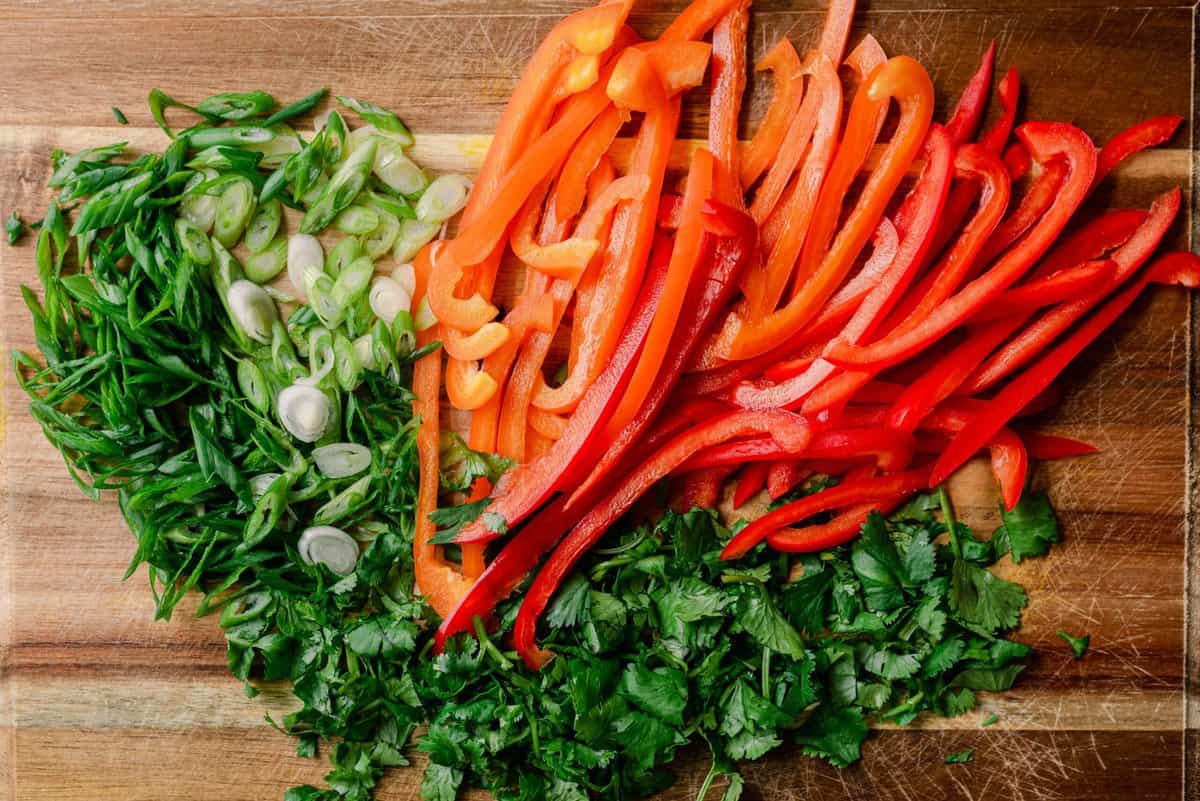
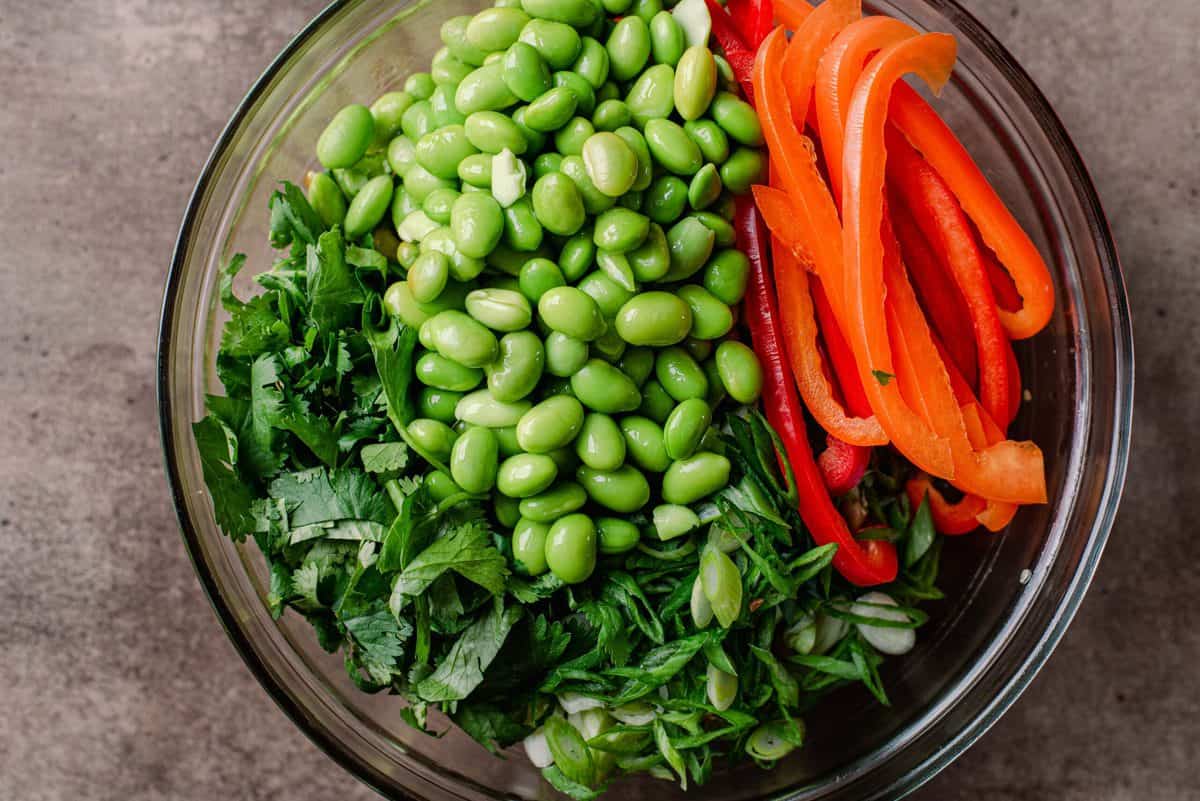
Prep the vegetables and herbs: slice the bell peppers and scallions, and chop the cilantro.
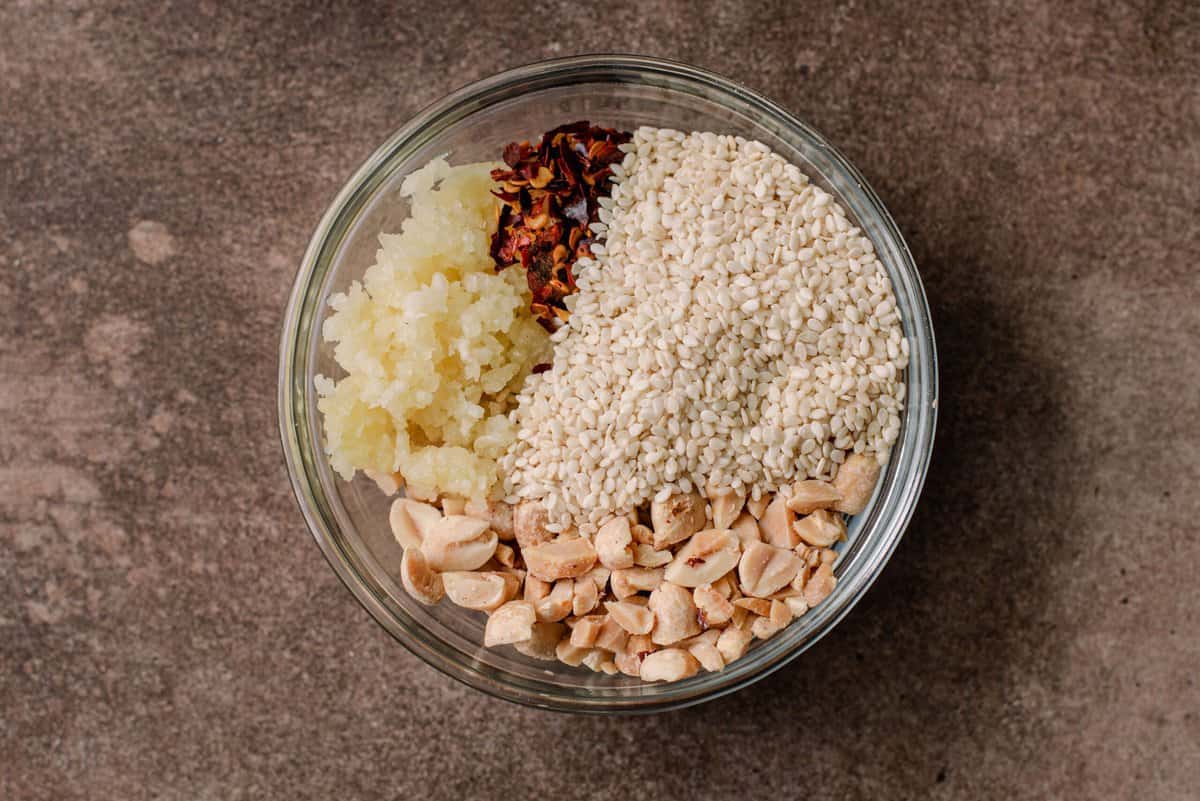
Mince the garlic, chop the peanuts, and add them to a bowl along with the chile flakes and sesame seeds.
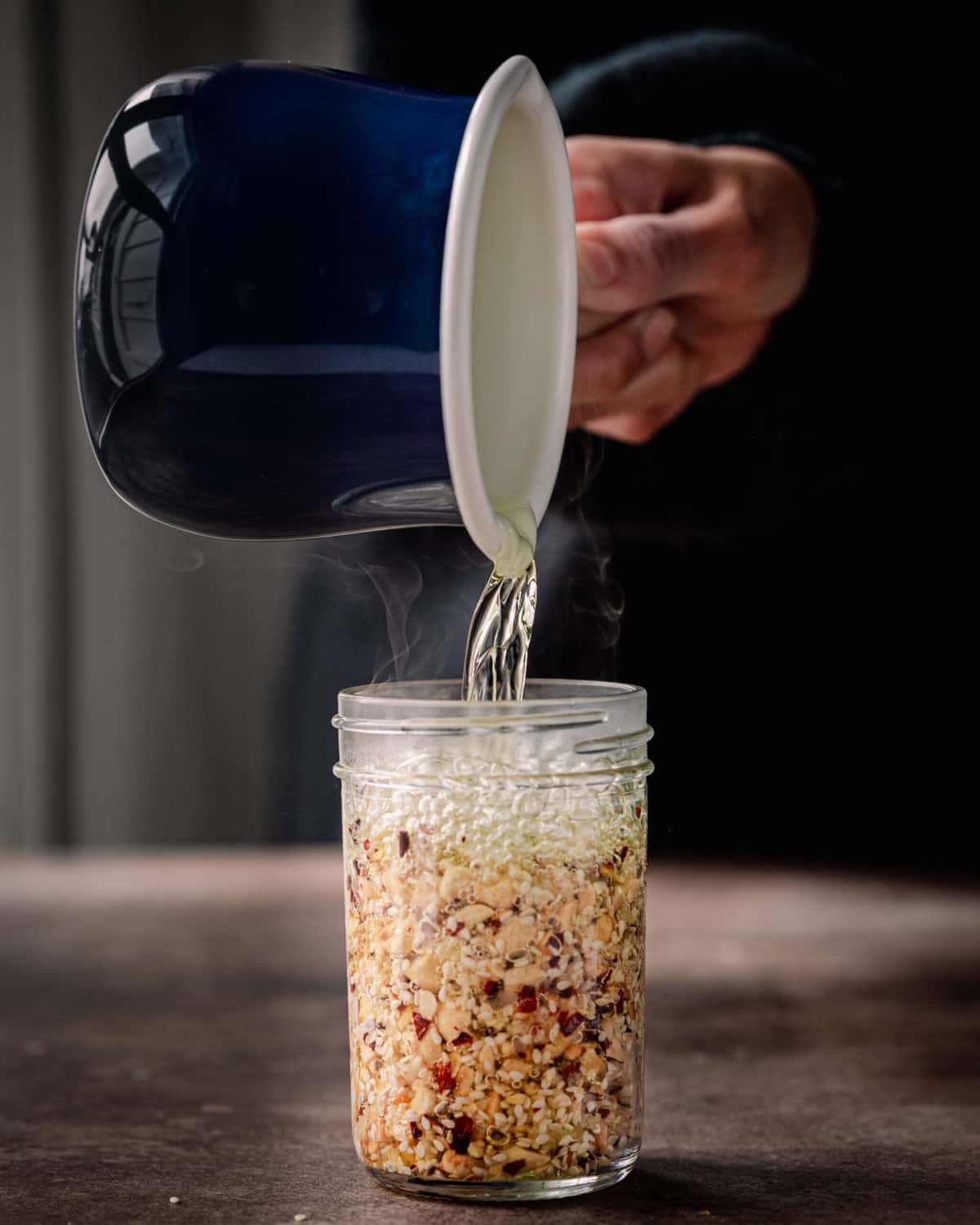
Heat the oil in a small saucepan for several minutes until it reaches 350ºF/175ºC. Pour the hot oil over the garlic-peanut mixture. It should sizzle.
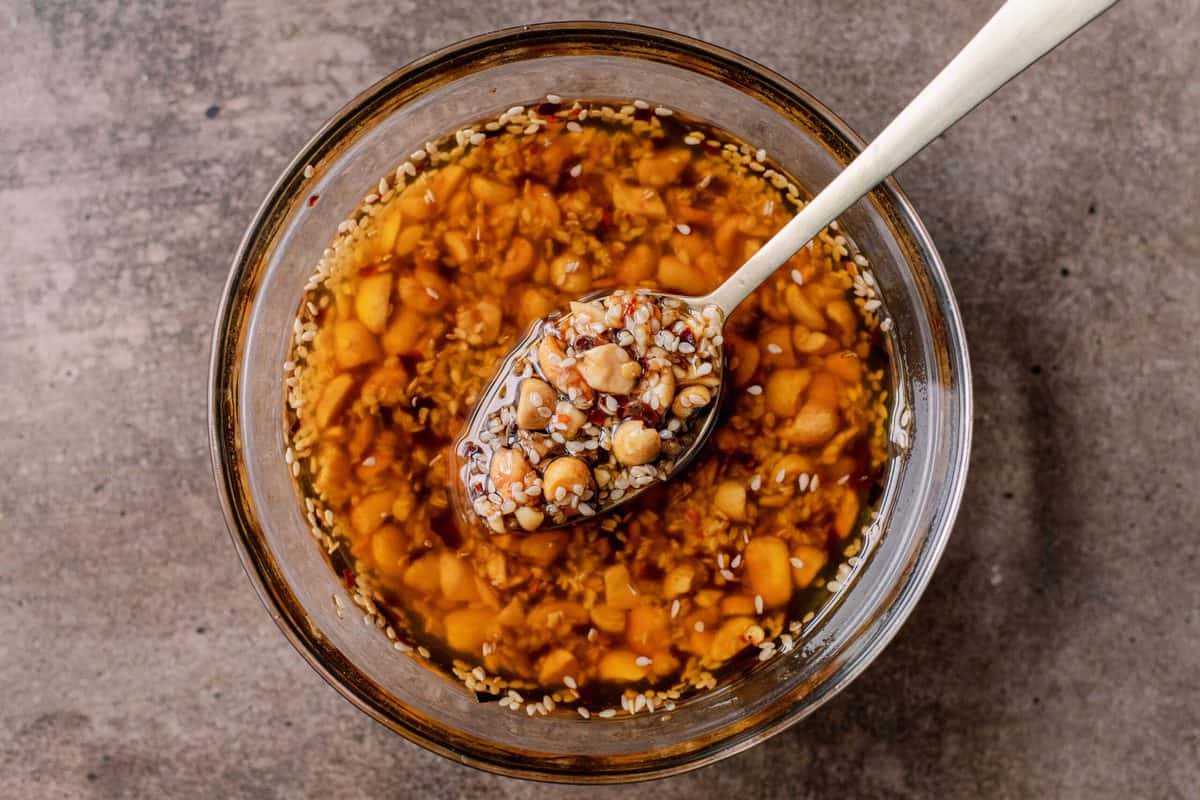
After a minute, stir the soy sauce, Chinese black vinegar, and maple syrup/agave into the chili-garlic oil.
Pour the garlic chili oil/sauce over your cooked udon noodles and toss to coat.
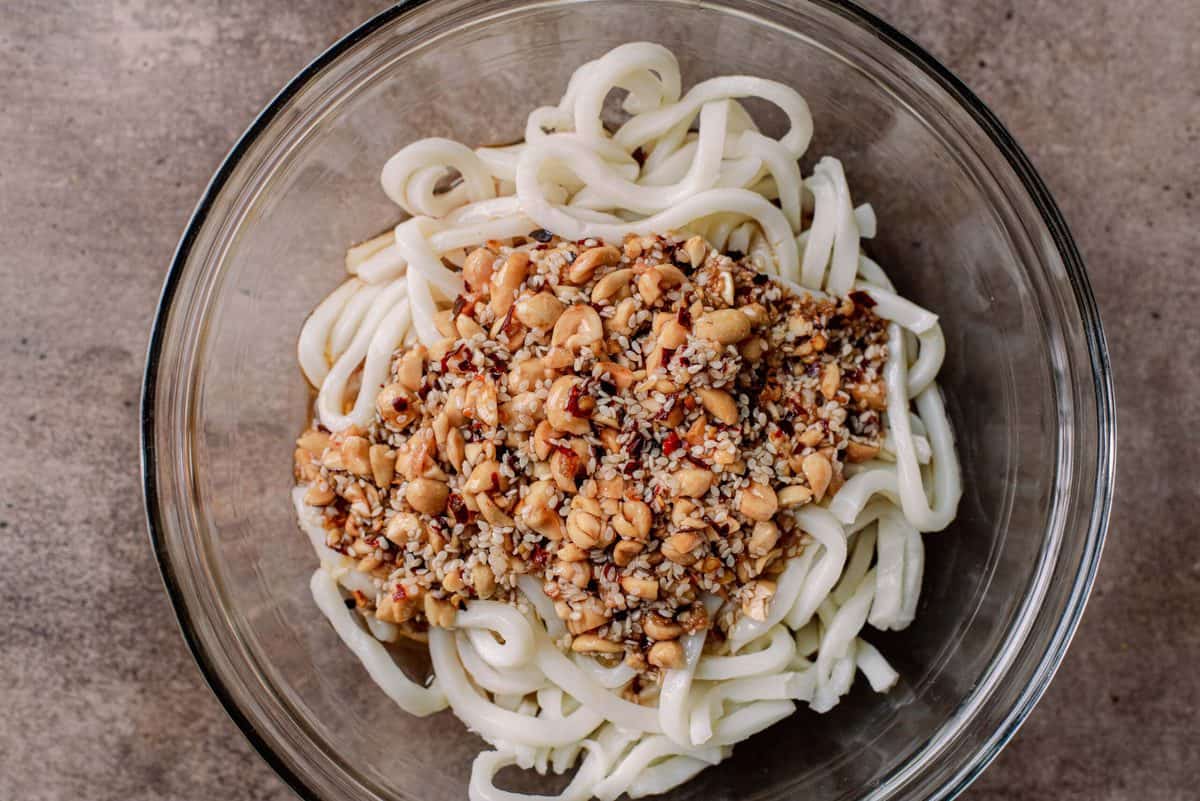
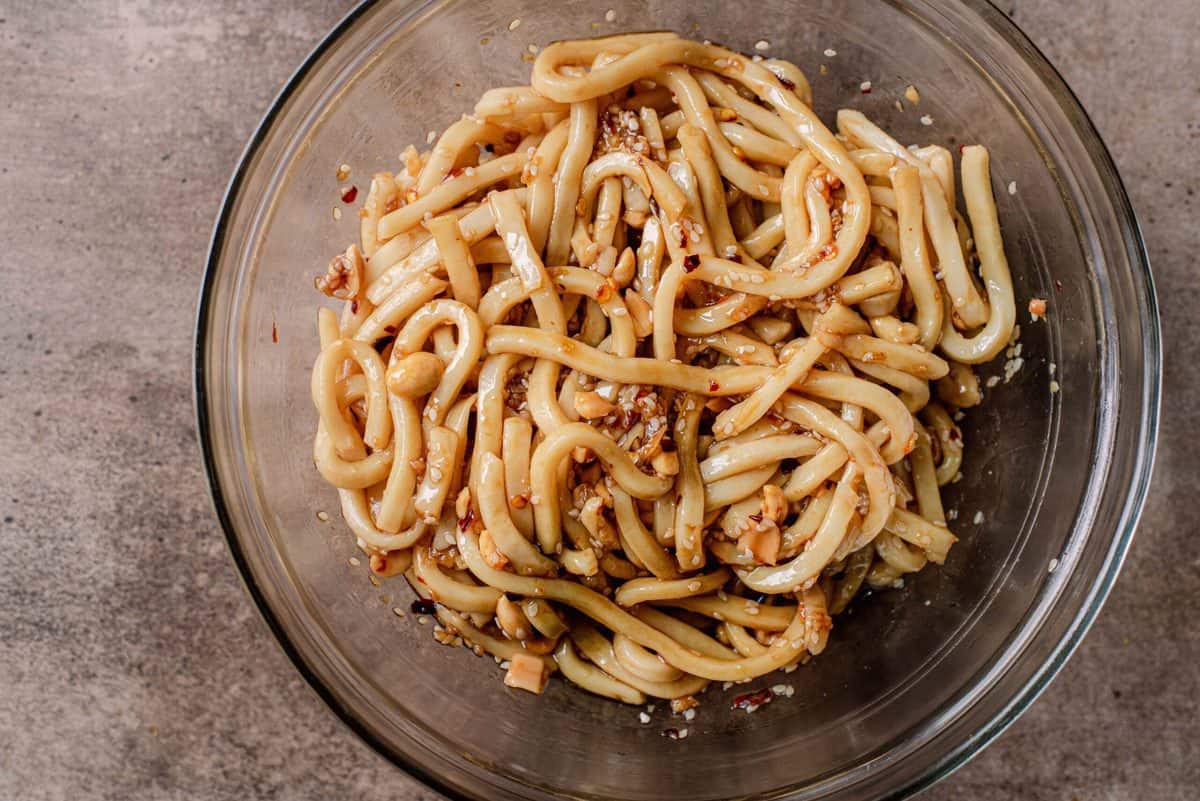
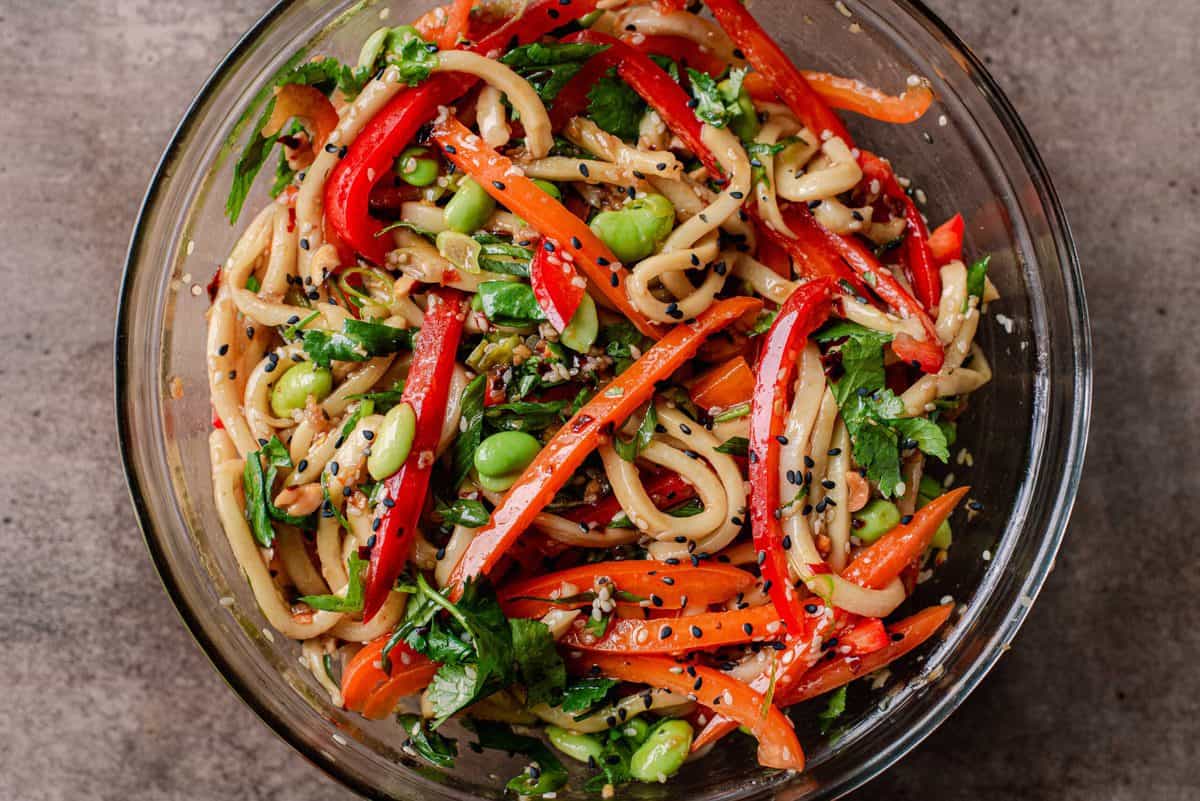
Add the sliced bell pepper and scallions, chopped cilantro, and edamame. Toss to coat well.
Tips and Substitutes
Multitask for maximum efficiency
If you want to maximize time and make this in 15 minutes, you have to multitask.
While the water for the noodles is boiling, chop your garlic and peanuts for the chili oil. And when the oil is heating up on the stove, grab your vegetables and herbs. While the chili oil sauce is resting and the noodles are cooking, slice your vegetables and herbs. You get the point!
Also, fresh or frozen udon noodles cook very quickly—about 2 minutes. If you’re using a different noodle, it might add to the cook time by a few minutes.
Don’t sleep on Chinese Black Vinegar
Chinese black vinegar is one of the most unique and delicious pantry ingredients and really makes this dish shine. Unlike a standard Western vinegar, it’s fermented and has a complex flavor profile: umami-rich, earthy, sour, and a little sweet.
The most common variety sold in the states is Chinkiang black vinegar (affiliate link) from Southern China, which is made from fermented sticky rice (you might also find it sold as Zhenjiang). Bonus: it’s very affordable (at an Asian grocery store like HMart, it costs about $4), and will stay good in your pantry for a very, very long time.
If you want to read more about Chinese black vinegar, check out these posts from The Woks of Life and Bon Appetit.
Adjust the spice level to your taste
Since these are garlic chili noodles, they need some heat. That said, I don’t think this recipe is very spicy.
If you want the noodles to be very spicy, add more chile flakes. If you’re sensitive to spicy food, use half the amount.
I love using Sichuan chile flakes for this recipe, as it’s a Chinese inspired recipe and the flavor is wonderful (toasty and nutty), but this recipe also works great with standard red pepper flakes.
Make sure the oil is adequately heated
This is not a traditional chili oil where the aromatics are cooked in oil on the stove. Instead, it’s a quick and streamlined version where you pour hot oil over the aromatics and allow the hot oil to cook them that way. So, it’s important the oil is hot enough.
I use a thermometer like this to ensure the oil is at 350ºF. If you don’t have one, allow your oil to heat for 3 to 5 minutes (the smaller the saucepan, the less time it needs). Then, add a piece of minced garlic to the oil. If it sizzles immediately, the oil should be hot enough.
Frequently Asked Questions
You can find fresh or frozen udon noodles at East Asian grocery stores in the refrigerated or freezer section. They typically come in packets or bundles as shown below.
Add them to a pot of boiling water like this and use a chopstick to loosen them from their bundle. They typically only take 2 minutes to cook. Then drain and rinse under cool water (you can use them hot in other dishes, but this is a cold/room temperature noodle salad). 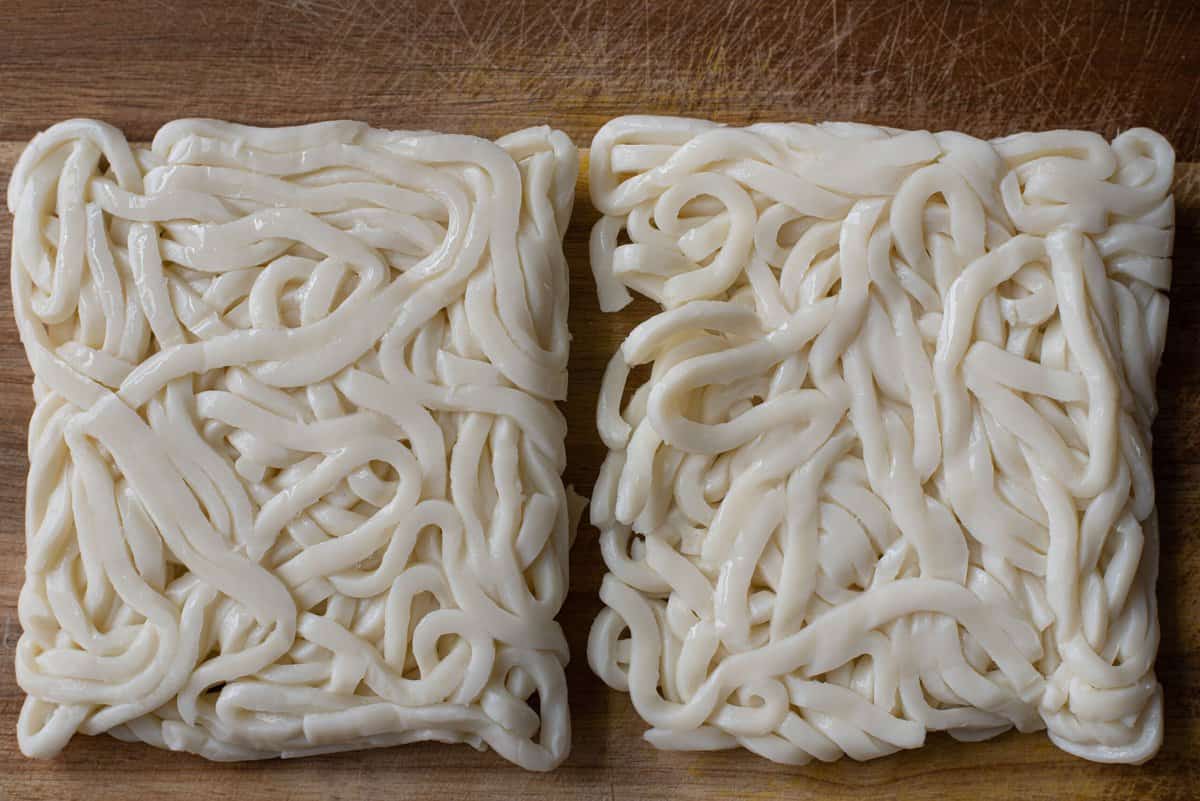
You can find Chinese black vinegar and Sichuan chile flakes at East Asian grocery stores, or order black vinegar and Sichuan chile flakes online (affiliate links).
PS: if you are allergic to gluten, skip the Chinese black vinegar because it is fermented with small amounts of grain.
You can use rice vinegar with good results, but the dish won’t have the same complexity or depth of flavor. If you have a good-quality aged balsamic vinegar, you can add a small amount of that (1/2 tbsp aged balsamic vinegar to 2 tbsp rice vinegar).
Use it in other noodle dishes or in stir-fries (start slowly, as it’s quite strong in flavor), and usually add it towards the end. It’s also commonly used with equal parts soy sauce as a dipping sauce for dumplings. I also love it in a Chinese smashed cucumber salad, like this one from Lisa of Healthy Nibbles.
When cooking Chinese dishes, you can also use a small amount of black vinegar enhance the flavors in a dish or to balance a dish that’s too spicy, too sweet or too bitter.
That means the oil wasn’t hot enough. Don’t worry, you can fix this. Just transfer the entire mixture—oil and aromatics—to a small frying pan over medium-ish heat. Cook the aromatics in the oil until the garlic just starts to turn golden, then take off the heat.
Try these East Asian Recipes Next!
- Restaurant-Style Tofu Stir Fry
- Marinated Tofu
- Chinese Braised Tofu
- Gochujang Noodles
- Spicy Korean Cucumber Salad
- Creamy Umami Noodle Soup with Crispy Mushrooms
Watch! How to Make Vegan Noodles
That’s all I’ve got for these quick and easy vegan chili garlic noodles! If you love this recipe, be sure to rate and review it below 🙂 And if you snap a pic, tag me with your remakes on Instagram!

Introducing
Big Vegan Flavor
Techniques and 150 recipes to master vegan cooking.
15-Minute Vegan Chili Garlic Noodles
Ingredients
- 10 ounces (285g) fresh or frozen udon noodles (See Note 1)
- 1 small or medium red/yellow/orange bell pepper, thinly sliced
- ¾ cup (12g) fresh cilantro leaves and tender stems, chopped
- 3 scallions, sliced on a bias
- 6 ounces (170g) frozen edamame, defrosted
- ⅛ teaspoon sea salt
Garlic Chili Oil (See Note 2)
- 1/3 cup (75g) neutral-flavored oil (such as grapeseed oil, avocado oil, canola oil)
- 2 teaspoons Sichuan chile flakes or red pepper flakes
- 2 tablespoons white sesame seeds
- 6 garlic cloves, minced or crushed with a garlic press
- 1/2 cup (70g) dry-roasted peanuts, roughly chopped (unsalted or salted, either is fine)
Sauce
- 3 tablespoons soy sauce or tamari
- 2 ½ tablespoons Chinese black vinegar (See Note 3)
- 1 tablespoon maple syrup or agave nectar
Instructions
- Cook the udon noodles. Bring a large saucepan of water to a boil. Once boiling, salt generously (2 to 3 teaspoons kosher salt) and add the bundles of udon noodles. Cook for 1 minute, then use a chopstick or tongs to loosen and separate the noodles. Cook for another 1 minute, for a total of 2 minutes until chewy but tender. Drain in a colander and rinse with cold water until cool. Shake the colander well to drain (you can leave the noodles to continue draining if you have other ingredients to prep). Transfer noodles to a large bowl.
- While the water is boiling, mince the garlic, chop the peanuts and cilantro, slice the bell peppers, and scallions. In a bowl, toss the edamame with the sea salt.
- Make the Garlic Chili Oil. Add the chile flakes, sesame seeds, garlic, and peanuts to a small-medium bowl. Heat the oil in your smallest saucepan over medium heat until hot and shimmering, 3 to 5 minutes (depending on your saucepan size and material), or until it registers 350ºF/175ºC. Pour the hot oil over the garlic-peanut mixture (it should sizzle). Stir and let sit for 1 minute. Stir the soy sauce, vinegar, and maple syrup or agave into the garlic-chili oil.NOTE: If you don’t have a thermometer, add a piece of garlic and if it sizzles immediately, it should be ready
- Pour only HALF of the chili oil-soy sauce mixture over the noodles; reserve the rest for another recipe (it stays good in the fridge for at least 5 days). Add the bell peppers, edamame, cilantro and scallions, and toss really well (the dressing pools at the bottom). Serve at room temperature, or chill in the fridge if desired.
Video
Notes
Nutrition
Nutrition information is automatically calculated, so should only be used as an approximation.
 Love this? Leave a rating below!









I made this dish for a mixed group of omnivores and herbivores and it was a HIT! We added extra noodles and veggies to feed four, and used the entire amount of crispy chili oil. So fast, easy and delicious. Thank you again Nisha!
We appreciate your feedback and support, Koko. Thank you for leaving a review!
I made this last night. It was so good! I should have double the noodles!! No leftover for lunch 😢
It’s awesome to hear you loved the noodles, Anne-Marie! Too bad about no leftovers, sounds like you won’t be making that mistake twice!
This looks delicious… I don’t have the stuff in my house to make it though, so maybe I need a grocery list reminder. My favorite asian grocery store just moved CLOSER to me though so, YAY! stocking up…
Thanks for the compliment, Stef! We can’t wait for you to try this recipe yourself 🙂 Enjoy!
I made this for dinner tonight…absolutely delicious!! This will be in my weekly rotation. Thank you for posting it❤️
Hi Connie, we’re thrilled to hear you enjoyed this recipe! You are very welcome for posting it, thanks for reading and taking the opportunity to try it out 🙂
Next time, would you mind leaving a rating alongside your review? Star ratings are big help to readers who are thinking of making the recipe. Thanks!
Yum! Looking forward to making this next week. For the celiac disease folks commenting, please be aware that Chinese black vinegar almost always has wheat in it. You’ll want to substitute or shop around.
We can’t wait for you to try it, Bette! And you are correct, people with a gluten intolerance can use rice vinegar as a substitute.
I am eating these for lunch today! I’m also proud to say that I think I’ve “graduated” from “baby mouth” to “toddler mouth” due to these noodles! Also, I paired this with your “seriously delicious marinated tofu” for added protein. Both are wonderful recipes. Thanks so much for this one!
Sounds like a killer combo, Dave! Proud of you for stepping up your spice game and we’re happy you enjoy the recipes!
I wish you’d consider “gluten- free” substitutions for those of us who would like to try this recipe and are gluten free or have celiac disease.
Hi Suzanne, you could probably substitute thicker nice noodles or shirataki noodles for a gluten-freen substitute!
Hi Suzanne, for this recipe you can use rice noodles and substitute the black vinegar for rice vinegar for a GF version.
Love these and have made them 4 times in the last month. I confess tho that I never have peanuts in the house (cause I would just eat them from the cupboard) so I used peanut butter in the recipe everytime! It’s fabulous!
Also love that these noodles lend themselves to substitutions of many kinds. One time I had no edamame so used left over oven baked tofu plus peas and corn. It was still delicious!
A very useful recipe!
Hey Claire! Wow, I can feel your enthusiasm about this recipe through the screen! Love it!
You outdid yourself on this one Nisha. Just finished eating it. Wow. So delicious. I don’t like peanuts so I used Spicy Thai Almonds from Trader Joe’s and I’m allergic to wheat so used a mix of Shirotaki and edamame noodles. Really loved it!
Thanks for sharing, Eve! We’re so happy you enjoyed the noodles 🙂
I made this recipe last night. It was easy and incredibly delicious. I recently discovered your website while looking for a chile recipe. Made the chile and have been hooked on your recipes ever since. Thank you so much for sharing your recipes.
PS: I love the clips of your family trying the food you make
We’re over the moon to hear you enjoyed the recipe, Bruce. Thanks for your kind words!