


If tempeh doesn’t have a spot in your plant-based protein rotation, you are missing out.
- It’s jam-packed with protein and fiber.
- It’s just as versatile as tofu.
- It’s easy to cook.
I get it—where tofu is the gateway plant-protein for most vegans, tempeh can feel intimidating. But believe me: properly prepared, tempeh can be a flavor-saturated, crispy-edged meat substitute that will blow you away.
I wrote this comprehensive guide to pass on all the tips and tricks I’ve learned from transforming tempeh haters into tempeh lovers.
You’ll learn my favorite ways to prepare and cook tempeh, as well as my trusted flavor-boosting techniques for eliminating tempeh’s natural bitterness and infusing it with can’t-get-enough flavors, and one of my go-to recipes—Savory Tempeh Nuggets—that will quickly join your meal prep rotation.
It’s time to join Team Tempeh 💪🏽
In this post:
🎥 Video: how to make amazing tempeh
I invited 28 tempeh skeptics to try my tempeh recipes to see if I could convert them into tempeh lovers.

With over 300K views, this video was a massive hit with my community. I hope you’ll love the featured recipes just as much!
Tempeh 101
What is tempeh?
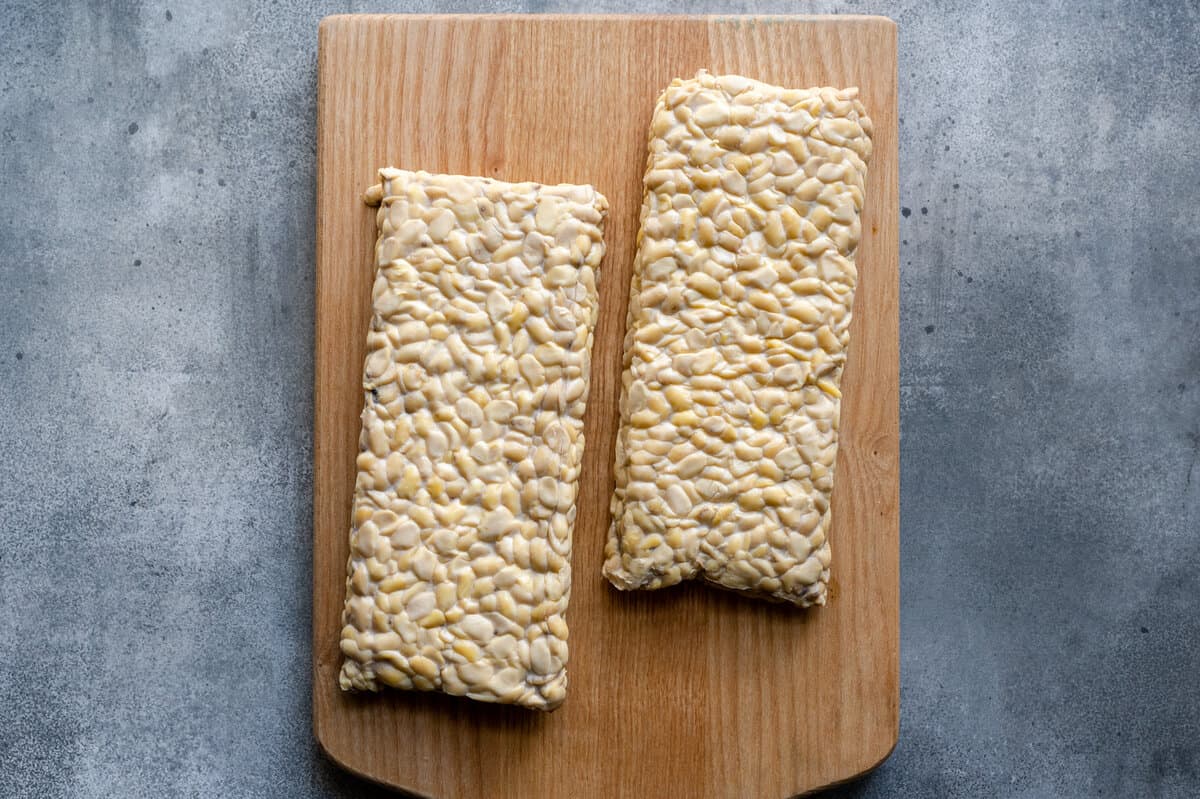
Tempeh is an Indonesian food made from fermented soybeans. You can find it in major grocery stores sold in rectangular or square blocks. You can also find pre-seasoned tempeh, but I don’t call for those in RPL recipes.
Like tofu, tempeh can soak up flavors like a sponge and is easy to cook (if you know a few tricks). And it delivers an impressive nutritional bang for your buck: a 3-ounce serving of tempeh contains 18 grams of protein and 6 grams of fiber!
According to the Cleveland Clinic, tempeh is loaded with nutrients, including iron, manganese, magnesium and B vitamins, and it contains probiotics that can improve gut health. They even say it can lower cholesterol and reduce the risk of heart disease.
Lastly, tempeh is fermented, which our guts love.
What does tempeh taste like?
Just because you can eat raw tempeh, it doesn’t mean you should. It’s naturally bitter with earthy, nutty, and subtle umami notes. Texturally, it’s dense, crumbly and slightly chewy.
But tempeh will absorb any flavor you throw at it, meaning you can take it from “meh” to “WOW!” with a few simple techniques.
Three tricks for actually good tempeh
If you’re dying to start cooking tempeh like now, skip to the recipe for savory tempeh nuggets at the bottom of this post.
But if you want to understand the principles of cooking great tempeh, this section has you covered!
Slice your tempeh the right way(s)
Tempeh preparation is straightforward: it’s all about how you slice it. The number one rule? Go small.
Smaller, thinner cuts crisp up much better AND absorb marinades and sauces more thoroughly. In contrast, with larger or thicker cuts, you’re more likely to taste tempeh’s natural bitterness and experience a drier, crumbly texture.
Here are my go-to slicing methods:
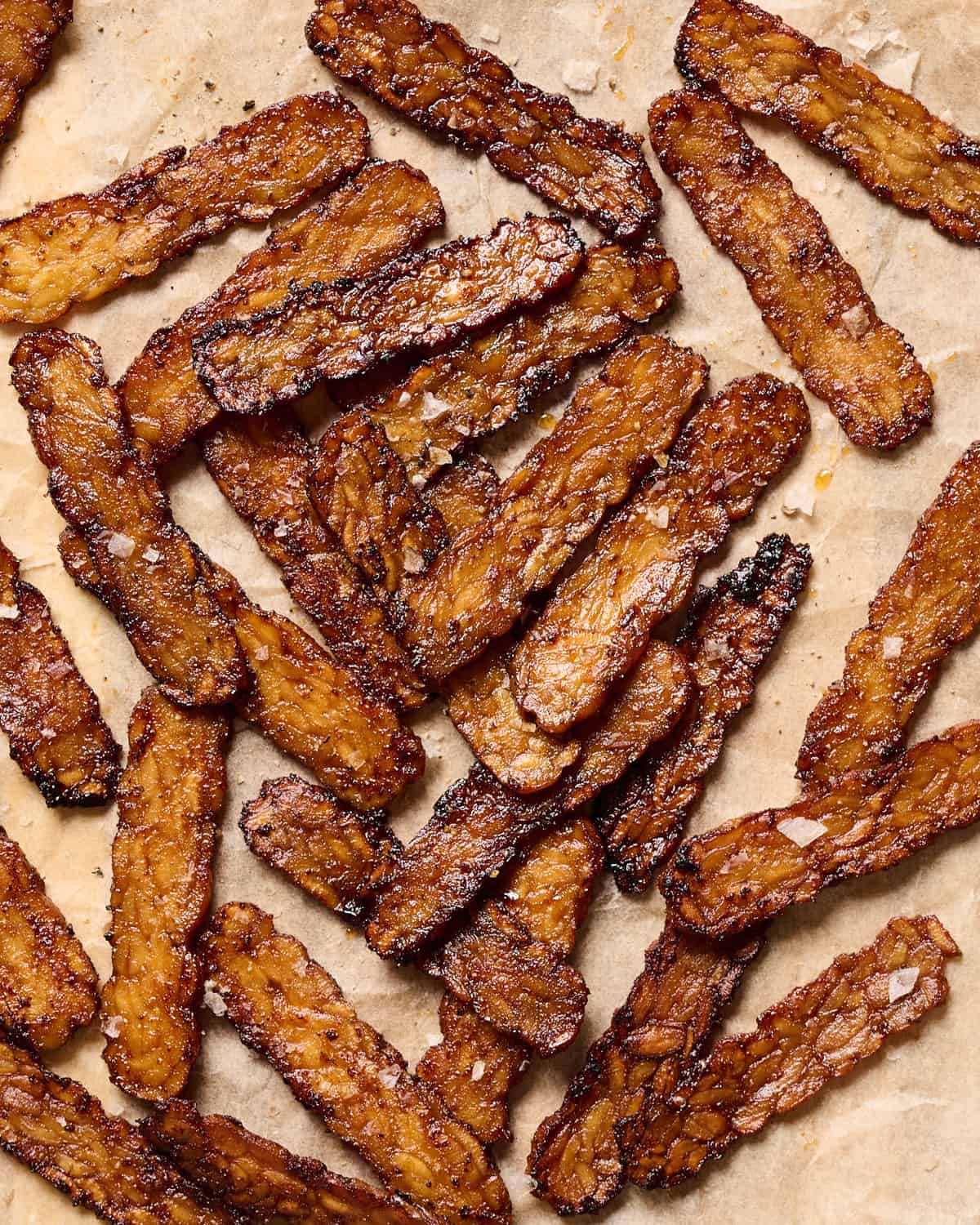
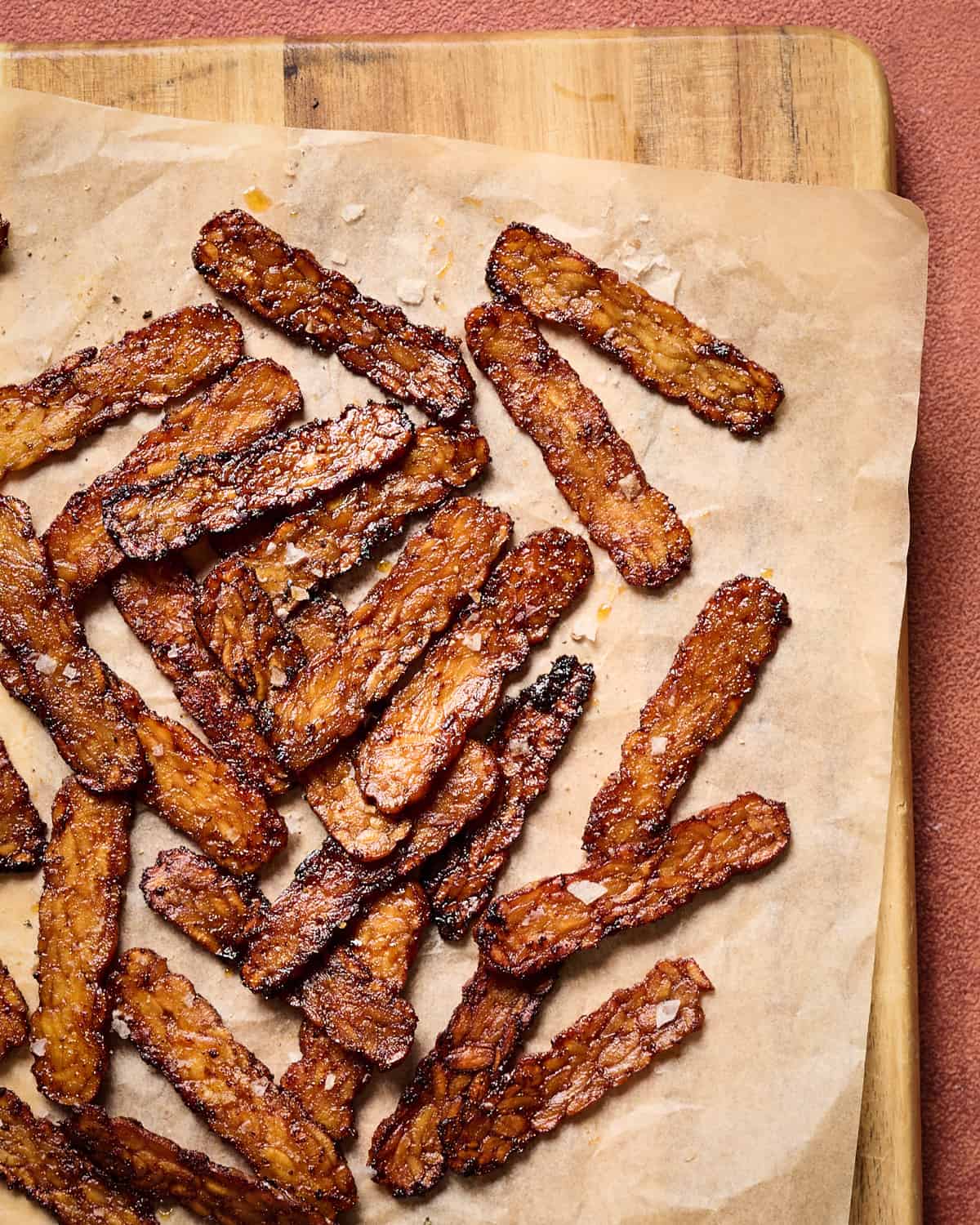
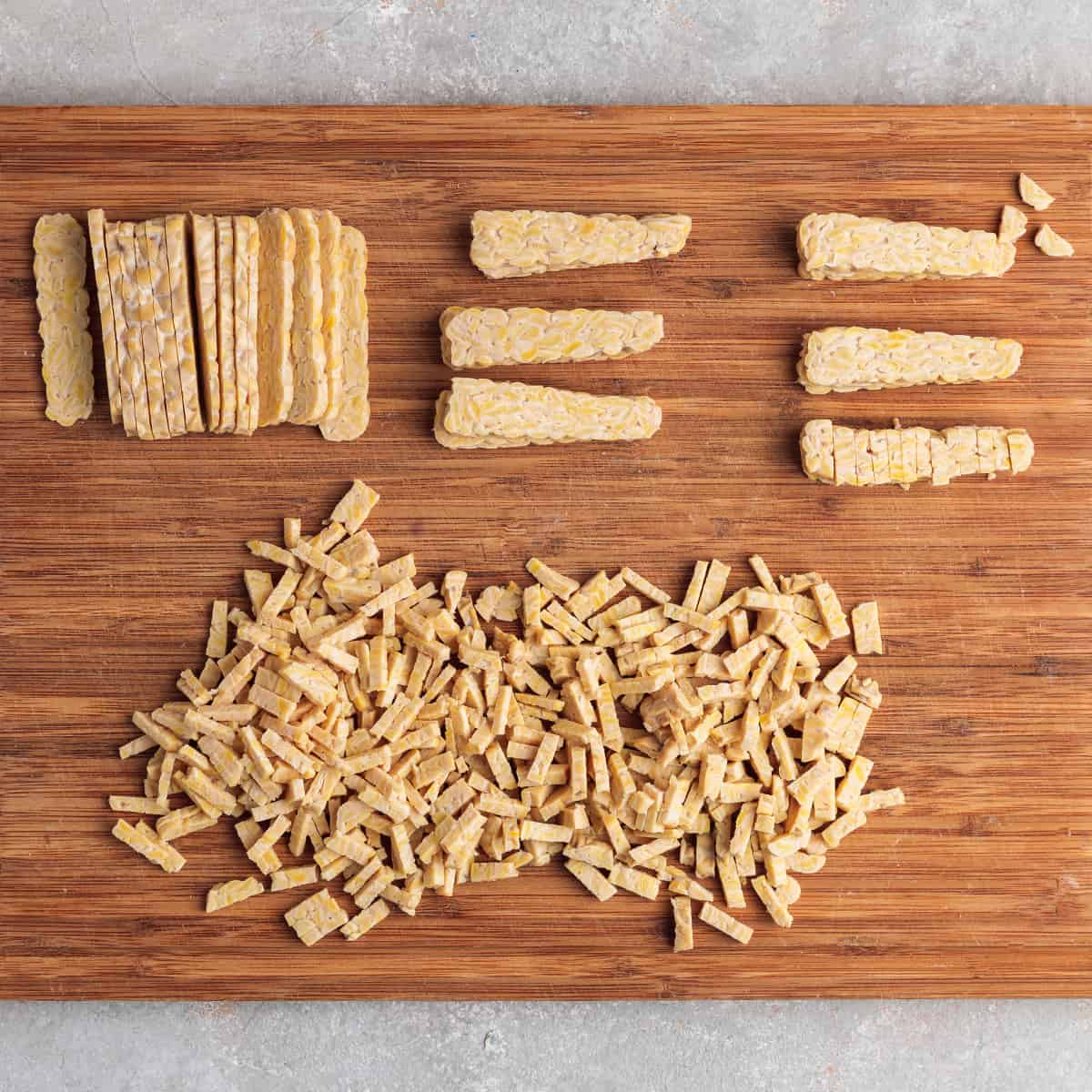
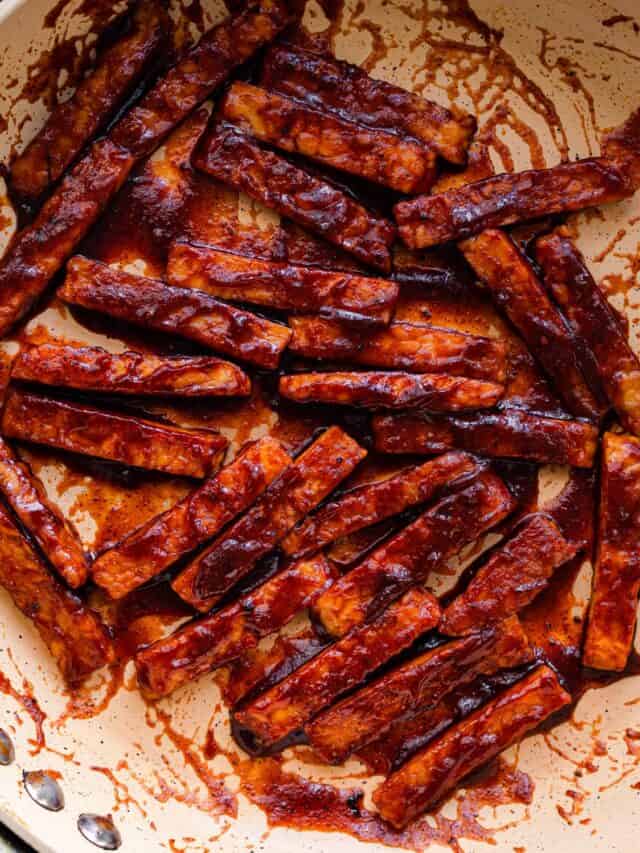
- Thin strips — this is what I use for my BBQ Tempeh and Tempeh Bacon recipes. Slice the block of tempeh crosswise into thin strips (or super thin strips for bacon-esque vibes).
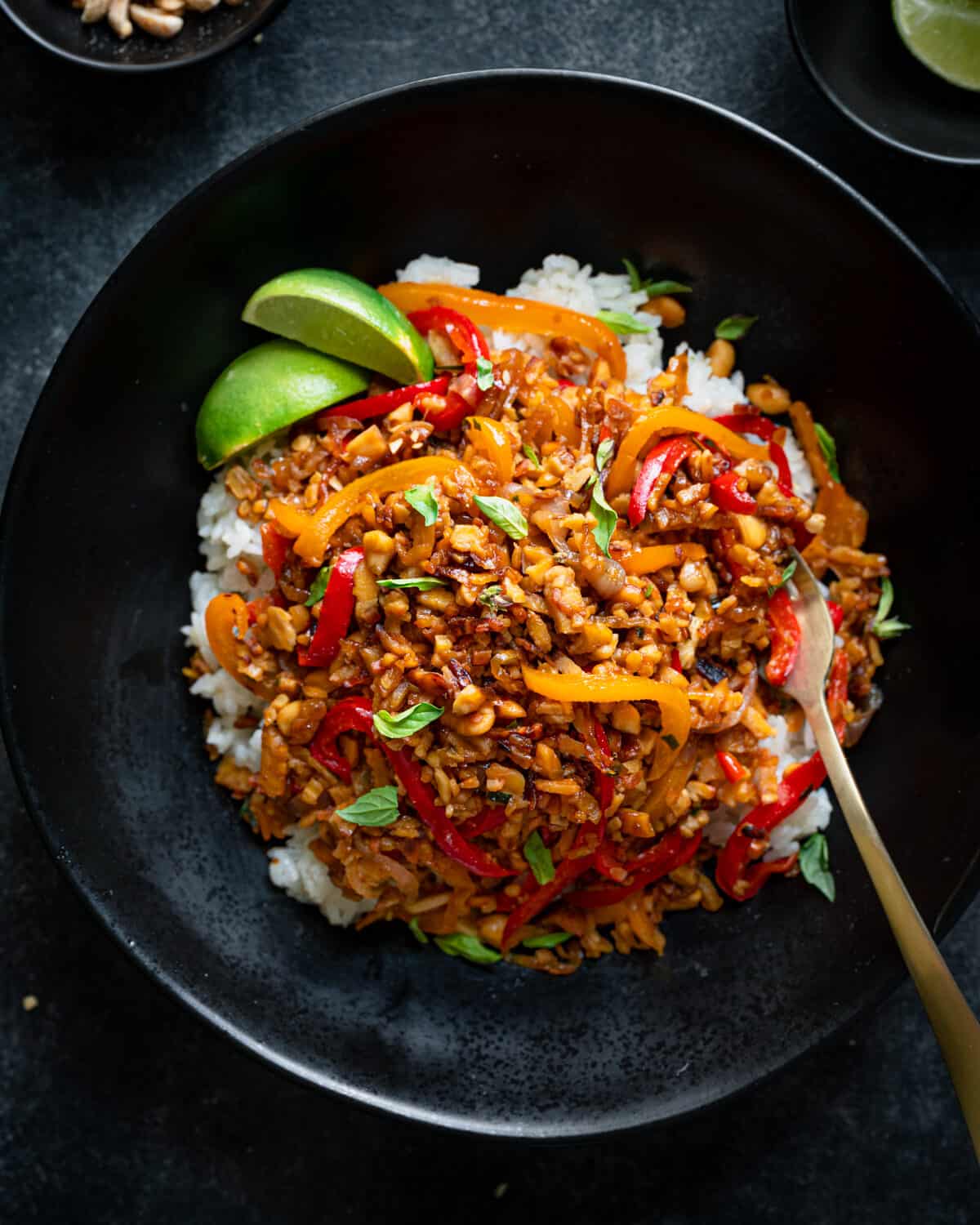
- Crumbled or grated — break apart the block by hand into tiny crumbles or use the large holes on a box grater. This yields a ground meat-adjacent texture perfect for vegan tacos, stir-fries, and the Savory Tempeh Nuggets recipe below.
- Matchsticks — the method I use in my Tempeh Kecap. It takes a few extra minutes, but all that surface area means maximum crispiness.
Tip: If you do want to keep your tempeh in bigger pieces, like cubes or triangles, I highly recommend steaming the tempeh for 10 minutes first (use a steamer basket over a pan of simmering water). This will help tame some of that bitterness.

Enhance the flavor!
Tempeh has a naturally bitter, earthy flavor, but the good news is that it’s easy to mask. The trick is to pair it with bold flavors that balance that bitterness: think tart, slightly sweet, and salty. Here are three techniques I come back to again and again:
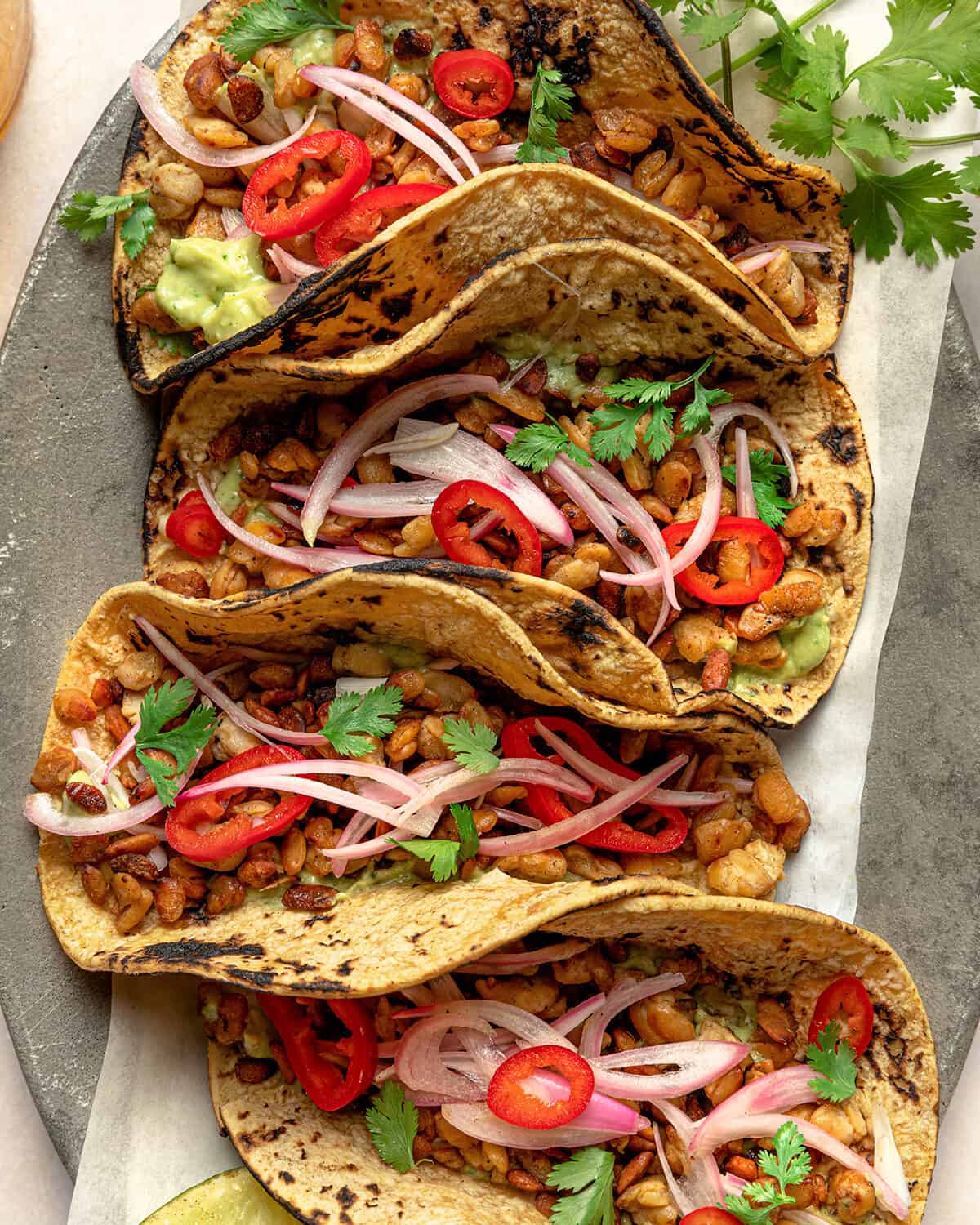
- Pair it with a balanced sauce. In my Tempeh Tacos recipe, I toss pan-fried tempeh crumbles with soy sauce (salty, savory) and lime juice (tart), then top the tacos with pickled shallots (tart, sweet).
- Marinate the tempeh. A bold marinade can utterly transform tempeh’s flavor. Tempeh Bacon with a sweet-salty-savory marinade is a perfect example. For the best results, marinate your tempeh for at least 1 hour, though 8 hours is even better. In our tests, the longer marinating time yielded a richer flavor profile and sticky, caramelized edges.
Pan frying is the way to go
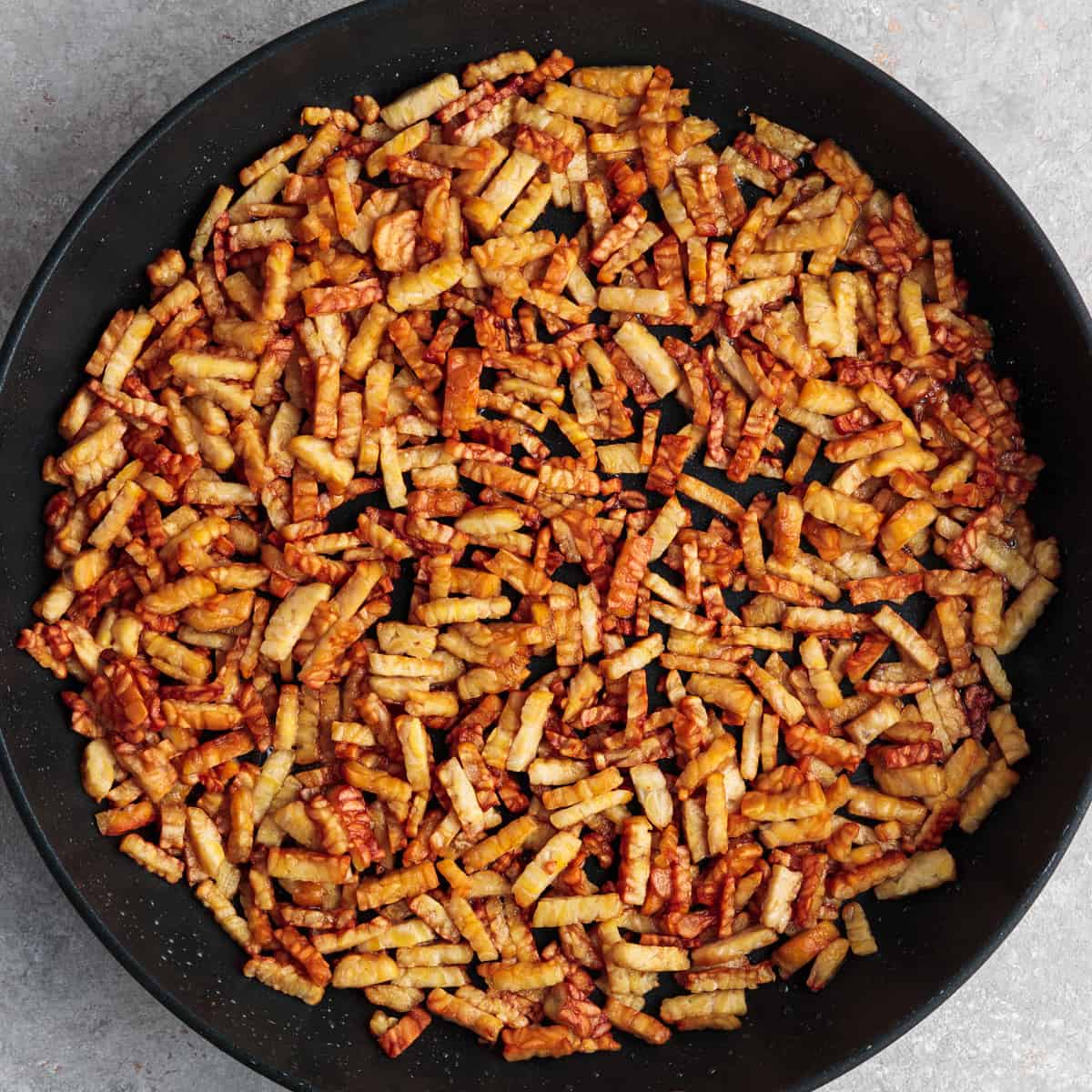
Across all of my (manyyyyy) recipe tests, for both blog posts and Big Vegan Flavor, pan-frying in an oiled skillet came out on top as the best cooking technique, time and time again.
This cooking method locks in moisture and gives tempeh a golden crust that no other method can match. If you want to minimize the amount of oil and sticking, use a nonstick pan (but you can also use a properly pre-heated stainless steel or cast iron skillet; learn how to use a stainless steel skillet almost like a nonstick pan here).
Check out the FAQs for more on why I don’t love baking or air frying tempeh (though I do love baked tofu and air-fried tofu!).
Frequently Asked Questions
You can of course bake and air fry tempeh, but these are not cooking techniques I enjoy or recommend.
In my experience, the dry heat of the oven/air fryer tends to dry tempeh out even when paired with a great marinade. The tempeh tends to “eat up” the marinade and mute the flavors.
The most commonly available brand of tempeh sold in U.S. grocery stores is Lightlife. I almost always buy their “original” tempeh, and it can usually be found at major grocery stores, including Vons/Safeway, Albertsons, Whole Foods, Sprouts, Fairway, Key Food, and even Target.
I’ve also seen tempeh sold by the brands Franklin Farms and Tofurky, but not as frequently.
Tempeh slices and crumbles will take anywhere from 5 to 10 minutes to become golden and crispy when pan-fried. However, the cooking time will vary depending on how the tempeh was prepared (steamed ahead of time, marinated, cooked in a sauce, etc.).
Tempeh is safe to eat raw. But do I recommend it? Definitely not.
Its naturally bitter and earthy flavors make raw tempeh quite unappetizing. To enjoy tempeh to the fullest, I always recommend soaking it in a marinade and/or pan-frying it with a tart, sweet, and salty sauce.
Leftover cooked tempeh will stay fresh for about 5 days when stored in an airtight container in the refrigerator. To get its crispy edges back, reheat the tempeh in a lightly oiled skillet over medium heat until it’s warmed through.
Excited to cook some tempeh?
With these techniques for slicing, seasoning, and pan-frying in your back pocket, you’re ready to start making some seriously flavorful meals starring this underrated protein.
Try my Savory Tempeh Nuggets recipe below and let me know what you think by leaving a rating and review!

Introducing
Big Vegan Flavor
Techniques and 150 recipes to master vegan cooking.
Savory Tempeh Nuggets

Ingredients
- 1 (8-ounce / 227g) block tempeh (see Note 1)
- 1 ½ tablespoons (21g) avocado oil (or other high-heat oil)
- Kosher salt
- 1 tablespoon (17g) soy sauce (or tamari if gluten-free)
- 2 teaspoons freshly squeezed lime juice
Instructions
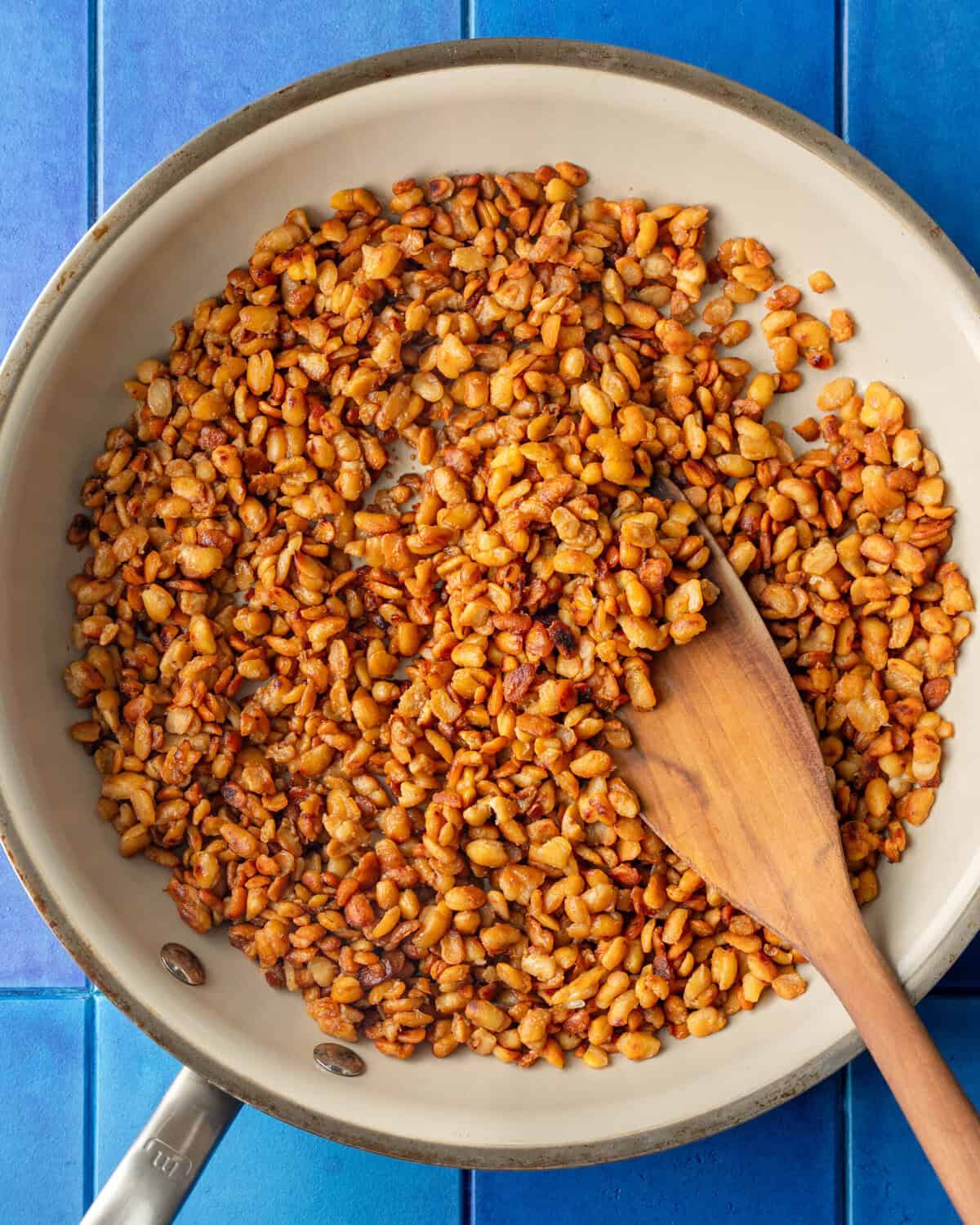
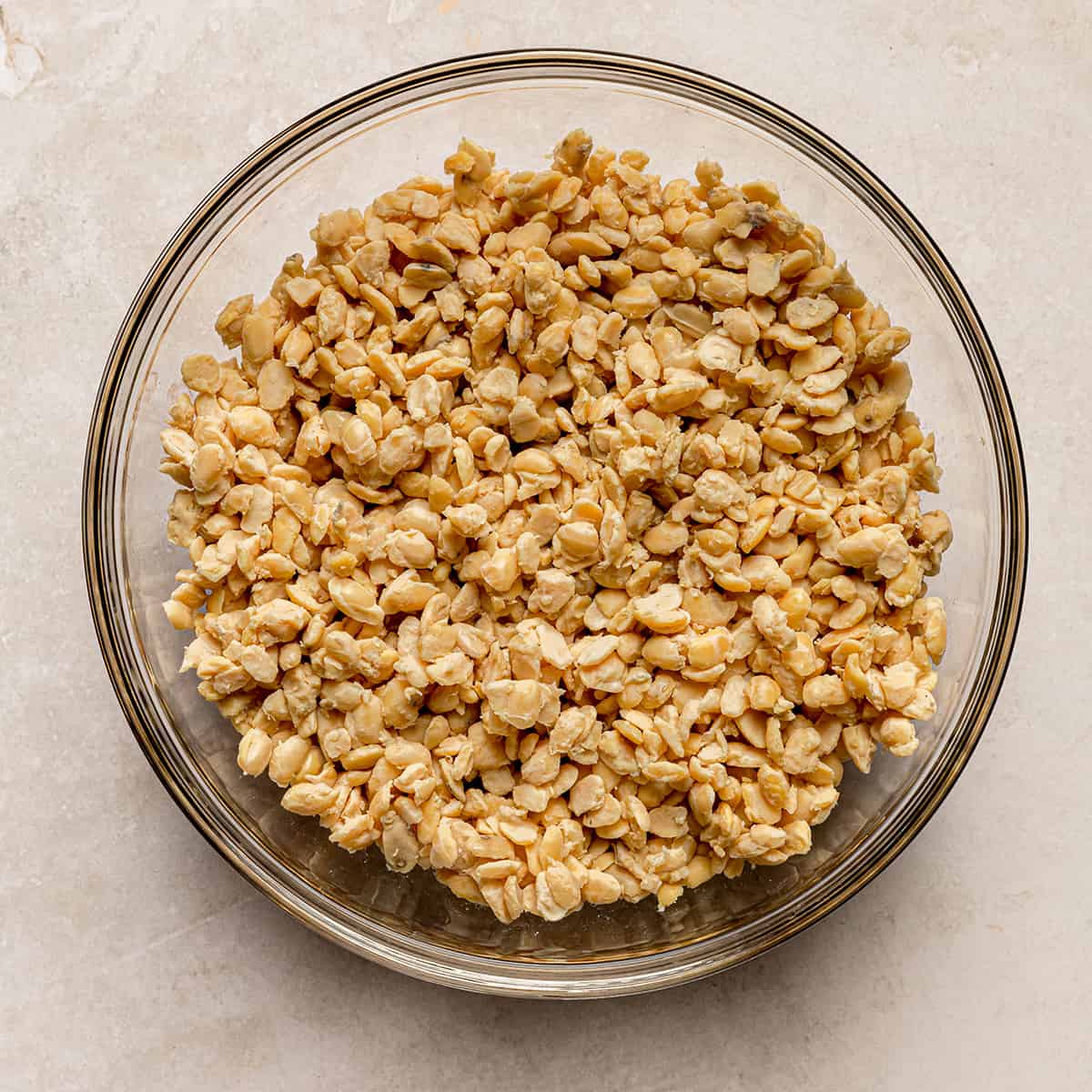
- Use your hands to crumble the tempeh into very small pieces, ideally around the size of a pine nut (the smaller the pieces, the crispier the tempeh gets).
- Open some windows for ventilation and line a large cutting board or plate with a few paper towels.
- Heat a nonstick frying pan with the avocado oil over medium-high heat until it just starts to lightly smoke. Add the crumbled tempeh pieces and arrange them in a single layer.
- Cook for 2 minutes undisturbed, then toss. Cook for 6 to 8 more minutes, stirring every 1 ½ to 2 minutes, until mostly golden brown and crisp (some pieces will get brown before others, that’s okay). If needed, lower the heat to medium to prevent burning.
- Transfer the tempeh to the paper-towel lined surface to blot out excess oil and season with a couple pinches of salt. Once the tempeh has cooled off a bit, transfer it to a bowl. Add in the soy sauce and the lime juice. Toss to coat the tempeh.
Notes
- If you want to double the recipe, simply double all ingredients. Be sure to use your largest pan, and cook for slightly longer, a total of 12 to 14 minutes. Or, cook in two batches for the most even browning.
Nutrition
Nutrition information is automatically calculated, so should only be used as an approximation.
 Love this? Leave a rating below!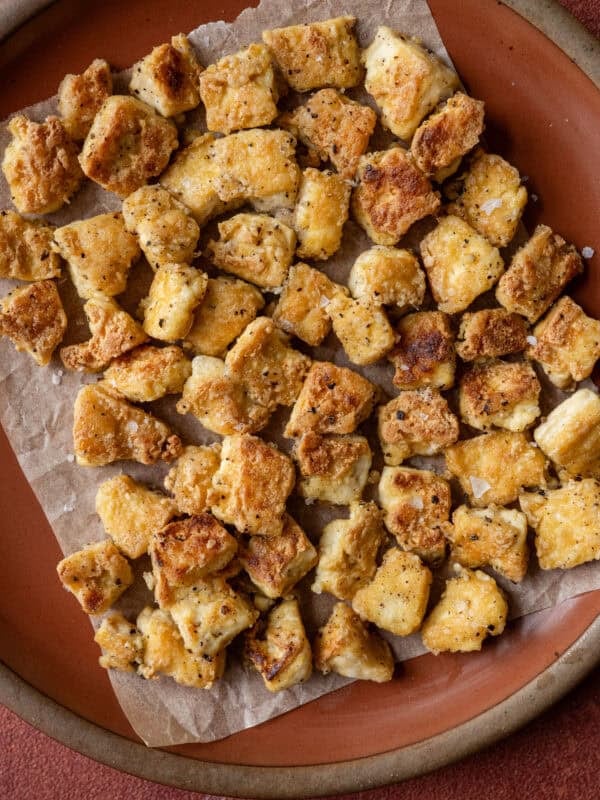











I made Nisha’s tempeh bacon. The flavor was good but the slices all fell apart. This was the first and only time I’ve worked with tempeh. Is there a trick to slicing it?
Hi Kim, it’s great to hear you loved the tempeh bacon, thanks for trying it out! Sorry to hear yours fell apart. Our best tip would be to use a sharp chef’s knife to more accurately and thinly slice the tempeh. Or, next time, try slicing a bit thicker.
I had the same problem………..maybe a better description of this would be “bacon bits”, of which there are tons of great uses (mostly toppings)
Thanks,
This was just the information I need as a total newb with tempeh. I just ordered a block with my grocerires and will try it out with a marinade
It’s lovely to hear you found the article useful, Annelies! Best of luck on your tempeh journey!
Oh I see, this article is about a year old. 😊
You’re welcome for the overview, Melody! 🙂 We hope you’re able to pick up a copy of Big Vegan Flavor very soon!
I know tofu well but not Tempeh. Thanks for the great overview. Just what I needed. …and I noticed a reference to your next cookbook?
I’m on a campaign to expand my list of healthy plant based foods. I’ve been eating tofu and edamami(sp) for years. I haven’t considered tempeh before now, because I thought it was a wheat product. As I write this my care-provider and I are attempting to steam and bake an 8 oz pack of tempeh. Most of the websites I opened up were ‘fairly’ helpful, but your site is the most informative. I feel confident about prep techniqus, but haven’t a clue when it comes to seasoning and marinading. Any recommendations for ‘very low’ sodium marinades would be appreciated.
Hi Wayne, we’re so glad you’ve found the resources on the blog helpful!
We aren’t sure of the best “very low” sodium marinades, because we cook with salt and believe it’s an integral ingredient in cooking the most flavorful foods. That being said, you can try using a reduced sodium soy sauce when it calls for soy sauce, but keep in mind that salty flavors help mask tempeh’s naturally bitter flavor.
Ah this came in so clutch as I tried to cook tempeh for the very first time! Love the guide and all your recipes. Thank you!
We love to hear it, Lindsay! 🙂 Thanks for sharing!
I’ve made tempeh bacon just once and I cut the block into 4 slabs and steamed it as a friend said it makes the tempeh more tender and easier to slice the “bacon” strips very thin. Have you found that to be true? I noticed the photo in this article shows tempeh already cut into very thin strips and then steamed. Does cutting it thin before steaming offer an advantage? Any of your amazing advice on these issues would be appreciated.
From Nisha:
“Hi Kathe, yes, steaming tempeh can remove some of its bitter flavor. With my tempeh bacon recipe, I don’t find steaming is necessary since the marinade has all the flavors that minimize bitterness: salty, savoriness, sweetness, acidity.
I don’t think it would be easy to thinly slice, then steam, as the thin pieces may fall apart once exposed to heat.
Here’s my tempeh bacon recipe if you want to try it out!”
Very helpful. I bought it and didn’t know what to do with it. Thanks so much.
Lovely to hear you find the blog post helpful, Jen! We can’t wait for you to get started on the recipes!
Thank you for your very detailed tempeh cooking instructions! Very much appreciated along with your yummy recipes! I use your tips for the smoothest hummus all the time.
You’re very welcome, Adriana! Happy to hear you love the RPL recipes 🙂
Thank you for info on how to cook tempeh. Am grateful and your explanation is as I had imagined the right way to cook it
You are very welcome, Ian! 🙂 Thanks for the kind words.
I think raw marinated tempeh is delicious, it’s bitterness shouldn’t be overstated, it’s quite mild
I fermented my own tempeh this week in my Instant Pot (first 6 hours on normal (yoghurt setting) then another 20 hours on low) and it came out amazingly. It’s so much cheaper than buying it, and I only cooked the soybeans for 2 mins with a 5 min delayed release (after soaking overnight) and then used a pastry chopper to mash them up rather than dehulling them, so all the fibre stayed in. It’s absolutely delicious and has been the best batch I’ve ever made!
Wow, interesting to read, Allie! Thanks for sharing!
If you cook the tempeh, you would kill all the healthy bacteria and probiotics.
My point is that this article mentions that its full of gut healthy bacteria, but you kill it when you heat it so its really no benefit. Same thing with sourdough. People advertise the healthy bacteria, but once baked that is all gone.
While that is true, it’s safer not to eat raw Tempeh. It still retains the protein, fiber, iron, etc.
How do you cook it, or make it? Do you eat it raw? I heard if you do not cook it on high heat it will not kill the healthy bacteria & probiotics…
Thank you for this article! I adore tempeh and buy/cook it regularly. I have even experimented with making my own, which takes a long time but is quite an interesting process. I have stored tempeh (in its original package) in the freezer very often and have not found any lack of taste or texture when defrosted later. And, believe it or not, I sometimes eat uncooked tempeh as a snack. I don’t find it bitter and it I enjoy it as much as I do cooked tempeh. Just an all-around wonderful product in my mind. I have never tried the crumbled tempeh option but I definitely plan to experiment with that and also make the Tempeh Bacon.
Hi Donna, thanks for the lovely comment! We appreciate your input and can’t wait for you to try some of the RPL tempeh recipes!
Great post. I am eager to try tempeh bacon. I need to find more ways to increase protein – this might be my go to.
Hi Kathy, thanks for the sweet comment! You definitely need to try the recipe for tempeh bacon 🙂 Have you seen Nisha’s guide to cooking tofu as well? That one’s a great resource!
Thanks for posting this. I LOVE tempeh and don’t mind the slight bitterness at all. One question I did have was about cooking tempeh in an instant pot, specifically, steaming the slices. I LOVE my IPs and use them quite often. It’s hard for me to find tempeh in the vegan wasteland that is Mississippi as Wal-Mart has stopped carrying it (LifeLine). I’ve been vegan for 12 years and have benefitted greatly from the lifestyle. Love your site and will be trying the chocolate chip recipe when it pops up again.
You’re welcome, Janne!
We have not tried steaming tempeh in an IP ourselves, but you should be able to steam tempeh slices as long as you have a steamer basket like this or this.
Depending on your model, you may have a Steam setting, which you can use for 5 minutes. If you don’t have a steam setting, I’d use the Pressure Cook setting but at low pressure.
As always, a fantastic, easy-to-digest offering to us all! Thank you. Can’t wait for your new cookbook!
Thanks for the lovely feedback, Howard! We can’t wait for the cookbook to be out either!
Thank you! I’m going to try it this week now I feel knowledgeable and inspired. I really appreciate these in depth guides.
You’re welcome, Cassandra! Enjoy! 🙂
I’m willing to try tempeh again. I’m in the “yuck, bitter!” camp at this point. But your easy to understand directions “temp”t me to try it once more. I can always use more protein.
Hi Lee, we definitely encourage you to try it again! In my experience, I really love it when there are other flavors going on with the dish: aka tempeh bacon is in a TTLA sandwich, or when the tempeh is coated in bbq sauce!
Does pan frying the tempeh diminish its nutritional value?
Hi Sharon! When tempeh is cooked, it decreases the quantity of probiotics, although not entirely. Despite cooking, tempeh maintains its status as a probiotic-rich food owing to the fermentation process. To enhance your probiotic intake, you could pair tempeh with probiotic rich foods like sauerkraut or kimchi as well.