

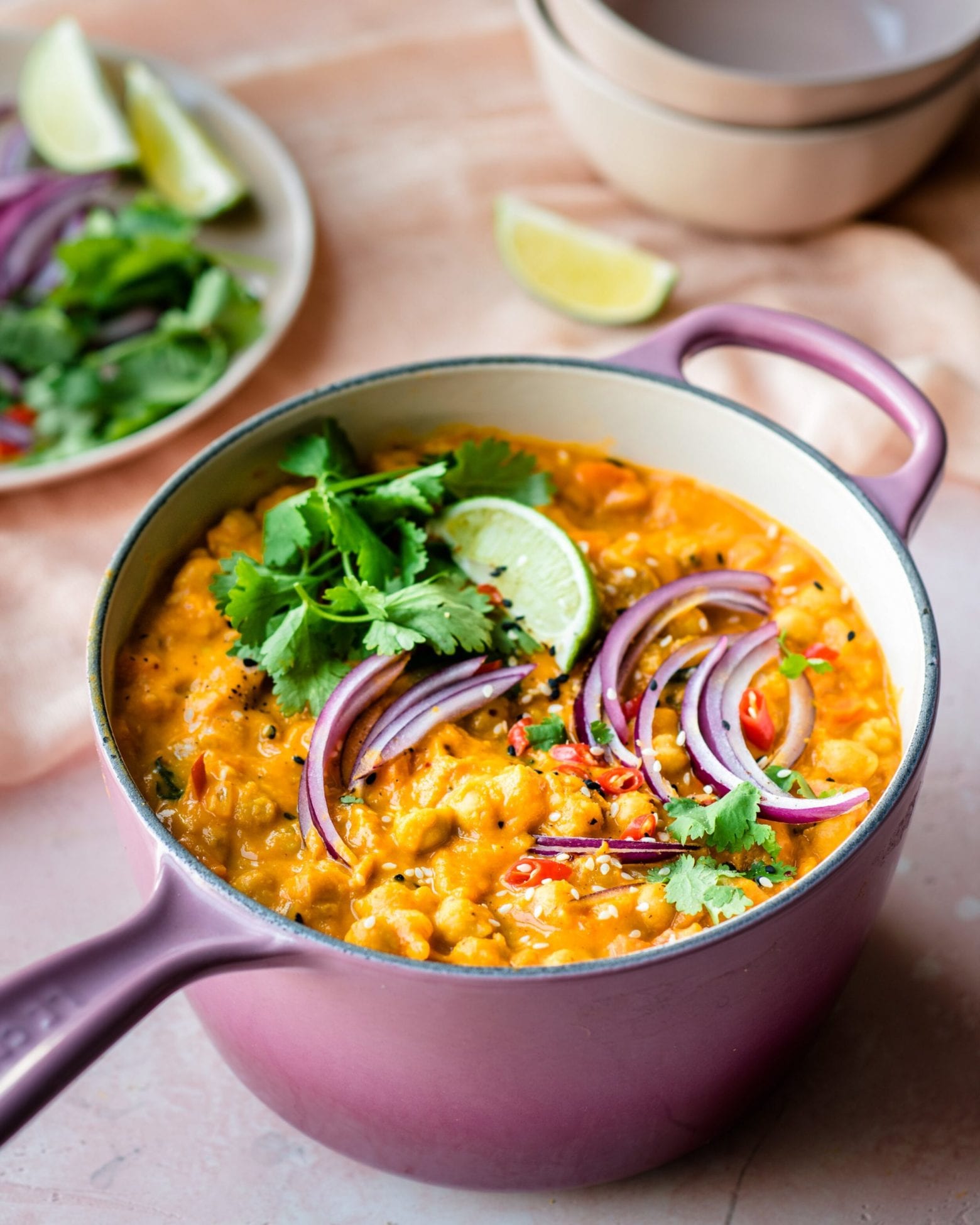
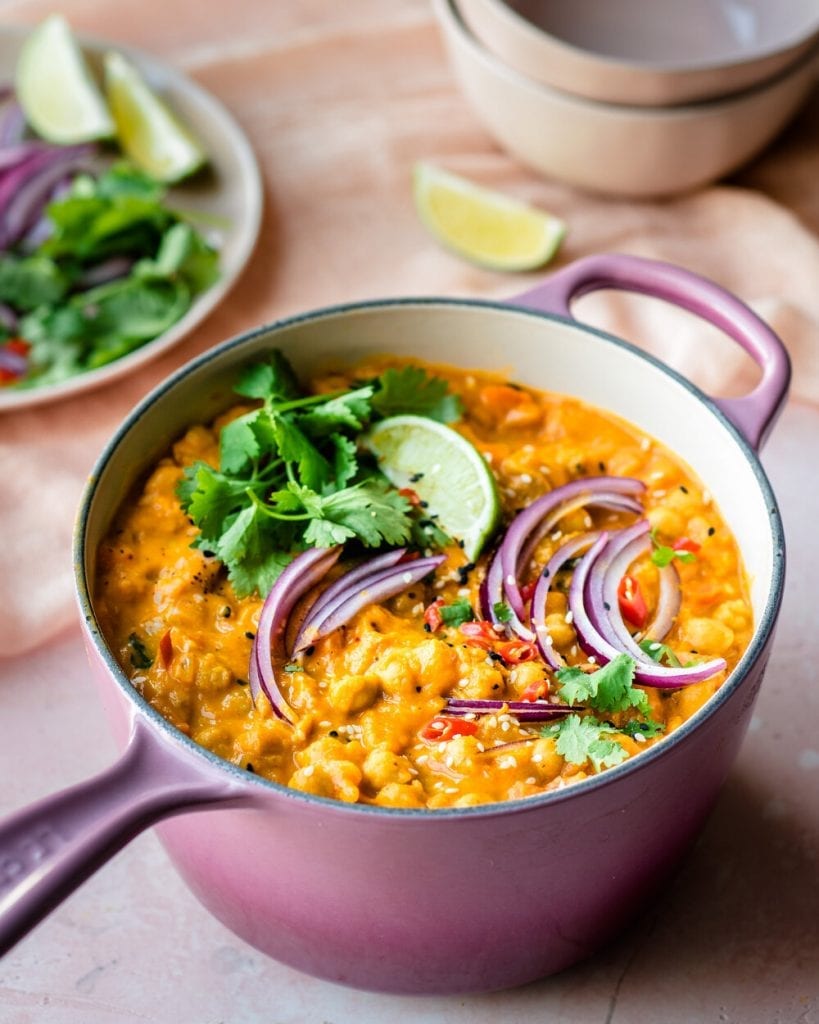
This Vegan Thai-Inspired Kabocha Squash Curry is the perfect fall recipe. It’s easy to make, jam-packed with flavor, and so comforting on cold fall days.
And since my Thai Butternut Squash Chickpea Curry from earlier this year has been so popular, I was inspired to make a similar curry but using kabocha squash.
This post covers everything you need to know – how to cut kabocha squash (it’s easy), how to cook it, and how to make this delicious curry. Buckle up!
What is Kabocha Squash?
If you’re not familiar with kabocha squash, it’s a variety of winter squash also known as a Japanese pumpkin and commonly used in Japanese cooking. It’s one of the more unique-tasting winter squash varieties. IMO, it’s like the more refined cousin of butternut squash (you know, the one who studied abroad in Vienna during college).
Kabocha squash usually comes with a dark green skin, but you might also find the red-orange varieties as well. In either case, the flesh is a vibrant orange color.
When you bake kabocha squash, the texture becomes almost velvety, which I absolutely love. But if you don’t know what you’re doing, you can end up with dry, mealy squash.
Regarding the taste, it’s a bit sweeter than pumpkin and butternut squash, so it adds a subtle natural sweetness to recipes. It has a characteristic nutty taste with undertones of chestnut.
Kabocha squash peak season is late summer through the fall, but you can sometimes find it year round. You can find kabocha squash at farmers markets as well as many grocery stores these days (I’ve purchased it at Whole Foods, Trader Joe’s, and Sprouts).
Looking for more kabocha squash recipes? This Thai Pumpkin Soup is FANTASTIC with kabocha squash!
Like many a winter squash, cutting kabocha squash can be difficult. But it needn’t be!
First, you’ll need a long, sharp, and sturdy knife. A really good chef’s knife or a serrated knife works great. As when you’re cutting a pumpkin or butternut squash, you want to use a slow, steady rocking motion. Don’t try to slice the squash in one fell swoop (you will be disappointed and may cut yourself).
Before you slice into it, though, there are two tricks to cutting kabocha squash. First, try slicing a thin layer off the top and bottom of the squash so you expose the flesh of the squash. It can be a bit difficult to slice off a clean layer on the top of the squash if the stem is attached, but even getting some flesh exposed is helpful. That’s because your knife will have a much easier time slicing through the squash if the knife hits the flesh first, rather than the much thicker skin.
And second, if you’re still having trouble cutting the squash (for instance, if your knife hasn’t been sharpened in awhile), just microwave the whole squash for 1-2 minutes. This will lightly soften the squash (but not cook it) and make it easier to slice.
Why you’ll love this Vegan Thai Kabocha Squash Curry
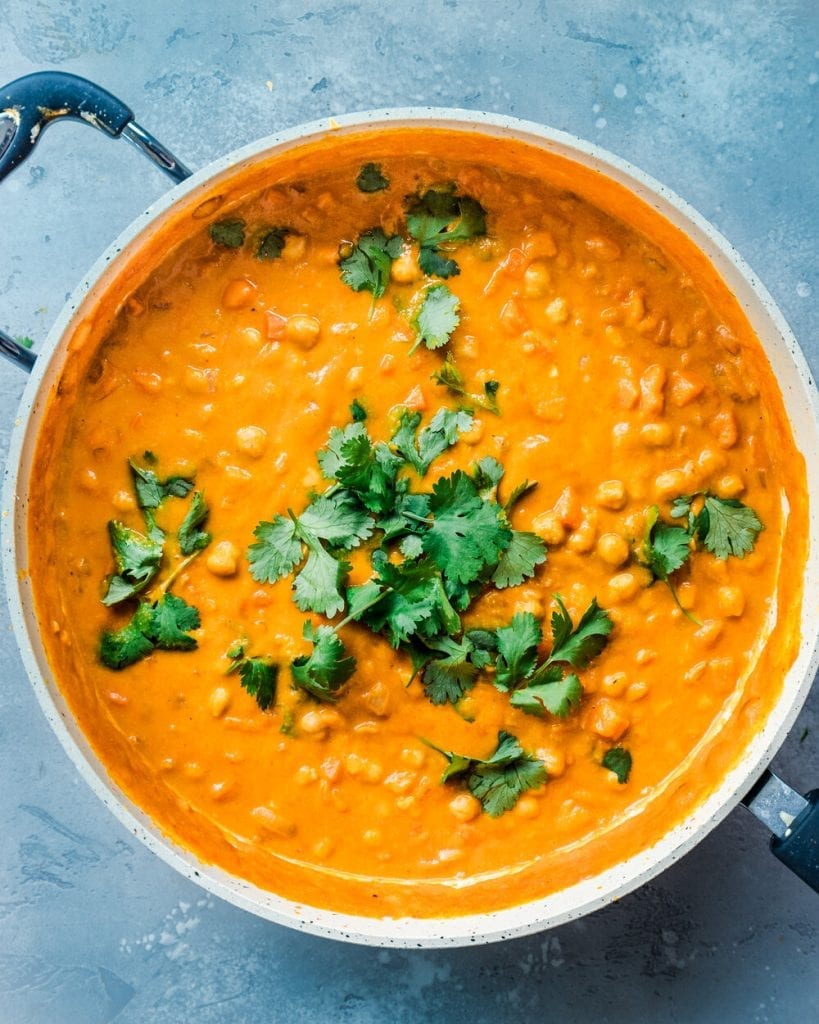
Super creamy. This curry is incredibly creamy despite not using full-fat coconut milk. The secret? Kabocha squash puree! When you roast winter squash and then puree it, it becomes so silky smooth and luxurious (have you seen my pumpkin mac and cheese??). Adding the squash puree directly to the curry makes it really thick, and means you can save some calories by using reduced-fat coconut milk instead of full-fat.
Maximal flavor. Packed with the flavors of ginger, garlic, and chili peppers, this dish reminds me of the incredibly fragrant, aromatic curries I happily devoured in Thailand.
Well-balanced. What I learned from Thai cooking is that every dish should be well-balanced in flavors: a little spicy, a little sweet, a little sour, and plenty of umami. A good-quality curry paste and Thai chili peppers, coconut sugar, lime juice, miso paste, and tamari take on those roles in this recipe.
Decadent yet healthy. Just as is the case with my vegan curry with tofu, This curry is oh-so-creamy and tastes indulgent. But it’s also really nourishing and packed with antioxidants, protein, and fiber, thanks to a garlic-ginger duo and plentiful amount of chickpeas and kabocha squash.
Meal prep-friendly. This dish makes excellent leftovers and will stay good in your fridge for 4-5 days.
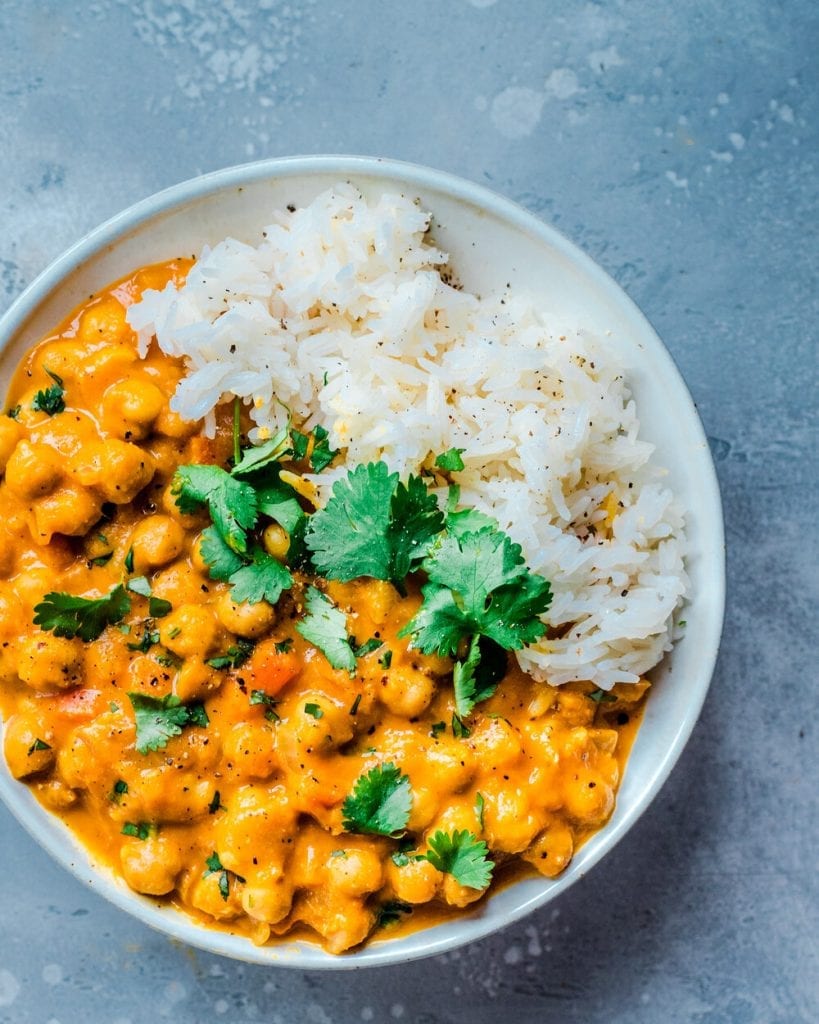
Watch! How to make Thai Kabocha Squash Curry

Tips for making this Vegan Thai Kabocha Squash Curry
If spicy food ain’t your thing, you may want to use a bit less curry paste than the recipe calls for. On the other hand, if you love spicy food, I recommend adding those Thai chili peppers. The spiciness balances out the sweetness of the curry.
For curry paste, my favorite brand is Maesri. More commonly available is the Thai Kitchen brand. You can also try the Mekhala organic curry paste. If you can’t find any of these brands, just be sure to read the ingredients to ensure it’s vegan (many curry pastes contain shrimp paste).
If you are allergic to coconut milk or don’t want to use it, you can use oat milk or cashew milk. Be sure to use an unsweetened variety. I don’t recommend using almond milk, as it is quite thin and not good for curries.
I know this is a kabocha squash curry, but if you can’t find kabocha squash (it’s not always available outside of its peak season), feel free to substitute with butternut squash, pumpkin, or red kuri squash. As I mentioned, these varieties are a bit less sweet than kabocha, so taste the curry before finishing and add a tiny bit more sugar or maple syrup as needed.
Don’t skip the final step, which is to add a bit of lime juice. Finishing a rich dish like this curry with a splash of acid at the end helps balance the spicy flavors, enhances the salty and umami flavors, and brings some freshness to this creamy dish.
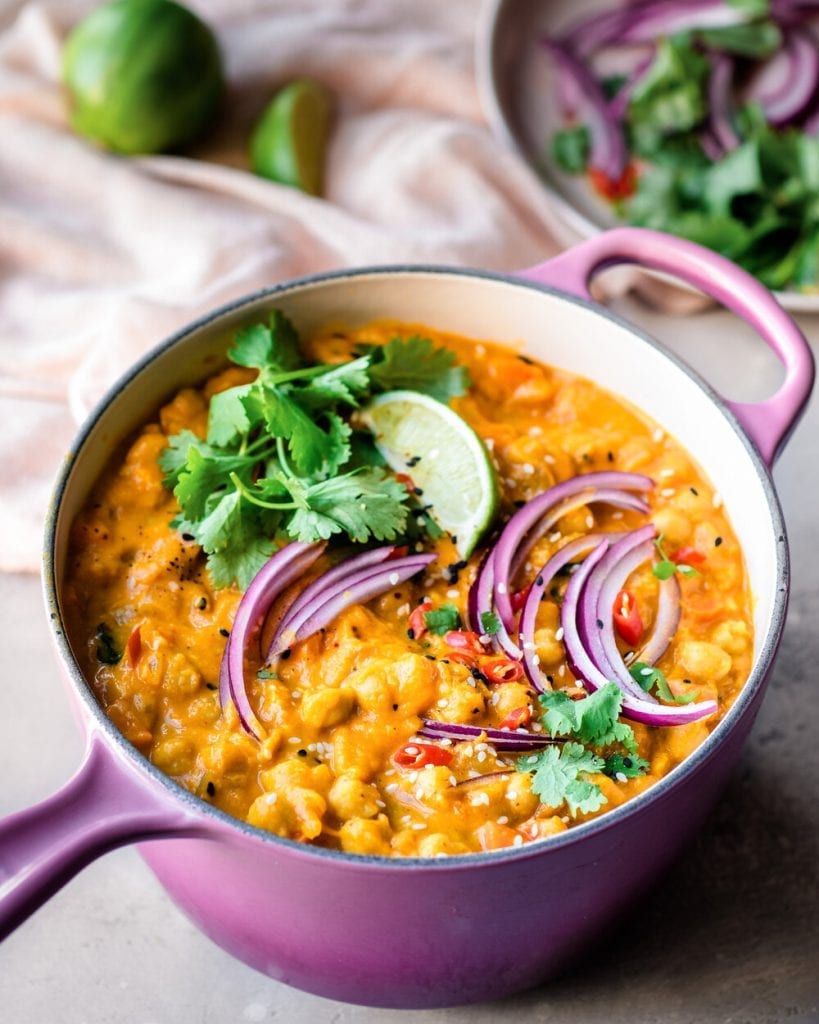
That’s all you need to know to make this Vegan Thai Kabocha Squash Curry! If you make the recipe, drop a comment below or over on Youtube!
More Southeast Asian recipes!
- Thai Laab with Tofu: an aromatic, zesty ground meat salad made 100% plant based.
- Vegan Thai Green Curry: your favorite Thai takeout order, made at home!
- Thai Green Curry Paste: to take your green curry to the next level, you need a killer curry paste!
- Thai Pumpkin Soup: a velvety winter squash soup with SO much flavor!

Introducing
Big Vegan Flavor
Techniques and 150 recipes to master vegan cooking.
Vegan Thai Kabocha Squash Curry

Ingredients
- 1 medium kabocha squash (~2 to 3 lbs / 900g to 1.4 kg)
- 1 - 1 1/2 tablespoons coconut oil* (or oil of choice), plus more for brushing squash
- Kosher salt or sea salt to taste
- Black pepper to taste
- 1/2 cup water (or vegetable broth)
- 1 large yellow onion, diced
- 2 medium carrots, scrubbed (or peeled) and diced
- 4 cloves garlic, minced
- 2- inch piece ginger, grated or finely minced
- 1-2 Thai bird’s eye chili peppers, (see Note 1)
- ¼ cup cup red curry paste (use less to make it less spicy)
- 1 teaspoon ground turmeric
- 1 (13.5 ounce) can “lite” or reduced-fat coconut milk
- 1 tablespoon reduced-sodium tamari (see Note 2)
- 1 tablespoon white miso (optional but recommended, see Note 3)
- 1 tablespoon maple syrup, agave nectar, or coconut sugar
- 2 (15 ounce) cans chickpeas, drained and rinsed (~ 3 cups cooked chickpeas)
- 1-2 tablespoons freshly squeezed lime juice
- ½ cup fresh cilantro, roughly chopped
- For serving: white rice or grains of choice
Instructions
- Preheat the oven to 400°F (205°C) and line a sheet pan with parchment paper for easy cleanup.
- Use a large, sharp knife to slice the kabocha squash in half. For tips on how to slice the kabocha squash, see the blog post section on “how to cut kabocha squash.” Once sliced in half, use a spoon to scoop out the seeds. Lightly brush each squash half with a bit of oil and sprinkle with salt and pepper.
- Place the squash halves, flesh side down, on the sheet pan. Roast for 40-45 minutes until the flesh is very tender. If your squash is large, bake for an additional 10 minutes.
- Once it’s cool enough to handle, use a spoon to scoop the flesh out of the skin, and discard the skin. Place the kabocha squash flesh in a blender and add ½ cup water (or vegetable broth) and puree until very smooth. You should end up with approximately 3 cups of liquid.
- While the kabocha squash is roasting, prepare the rest of the ingredients. Dice the onions and carrots.Mince the garlic, grate or finely mince the ginger, and thinly slice the chile peppers (if using). Measure out the other ingredients.
- Heat a Dutch oven or a large saucepan over medium-high heat. Add the coconut oil, and once it’s shimmering, add the onions and carrots along with a pinch of salt and pepper. Cook the vegetables for 7-8 min, or until they are very tender and lightly browned.
- Add the garlic, ginger, chile peppers (if using), red curry paste, and turmeric. Cook for 2 minutes, stirring very frequently to coat the vegetables in the aromatics. If you aren’t using a nonstick pan, you may need to add a splash of water to prevent the mixture from drying out and burning.
- Pour the pureed kabocha squash sauce into the pan, then add the lite coconut milk, tamari, miso paste (if using), maple syrup, and black pepper to taste. Stir or whisk until the mixture is smooth and creamy.
- Add the drained chickpeas and stir to combine. Bring the mixture to a simmer and cook for 15-20 minutes, or until the curry has become thick and creamy, and the veggies are fully softened.
- Remove from the heat. Stir in 1 tablespoon lime juice and cilantro. Taste, adding more lime juice or salt/pepper as needed. Serve with white rice or grains of choice.
Video
Notes
- If you are sensitive to spicy food, omit the chile peppers. Alternatively, you can use a less spicy pepper, such as half of a jalapeño pepper.
- Use tamari to keep gluten-free. Otherwise, you can use reduced-sodium soy sauce.
- The miso paste adds a deep, complex umami flavor. If you don’t have any, you’ll want to add a bit of salt (or more tamari) at this stage.
Nutrition
Nutrition information is automatically calculated, so should only be used as an approximation.
 Love this? Leave a rating below!









Here to cook this AMAZING soup once again. Never disappoints. THANK YOU SO MUCH!
Marsha, So glad to hear you loved this recipe!
Absolutely delicious! I shall definitely make this again.
Can the leftovers be frozen? If so, how long will they keep in the freezer? If not, how long can they be stored in the fridge? Thanks in advance!
Hi Rachel, it’s great to hear you enjoyed the curry! Sure, this freezes pretty well. I’d say it’s best within 3 months.
The leftovers thicken considerably in the fridge because of the coconut milk. Once you reheat it in a saucepan, it should loosen up, but if needed, add a splash of water or veggie broth to loosen it more.
This flavor is lipsmacking and addictive. The clever use of combination maple syrup, tamari, miso, and red curry paste, blended into the pureed roasted squash — pure genius. I love how you broke down the steps and ingredient tips, top notch organization. I had only left over bits of kabocha squash (made the moroccan tagine with chickpeas and kabocha squash from Nisha’s Vegan Instant Pot cookbook separately earlier), so I bought a small butternut squash and combined the two squashes.
The more the curry sat in the fridge the more outstanding it became.
Next on my list is kabocha squash soup with lemongrass (also from the Vegan Instant Pot cookbook). Go Nisha.
Hi Ansu, thank you for the lovely comment and for all of your support 🙂 We appreciate it!
This was absolutely fantastic and I know the leftovers are going to be even better.
Yay, that’s amazing to hear, Hayley 🙂 Thanks for sharing!
We received kabocha squash in our CSA box and I was thrilled to find this recipe. My husband said it was one of the best meals I have ever made him. Definitely adding this to our regular rotation and hoping to find another kabocha squash at the farmer’s market this weekend now that the CSA season has officially ended.
Wow, what a compliment, Elizabeth! It’s great to hear this recipe’s going into the rotation!
This is one of my favorite recipes of all time. A gift to the world. Thank you!
Hi Gretchen, wow! Thank you so much for such a fantastic review! We’re honored 🙂
I was gifted a Kabocha squash and my husband isn’t a fan of squash so I went looking for ways to get it into him. Made this recipe and it is DELICIOUS! I made 2 small adjustments: used one serrano pepper instead of the birds eye chilis (I was scared to make it too spicy but wish I used the birds eye, the one serrano wasn’t enough heat for me). I also used one can of chickpeas, as the husband also doesn’t like these, and added baked soy curls. This recipe is amazing, I can see it being versatile to making personal adjustments and was easy to make. I used the Thai Kitchen jar of red curry paste (a whole jar as I find this brand lacks heat but is the only vegan one in my area).
Hi Stephanie, it’s great to hear you had success with the recipe. Thanks for the review!
This recipe was fabulous! Thank you so much Nisha. We didn’t have all ingredients so used what we had on hand and it tastes like a good restaurant curry!
In case it helps anyone- the way we made it was as follows:
We left out the miso, cilantro and maple syrup (our squash was plenty sweet!) And we used our own garden-grown hot shishito peppers. We only used 1 tsp of red curry paste and that was sufficient for us. No extra salt needed in the recipe.
In addition to listed veggies, we added bella mushrooms, green beans, baby potatoes (cooked separately) and celery. We love lots of veggies! We only used the liquid from the chickpeas and 1/2 cup water with 3/4 tsp chicken bouillion.
We didnt blend it at all but enjoyed it simply as a soup/stew. We just discovered your blog and can’t wait to try more plant-based recipes. Thank you!
Thanks for sharing, Pauline! 🙂 Happy to hear you enjoyed the recipe.
Hi, am I supposed to add two cans of chickpeas with the liquid or drain?
Hi MB, drain and rinse the chickpeas before adding! Enjoy 🙂
Hi M.B., thanks for catching that! We’ve updated the blog post to say “2 (15 ounce) cans chickpeas, drained and rinsed (~ 3 cups cooked chickpeas)” in the ingredients section! Enjoy!
I cook almost everyday and this is one of the best recipes I have ever made. It was my first time using a pumpkin different to the traditional one and now I am hooked. I will definitely be buying more exotic pumpkins and squash because it was to die for. Thank you for a great recipe.
We’re over the moon to hear you enjoyed the recipe, Helen. Thanks for your kind words!
Such a great recipe, Nisha! I loved it! Thank you so much for all your amazing recipes, and big big congratulations on your new cookbook!!
This is so good! I didn’t add the chiles because I’m wimpy. lol You don’t say if the canned chickpeas should be drained or not, so I drained them (now to find what to do with the aquafaba). Since I wanted more of a soup rather than a thick curry, I added homemade broth (not vegetarian, though). I’ve made pumpkin curry by cooking the squash in cubes in the soup itself, not roasting and blending, so this was different. Seems my squash was much larger than medium, since I got about 8 cups of puree — put most of it in the freezer for future use. Thanks for a delicious recipe!
Thanks for all the notes, Irene! It’s great to hear you are a fan of the recipe. For the aquafaba, I recommend using it for this banana bread or these brownies!